In Quebec’s high-humidity industrial environments, effective cleaning is not a series of tasks but a systemic contamination control strategy that directly impacts food safety, operational efficiency, and environmental compliance.
- Condensation is a primary vector for pathogens, making humidity control a critical MAPAQ compliance point, not just a maintenance issue.
- Choosing the right cleaning method—from waterless techniques like dry ice blasting to specific bio-degreasers—is essential to prevent shutdowns and protect equipment in cold, damp conditions.
- Managing risks from airborne moisture, drainage, and equipment shutdown procedures (cadenassage) is a non-negotiable part of a modern sanitation program under CNESST and MELCC regulations.
Recommendation: Shift from reactive cleaning to a proactive, documented sanitation system that treats moisture as the central risk factor to be managed across all operations.
For any food processing plant manager in Quebec, the sight of condensation dripping from a ceiling beam is more than just an annoyance; it’s a critical failure point. In an environment governed by high humidity, the challenge transcends simple janitorial work. The ambient moisture becomes an active vector, accelerating corrosion, compromising food safety, and creating habitats for resilient pathogens. Many facilities react by increasing ventilation or deploying standard dehumidifiers, but these are often superficial fixes to a systemic problem. These approaches fail to address how moisture interacts with every facet of the operation, from the efficacy of degreasers in a cold warehouse to the integrity of hydraulic systems choked by damp, sticky dust.
The true key to managing these complex environments lies in a paradigm shift. Instead of treating cleaning, food safety, and equipment maintenance as separate functions, they must be integrated into a single, cohesive Systemic Contamination Control strategy. This means understanding the science behind why condensation is a hazard, how bacteria form protective communities called biofilms, and what specific Quebec regulations from MAPAQ, the CNESST, and MELCC dictate your procedures. It’s about recognizing that a greasy motor isn’t just a cleaning task—it’s an energy efficiency issue impacting your Hydro-Québec bill. This guide is built on that principle. We will deconstruct the challenges of high-humidity industrial spaces, moving from foundational food safety risks to advanced strategies for equipment maintenance and regulatory compliance, providing a roadmap tailored to the unique operational landscape of Quebec.
This article provides a detailed framework for plant managers to develop robust cleaning protocols. Below is a summary of the key areas we will cover, from identifying hazards to implementing compliant and efficient cleaning solutions.
Summary: A Strategic Guide to Industrial Cleaning in Quebec’s High-Humidity Environments
- Why Does Ceiling Condensation Become a Food Safety Hazard in Factories?
- How to Clean High Beams and Pipes Without Shutting Down Production Lines?
- Solvent-Based vs Water-Based Degreasers: Which Works Best in Cold Warehouses?
- The Drainage Mistake That Leads to Environmental Fines for Factories
- How to Implement Lockout/Tagout Procedures During Deep Cleaning Shifts?
- Why Does Dirt Ingestion Cause 80% of Hydraulic System Failures?
- Why Do Bacteria Become Harder to Kill When They Form a Community?
- Degreasing Heavy Machinery: How to Maintain Equipment Efficiency in Quebec Manufacturing Plants?
Why Does Ceiling Condensation Become a Food Safety Hazard in Factories?
In a food processing facility, ceiling condensation is not merely water; it’s a transportation system for contaminants. When warm, moist air from processing operations like cooking or washing contacts cold surfaces such as ceiling structures, pipes, or refrigeration units, it forms droplets. These droplets can absorb airborne particles, including dust, spores, and bacteria. When they eventually drip onto food products, packaging, or food-contact surfaces below, they create a direct pathway for cross-contamination, posing a significant food safety risk. This is a critical concern under the province’s regulatory framework, where specific guidelines for cleanrooms and food establishments are outlined in the Occupational Health and Safety Act to manage air quality and contamination.
The danger is magnified by the fact that these condensation-prone areas are often difficult to clean and monitor, allowing microbial growth to flourish undisturbed. This risk is why the Ministère de l’Agriculture, des Pêcheries et de l’Alimentation du Québec (MAPAQ) places such a strong emphasis on environmental controls as part of a facility’s overall HACCP (Hazard Analysis and Critical Control Points) plan. Managing condensation is a designated critical control point. The human element is also crucial; regulations stipulate that at least 10% of a facility’s workforce must have Food Handler training, ensuring staff can identify and mitigate such environmental hazards. The ideal relative humidity (RH) to prevent such issues is generally maintained between 50-60%, a level that balances operational needs with microbial growth prevention.
Ultimately, a single drip can compromise an entire batch of product, leading to costly recalls, reputational damage, and regulatory penalties. Treating condensation as an active hazard, rather than a passive condition, is the first step toward building a robust food safety program. This involves continuous monitoring, proactive dehumidification, and ensuring that all surfaces, especially those overhead, are included in regular sanitation schedules and ATP testing protocols to verify cleanliness.
How to Clean High Beams and Pipes Without Shutting Down Production Lines?
The need to clean overhead structures like beams, conduits, and pipes without causing costly production shutdowns is a major challenge in 24/7 industrial operations. Traditional wet cleaning methods involving high-pressure water are often not viable, as they introduce even more moisture into a humidity-sensitive environment and create a risk of contaminating production lines below. This operational constraint forces managers to seek “clean-in-place” solutions that are both effective and non-disruptive. These methods focus on removing contaminants without introducing water or requiring extensive quarantine of the area.
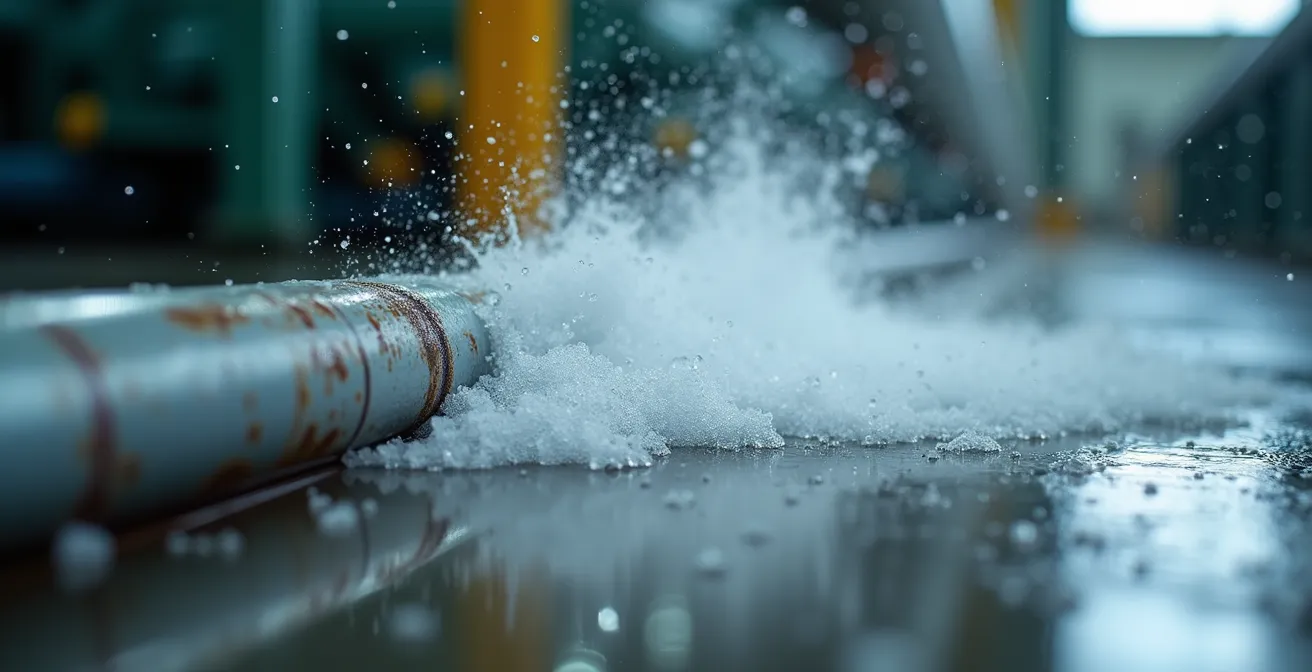
Several innovative technologies allow for safe and efficient cleaning during operations. For food and pharmaceutical environments where particulate control is paramount, HEPA-filtered vacuum systems can capture dust and debris at the source. For tougher buildup like grease or processing residue, dry ice blasting offers a powerful waterless alternative. This method uses solid CO2 pellets that sublimate on impact, creating a micro-explosion that lifts contaminants off the surface without leaving any secondary waste or moisture. It is exceptionally effective for cleaning complex machinery and electrical components that cannot be exposed to water.
Choosing the right technology depends on the type of soil and the specific industry. A direct comparison highlights the trade-offs between downtime, moisture introduction, and suitability for different contaminants. The key is to match the method to the operational reality of the facility, ensuring that sanitation goals can be met without sacrificing productivity.
| Technology | Best For | Moisture Added | Downtime Required |
|---|---|---|---|
| HEPA-filtered vacuum | Food/Pharma | None | Minimal |
| Dry ice blasting | Aerospace/Metal | None | None during operation |
| Ultrasonic cleaning | Small parts | Contained | Parts removal needed |
| High-pressure water | Heavy buildup | High | Full shutdown |
Solvent-Based vs Water-Based Degreasers: Which Works Best in Cold Warehouses?
In cold, high-humidity environments like refrigerated warehouses or unheated processing areas, the performance of chemical cleaners is severely tested. The choice between solvent-based and water-based degreasers becomes a complex equation of efficacy, safety, and environmental compliance. Solvent-based degreasers traditionally offer superior performance in cutting through heavy greases and oils, as their evaporation is less affected by low temperatures. However, they often contain high levels of Volatile Organic Compounds (VOCs), which pose significant challenges in Quebec.
As one expert on provincial regulations notes, “Using a high-VOC solvent-based degreaser can impact a facility’s annual environmental reporting obligations and potentially require specific air quality permits” under the authority of the Ministère de l’Environnement et de la Lutte contre les changements climatiques (MELCC). This makes their use increasingly problematic from a compliance standpoint. Furthermore, their flammability introduces a major fire risk, requiring stringent storage and handling protocols.
Using a high-VOC solvent-based degreaser can impact a facility’s annual environmental reporting obligations and potentially require specific air quality permits.
– Quebec Environmental Regulations Expert, MELCC Environmental Compliance Guidelines
Water-based degreasers, including modern enzyme-based bio-degreasers, are the preferred alternative for safety and environmental reasons. However, their effectiveness in cold, damp conditions can be limited. Low temperatures slow down the chemical reactions, and high humidity drastically extends drying times, potentially leaving surfaces damp and prone to re-contamination or creating slip hazards. This is compounded by the fact that humid air requires 15-30% more energy to heat, making it costly to create conditions where these cleaners work optimally. The solution often lies in using concentrated, fast-breaking formulas in conjunction with localized heat sources or mechanical action (scrubbing) to boost their performance, representing a balanced approach to efficacy and compliance.
The Drainage Mistake That Leads to Environmental Fines for Factories
One of the most overlooked yet financially damaging aspects of industrial sanitation is improper wastewater management. The critical mistake many facilities make is operating with a “one-size-fits-all” drainage system, where chemical-laden cleaning effluent, food waste, and general rinse water are all channelled into the same drains. This practice directly violates Quebec’s ‘polluter pays’ principle, enforced by the MELCC and municipal governments. Discharging wastewater that exceeds specified limits for pH, Chemical Oxygen Demand (COD), or heavy metals can result in automatic and substantial fines.
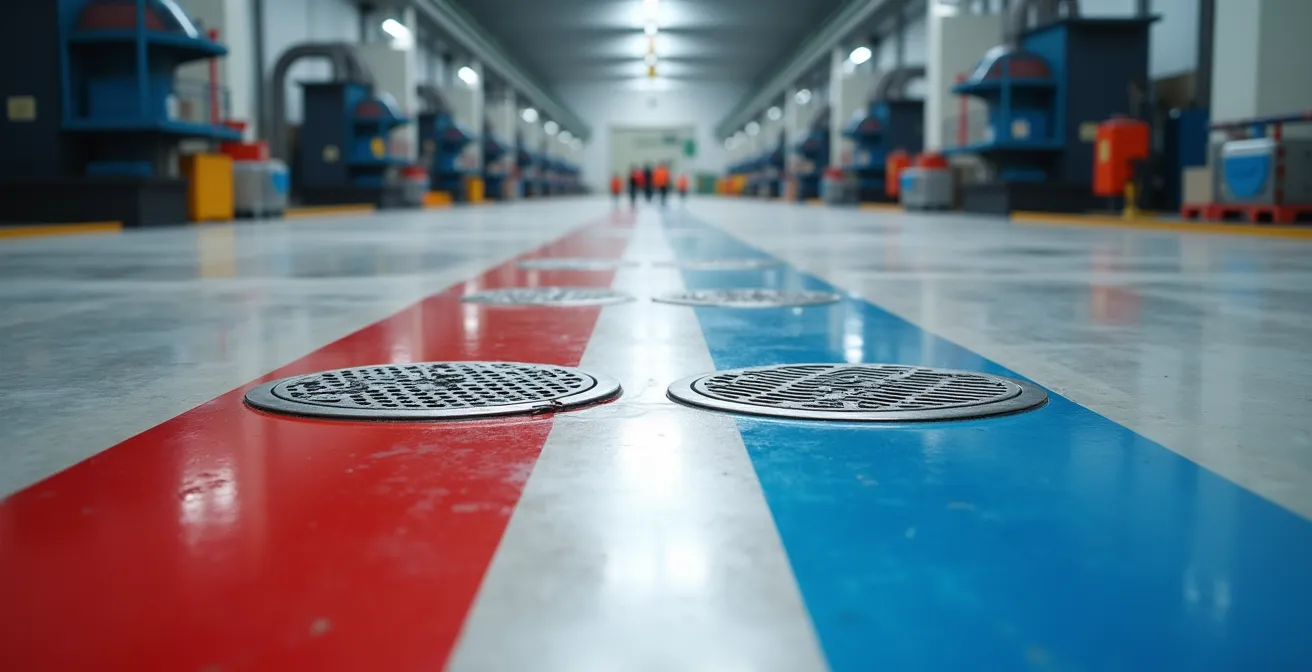
A compliant drainage system is segregated. The most effective approach is to implement a visual management system where drains and trenches are color-coded. For example, red-painted channels can be designated exclusively for chemical waste, leading to a specific holding tank for proper treatment or disposal. Blue channels can be used for general process water that can be safely discharged into the municipal system after passing through basic filtration or an oil/water separator. This simple visual cue drastically reduces the risk of accidental discharge of non-compliant effluent, which is a common trigger for regulatory penalties.
Beyond segregation, regular maintenance is non-negotiable. This includes scheduled cleaning of all trench drains, inspection of interceptors, and keeping meticulous logs of all maintenance activities. These records are not just for internal use; they form the backbone of a due diligence defense during a regulatory audit. An auditor will want to see documented proof that the facility is actively managing its wastewater, not just reacting to problems. Failing to provide this documentation can be interpreted as negligence, making it much harder to contest fines.
How to Implement Lockout/Tagout Procedures During Deep Cleaning Shifts?
Implementing lockout/tagout—known in Quebec as cadenassage—is a critical safety-of-life procedure required by the Commission des normes, de l’équité, de la santé et de la sécurité du travail (CNESST). Its purpose is to protect cleaning staff from the unexpected startup of machinery or the release of hazardous energy during deep cleaning and maintenance. A common mistake is assuming that a standard LOTO procedure for maintenance staff is sufficient for cleaning crews. Cleaning tasks often involve different teams, contractors, and longer shifts, requiring a more robust and tailored approach to cadenassage.
A compliant procedure must be clear, visual, and accessible to everyone involved. For a diverse workforce, this means creating bilingual (French/English) cadenassage sheets that use simple language and clear diagrams to show every energy isolation point for a specific piece of equipment. For tasks requiring multiple workers to service a single machine, a group lockbox system is essential. In this system, a supervisor places a single lock on the machine’s disconnect, and the key is placed inside a locked box. Each worker then places their personal lock on the box. The machine cannot be re-energized until the last worker has removed their lock, ensuring everyone is clear of the equipment.
Training and documentation are the pillars of a successful cadenassage program. All personnel, including in-house staff and third-party cleaning contractors, must be trained on the site-specific procedures before beginning any work. As Enviro Urgence, a Quebec-based industrial service, states, their teams are “committed to respecting CNESST standards and prevention programs.” This commitment must be verified. Furthermore, strict shift handover protocols are vital. The CNESST prohibits the transfer of a lock from one person to another; the incoming worker must apply their own lock before the outgoing worker removes theirs, ensuring continuous protection. All of these steps must be meticulously documented to prove compliance during a CNESST inspection.
Checklist for Quebec Cadenassage Procedure Compliance
- Develop bilingual (French/English) cadenassage sheets with visual diagrams for each piece of equipment.
- Establish and use a group lockbox system for any cleaning task involving more than one worker on a single machine.
- Train all cleaning staff, including both in-house employees and external contractors, on site-specific procedures before they perform any work.
- Create and enforce a strict shift handover protocol that complies with CNESST’s non-transferability rules for personal locks.
- Document and authorize every individual who is permitted to perform work and apply a lock on any given piece of equipment.
Why Does Dirt Ingestion Cause 80% of Hydraulic System Failures?
The statistic that over 80% of hydraulic system failures are caused by fluid contamination is staggering but logical. Hydraulic systems operate on extremely tight tolerances, where microscopic particles can act like sandpaper, scouring internal components like pumps, valves, and seals. This leads to internal leakage, reduced efficiency, and eventual catastrophic failure. While many managers focus on filtering the hydraulic fluid itself, they often overlook the primary source of contamination: dirt ingestion from the surrounding environment, a problem that is significantly worsened by high humidity.
High humidity acts as a contamination multiplier. Research on industrial moisture control shows that elevated humidity levels can increase the adhesion of dust and dirt to surfaces by as much as 40-60%. In a manufacturing plant, this means airborne particulate matter sticks more readily to hydraulic cylinders, hoses, and fittings. When a technician opens a port for maintenance or to top-up fluid, this layer of adhered dirt can easily fall into the system, introducing a massive dose of abrasive contaminants. The moisture itself can also be drawn into the reservoir through breather caps, where it degrades the fluid and promotes corrosion.
Preventing dirt ingestion requires a “clean-before-opening” protocol as a non-negotiable step. Before any hydraulic line is disconnected or a reservoir is opened, the area immediately surrounding the access point must be thoroughly cleaned and dried. This simple discipline is the single most effective way to prevent contamination. Additionally, equipping reservoirs with desiccant breather caps is crucial. These breathers strip moisture and particulate from the air being drawn into the tank as fluid levels fluctuate, protecting the fluid from both solid and water contamination. Implementing these external control measures is far more effective and less costly than trying to remove contaminants once they are already circulating in the system.
Why Do Bacteria Become Harder to Kill When They Form a Community?
A single bacterium is relatively vulnerable to sanitizers and disinfectants. However, when bacteria are allowed to accumulate on a surface, particularly in a moist environment, they secrete a slimy, protective substance to create a communal structure known as a biofilm. This biofilm matrix acts as a fortress, making the embedded bacteria up to 1,000 times more resistant to cleaning agents than their free-floating counterparts. The biofilm shields the bacteria from chemical attack, prevents them from drying out, and allows them to share nutrients and genetic information, which can even include antibiotic resistance.
High humidity is a powerful catalyst for biofilm formation. Cleanroom humidity control studies indicate that bacterial growth increases exponentially when relative humidity rises above 60%. This ambient moisture provides the ideal conditions for bacteria like Listeria monocytogenes, a major concern in Quebec’s ready-to-eat food sector, to establish a foothold on surfaces. Once formed, biofilms are notoriously difficult to remove. The initial cleaning step is critical: you must physically scrub the surface to break apart the protective matrix before a sanitizer or disinfectant can reach the bacteria underneath. Simply spraying a disinfectant onto an intact biofilm is often ineffective, as the chemical may not penetrate the slimy outer layer.
This is why MAPAQ certification training places a heavy emphasis on preventing Listeria biofilm formation. The curriculum focuses on a multi-step process: first, a thorough cleaning with a detergent and mechanical action (scrubbing) to remove gross soils and break down the biofilm. This is followed by rinsing, and only then is a sanitizer or disinfectant applied for the required contact time to kill the now-exposed bacteria. Skipping or poorly executing the initial cleaning and scrubbing step is the most common reason for sanitation failures in facilities struggling with persistent microbial contamination.
Key Takeaways
- Systemic Control is Paramount: Cleaning in high-humidity environments is a systemic issue connecting food safety (MAPAQ), worker safety (CNESST), and environmental compliance (MELCC).
- Moisture is the Primary Vector: Condensation, airborne humidity, and poor drainage are not just conditions but active transport mechanisms for chemical and biological contaminants.
- Prevention is More Effective than Reaction: Procedures like “clean-before-opening” for hydraulics and physical scrubbing to break down biofilms are more effective than trying to fix contamination after the fact.
Degreasing Heavy Machinery: How to Maintain Equipment Efficiency in Quebec Manufacturing Plants?
In Quebec’s diverse manufacturing sector, from aerospace to aluminum smelters, degreasing heavy machinery is not just a matter of hygiene; it is a direct driver of operational efficiency and safety. A layer of grease on equipment does more than just look unclean. It can hide cracks or leaks that signal pending mechanical failure. More importantly, it acts as an insulator, trapping heat and forcing machinery, especially electric motors, to work harder. This leads to increased energy consumption and higher operational costs—a tangible impact for any business paying Hydro-Québec rates.
A greasy layer on electric motors acts as an insulator, reducing heat dissipation and increasing energy consumption – a tangible cost for businesses paying Hydro-Québec rates.
– Quebec Energy Efficiency Council, Industrial Energy Management Best Practices
The optimal degreasing method varies significantly by industry, dictated by the primary concern of that sector. In aerospace, where precision is everything, controlled solvent-based methods are often used to prevent any risk of corrosion. In aluminum smelters, the primary concern is fire risk, making non-flammable methods like dry ice blasting the preferred choice. For food processing facilities, the focus is entirely on hygiene and preventing product contamination, mandating the use of food-grade, often enzyme-based, bio-degreasers to meet stringent MAPAQ standards.
This table illustrates how degreasing requirements and compliance standards are tailored to the specific risks and regulatory bodies governing different Quebec industrial sectors.
| Industry Sector | Primary Concern | Recommended Method | Compliance Standard |
|---|---|---|---|
| Aerospace | Precision & Corrosion | Solvent-based | Transport Canada |
| Aluminum Smelters | Fire Risk | Dry ice blasting | CNESST |
| Food Processing | Hygiene | Bio-degreasers | MAPAQ |
| Pulp & Paper | Equipment efficiency | High-pressure water | MELCC |
Ultimately, a strategic degreasing program is a cornerstone of a well-run facility. By selecting the appropriate method based on your specific industry, you not only ensure compliance and safety but also contribute directly to your plant’s energy efficiency and mechanical longevity. The next logical step is to audit your current procedures against these industry best practices and develop a documented, compliant, and efficient degreasing protocol.
Frequently Asked Questions on Quebec Industrial Cleaning & Compliance
What are the main drainage requirements for Quebec industrial facilities?
Facilities must comply with municipal by-laws concerning wastewater discharge limits including pH, COD, and heavy metals, following the ‘polluter pays’ principle enforced by MELCC.
How can facilities avoid automatic drainage violation fines?
Install properly sized trench drains, maintain oil/water separators, implement visual management systems for different waste streams, and keep detailed maintenance logs.
What documentation is required for due diligence defense?
Maintain records of cleaning procedures, chemical usage logs, drainage system maintenance records, and regular interceptor inspection documentation for auditor review.