
The most significant infection risks in your lobby aren’t the obvious ones; they are “hidden multipliers” like elevator buttons and shared pens that silently bypass standard cleaning protocols.
- High-touch points like elevator buttons can harbour up to 40 times more bacteria than a toilet seat.
- Passive solutions, including antimicrobial copper surfaces and optimized ventilation, offer continuous, non-labour-intensive protection.
Recommendation: Shift from a reactive cleaning schedule to a proactive strategy of risk identification, material science, and behavioural nudges tailored to your Quebec facility.
As a building manager in Quebec, you know the daily rhythm of your lobby. It’s the gateway to your facility, a high-traffic zone buzzing with tenants, visitors, and delivery personnel, especially during the rush of a cold winter morning. Ensuring this space is clean is a top priority, but true infection control goes far beyond a visibly spotless floor. The standard advice often revolves around cleaning high-touch surfaces more frequently and placing hand sanitizer dispensers around the premises. While these steps are necessary, they are merely the baseline.
These common practices often miss the intricate, invisible pathways pathogens use to travel. They fail to account for the “hidden multipliers”—the overlooked objects and behaviours that exponentially increase the risk of transmission. What if the real key to a healthier building isn’t just wiping down what’s obviously dirty, but understanding the science behind the most potent, and often surprising, transmission vectors? The true threat lies not in visible grime, but in the unseen chain of infection that links a contaminated surface to a susceptible individual.
This guide moves beyond the checklist mentality. We will dissect the most critical, often underestimated, transmission risks lurking in your lobby and common areas. By focusing on data-driven insights and solutions tailored for the Quebec context—from material science to human behaviour and HVAC optimization—you can learn to break the chain of infection at its weakest points, creating a genuinely safer environment for everyone in your building.
For those who prefer a visual format, the following video provides a clear and concise demonstration of a fundamental hygiene practice that underpins all infection control efforts.
To help you navigate these critical areas of infection control, this article is structured to address the most pressing questions and provide actionable solutions. The following summary outlines the key topics we will explore to build a robust defense strategy for your facility.
Summary: A Manager’s Guide to Neutralizing Lobby-Based Pathogens
- Why Do Elevator Buttons Transmit More Pathogens Than Toilet Seats?
- How to Install Hand Sanitizing Stations Strategically to Maximize Usage?
- Copper vs Stainless Steel: Which Surface Material Naturally Kills Pathogens?
- The Guest Sign-In Pen Mistake That Undermines Your Hygiene Efforts
- How Increasing Air Exchange Rates Reduces Airborne Viral Load by 40%?
- Why Do “Clean” Desks Still Harbor More Bacteria Than Restroom Seats?
- The Coffee Machine Mistake That Makes the Breakroom a Bacterial Hotspot
- Paper Towels vs Hand Dryers: Which Solution Actually Reduces Bacteria Spread?
Why Do Elevator Buttons Transmit More Pathogens Than Toilet Seats?
It’s a counter-intuitive fact that challenges our perception of cleanliness: the elevator button you press multiple times a day is likely a far more significant microbial hotspot than a public toilet seat. The reason lies in a combination of high-frequency contact and a lack of targeted cleaning. While restrooms are subject to rigorous and regular disinfection schedules, elevator buttons are often overlooked. This creates a perfect breeding ground for pathogens. In fact, startling microbiology research reveals that elevator buttons can have bacterial loads as high as 313 CFUs (colony-forming units) per square centimeter, compared to just 8 CFUs on the average toilet seat.
This isn’t just a theoretical risk; it has been confirmed in real-world Canadian healthcare settings. A study conducted across three large Toronto hospitals provided clear evidence of this disparity. As the findings highlight:
Sixty-one percent of the elevator button samples showed microbiological growth, compared to only 43% of the toilet surface samples.
The bacteria found included dangerous pathogens like Staphylococcus, Streptococcus, and coliform bacteria, demonstrating that these small surfaces act as major hubs for cross-contamination. Every person entering the elevator deposits and picks up microorganisms, creating an ever-refreshing reservoir of germs that are then carried throughout the entire building, effectively turning the elevator into a vertical transmission vector.
How to Install Hand Sanitizing Stations Strategically to Maximize Usage?
Simply providing hand sanitizer is not enough; its effectiveness hinges almost entirely on strategic placement. The goal is to integrate hygiene into the natural flow of movement within your building, turning it into an unconscious, reflexive action rather than a conscious choice. Since IPAC Canada research shows that over 80% of common infections are spread by hands, interrupting this transmission route is paramount. Placing dispensers in low-traffic corners or out-of-the-way locations results in minimal usage. Instead, you must identify and target key “points of transition.”
These are moments when people are most likely to think about hygiene or have just contacted a high-risk surface. For a Quebec building, a prime example is the area where people remove their winter coats and gloves. Placing a dispenser here intercepts contaminants brought in from the outside before they spread further. Other critical locations include directly outside elevator banks, at reception desks, and at the entrance to common areas like kitchens or lounges. The illustration below visualizes this principle in a typical Quebec office context.
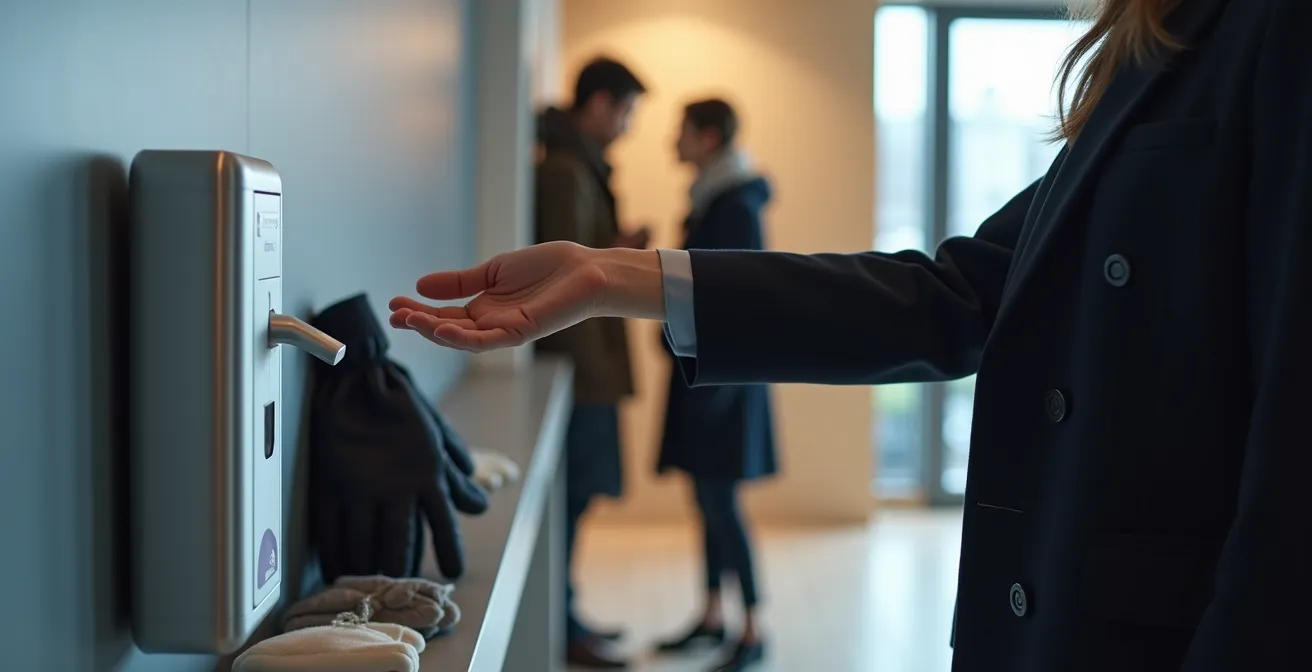
As you can see, positioning the dispenser at these points of transition makes hygiene a convenient and logical next step. It nudges behaviour by making the right choice the easy choice. For maximum effectiveness in a Quebec facility, ensure that any accompanying signage is bilingual (French and English) and uses clear, universally understood icons. The dispenser itself should be touchless and well-maintained to build trust and encourage consistent use.
Copper vs Stainless Steel: Which Surface Material Naturally Kills Pathogens?
While frequent disinfection is an active strategy, your building materials can offer a passive, continuous defense against pathogens. Not all surfaces are created equal when it comes to microbial survival. Stainless steel, prized for its sleek look and resistance to corrosion, is biologically inert; it provides a neutral ground where bacteria and viruses can survive for hours or even days. In contrast, antimicrobial copper alloys possess an inherent ability to kill pathogens on contact. This phenomenon, known as the oligodynamic effect, disrupts key cellular functions, destroying microorganisms without any chemical intervention.
The effectiveness of this material science defense has been quantified in Canadian healthcare settings. A comparative study in British Columbia long-term care facilities, detailed in the Canadian Journal of Infection Control, found a 79.3% overall reduction in microbial load on antimicrobial copper surfaces compared to conventional surfaces. The most significant impact was seen on high-touch items like faucet handles and grab bars.
This table summarizes the key differences in performance based on data relevant to Canadian facilities, demonstrating the clear advantage of copper in an infection control strategy.
| Surface Material | Bacterial Reduction | Time to Kill 99.9% Bacteria | Maintenance Requirements |
|---|---|---|---|
| Copper Alloy (80% Cu) | 79.3% reduction (ATP method) | Within 2 hours | Regular cleaning to prevent lacquer buildup |
| Stainless Steel | No inherent antimicrobial properties | Does not kill bacteria | Requires frequent disinfection |
| Copper-Impregnated Surface (16%) | 34.1% reduction (culture method) | 2-4 hours | Compatible with standard cleaners |
For a building manager, this means that retrofitting or specifying copper alloys for high-touch items—such as door handles, push plates, elevator buttons, and railings—can significantly lower the baseline microbial burden in your facility. It’s a one-time investment that works 24/7 to break the chain of infection.
The Guest Sign-In Pen Mistake That Undermines Your Hygiene Efforts
One of the most potent “hidden multipliers” of infection in any lobby is the humble guest sign-in pen. This single object can be touched by hundreds of different people in a single day, each one depositing and acquiring microbes. It becomes a communal vector, efficiently transferring pathogens from one visitor to the next, completely bypassing other hygiene efforts. Even with a rigorous cleaning schedule, it is nearly impossible to disinfect the pen between every single use. According to CCOHS guidelines, such high-frequency touch points require cleaning multiple times daily, a standard that is rarely met for a shared pen.
This single point of failure can undermine an otherwise robust infection control program. To neutralize this threat, you must implement a system that either eliminates the shared object or ensures it is used safely. This requires a shift in process at the reception desk, which serves as the frontline of your building’s hygiene defense. The following action plan provides a specific protocol for Quebec-based facilities, incorporating practical steps and bilingual considerations.
Your Action Plan: Reception Desk Hygiene Protocol
- Create a “Clean Pen / Used Pen” system with two clearly labeled containers in both French and English.
- Disinfect payment terminals and visitor cards every 2 hours during business hours.
- Clean service bells and sign-in tablets with disinfectants approved by Health Canada (possessing a DIN number).
- Implement a QR code sign-in system to eliminate pen sharing entirely.
- Train reception staff on the correct placement of bilingual signage for all hygiene protocols.
- Use dedicated, colour-coded cleaning cloths for each surface type (e.g., electronics, countertops), changing them daily or when visibly soiled.
By implementing these simple but effective measures, you dismantle a key link in the infection chain. Moving to a digital sign-in or a controlled pen system is a low-cost, high-impact change that significantly reduces cross-contamination risk in your lobby.
How Increasing Air Exchange Rates Reduces Airborne Viral Load by 40%?
While surface contamination is a major concern, airborne transmission represents another critical pathway for pathogens, especially in enclosed spaces like lobbies and elevators. The concentration of airborne viral particles can build up over time if the air is stagnant. The primary defense against this is ventilation, measured in Air Changes per Hour (ACH). This metric indicates how many times the entire volume of air in a room is replaced with fresh outdoor air in one hour. Increasing the ACH directly dilutes the concentration of airborne contaminants, including viruses, effectively reducing the risk of inhalation for occupants.
The scale of this issue is significant; according to CNISP data, an estimated 220,000 patients contract healthcare-associated infections annually in Canada, with a portion linked to airborne pathogens. In a Quebec winter, simply opening windows to increase ventilation is not a feasible or energy-efficient solution. This is where Energy Recovery Ventilators (ERVs) become essential. An ERV system simultaneously exhausts stale indoor air and supplies fresh, filtered outdoor air, while transferring heat and humidity between the two streams. This process, visualized below, maintains indoor air quality without a significant energy penalty.

By upgrading HVAC systems to meet or exceed standards set by resources like the CSA Health Care Facility Engineering guide, buildings can significantly lower airborne viral loads. Studies have shown that even modest increases in ventilation rates can reduce the concentration of infectious particles by 40% or more. For building managers in Quebec, investing in ERV technology, often supported by provincial energy efficiency rebates, is a critical step towards creating a healthier indoor environment year-round.
Why Do “Clean” Desks Still Harbor More Bacteria Than Restroom Seats?
The paradox of the “clean” desk is a stark reminder that visible cleanliness is not the same as microbial safety. An office desk, particularly in a hot desking or shared workspace environment, can harbour hundreds of times more bacteria than a toilet seat. Several factors contribute to this phenomenon. First, desks are rarely cleaned with the same rigour or frequency as restrooms. Second, they are cluttered with personal items—keyboards, mice, phones, coffee mugs—that are perfect reservoirs for germs and are almost never disinfected by professional cleaning staff.
These items create a complex surface area where biofilm, a sticky matrix of microorganisms, can develop undisturbed. Furthermore, many of these items travel with their owners, bringing contaminants from public transit, homes, and other environments directly to the workstation. A false sense of security leads to behaviours like eating at the desk, which introduces organic matter that fuels bacterial growth and provides a direct hand-to-mouth route for infection.
For building managers overseeing shared or flexible office spaces in dense urban centres like Montreal, establishing a clear disinfection protocol is not just a recommendation—it’s a necessity. This involves educating tenants on their personal responsibility. Simple, mandatory start-of-day and end-of-day wipe-down routines using approved disinfectants for all personal and shared equipment (keyboards, mice, phones) can dramatically reduce the microbial load. Posting clear, bilingual reminders at each station is a powerful nudge to reinforce these essential habits.
The Coffee Machine Mistake That Makes the Breakroom a Bacterial Hotspot
The office breakroom is designed as a social hub, but its communal nature also makes it a hotspot for cross-contamination. While the coffee machine itself gets the most attention, the biggest hygiene mistake is often the seemingly innocent item next to the sink: the shared sponge or dishcloth. This perpetually damp, porous object is an ideal incubator for bacteria. When used to wipe down the coffee machine, counters, and other surfaces, it doesn’t clean—it spreads a film of microorganisms everywhere it touches, creating a widespread contamination event.
Scientific benchmarks provide a clear target for surface hygiene. According to clinical microbiology standards, surfaces with less than 250 CFU/100 cm² are considered benign. A single swipe with a contaminated sponge can deposit a bacterial load far exceeding this safe threshold. Other high-risk items in the breakroom include coffee pot handles, water cooler buttons, and microwave door handles—all touched by numerous people throughout the day with varying levels of hand hygiene.
To neutralize this risk, the first and most critical step is to eliminate shared, reusable cleaning items. Replace all communal sponges and cloth towels with disposable paper towel dispensers. For facilities in Quebec, it’s also important to adhere to CNESST guidelines regarding physical distancing, which may require spacing out coffee stations or managing traffic flow in smaller breakrooms. Implementing a clear, bilingual cleaning charter that assigns daily responsibilities for disinfecting high-touch points can transform the breakroom from a bacterial hotspot into a safe and welcoming space.
Key Takeaways
- Elevator buttons are major microbial hotspots, often harbouring significantly more bacteria than toilet seats due to high-frequency use and infrequent cleaning.
- Strategic placement of hand sanitizer at “points of transition”—like entrances and elevator banks—dramatically increases usage and effectiveness.
- Antimicrobial copper surfaces offer continuous, 24/7 pathogen reduction, providing a passive layer of defense that stainless steel does not.
Paper Towels vs Hand Dryers: Which Solution Actually Reduces Bacteria Spread?
The choice between paper towels and electric hand dryers in a restroom is more than a matter of cost or environmental impact; it’s a critical infection control decision. While hand dryers are often promoted as a “no-touch,” eco-friendly option, they can inadvertently contribute to the spread of pathogens. High-powered jet dryers can aerosolize water droplets remaining on poorly washed hands, dispersing microorganisms into the air and onto surrounding surfaces. Furthermore, they do nothing to remove bacteria that were missed during washing. The key advantage of paper towels lies in physical friction. The act of rubbing hands with a towel mechanically removes residual contamination and exfoliates dead skin cells, a crucial step that dryers cannot replicate.
This decision is particularly relevant for building managers in Quebec. While hand dryers benefit from the province’s low-carbon hydroelectricity, their drawbacks in hygiene and noise pollution are significant. In contrast, commercially compostable paper towels align with the robust municipal composting programs available in cities like Montreal. The ultimate goal is to ensure hands are not only dry but also as clean as possible when leaving the restroom.
This comparative table, contextualized for Quebec facilities, outlines the trade-offs to consider when designing your restrooms for optimal infection control.
| Factor | Paper Towels (Recycled/Compostable) | Electric Hand Dryers |
|---|---|---|
| Bacteria Removal | Physical friction removes pathogens | No mechanical removal action |
| Energy Use (Quebec) | Manufacturing/transport emissions | Hydro-electric (low carbon) |
| Waste Management | Compatible with Montreal composting programs | No waste generated |
| Door Handle Solution | Can use towel to open door | Requires separate solution |
| Noise Level | Silent operation | Can exceed 85 dB |
Perhaps the most compelling argument for paper towels is the door handle solution. As IPAC Canada recommends, a user can use the paper towel to open the restroom door, avoiding re-contamination of their clean hands, and then dispose of it in a bin placed just outside. This simple behavioural allowance is a powerful final step in breaking the chain of infection that hand dryers simply cannot offer.
To effectively protect your occupants, the next step is to conduct a site-specific audit to map and prioritize your building’s unique transmission vectors.