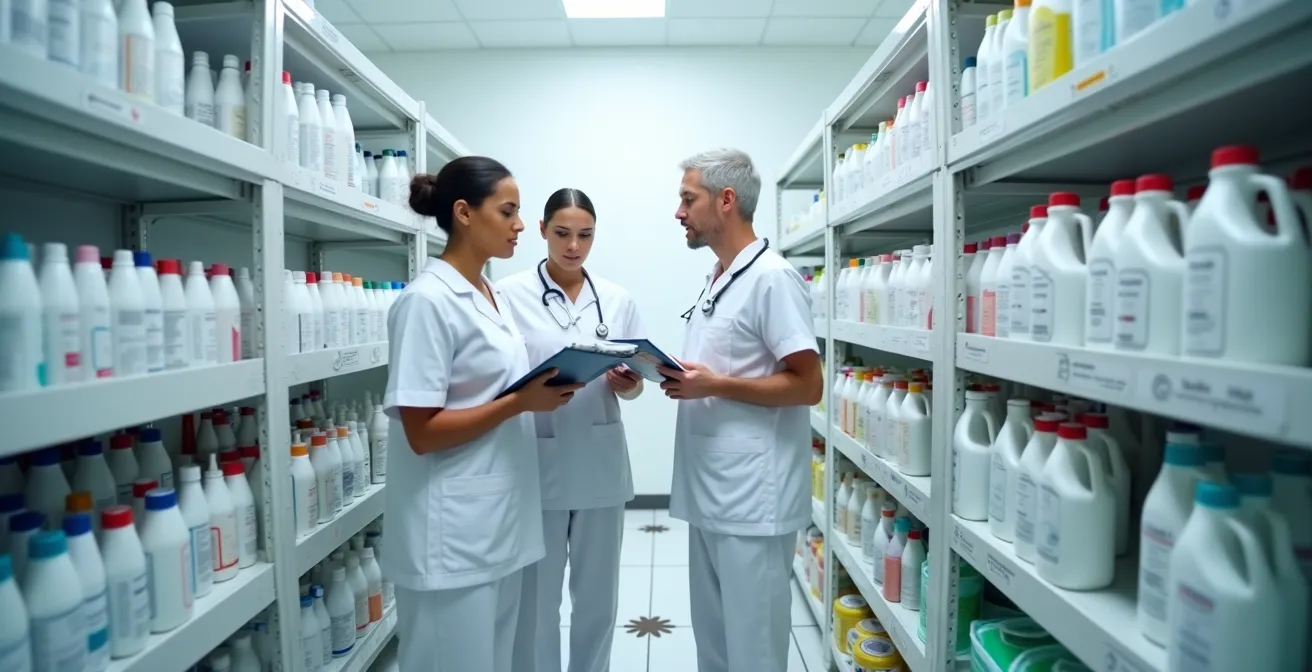
Choosing a DIN-approved disinfectant isn’t just about compliance; it’s a strategic decision that directly impacts safety, operational costs, and equipment longevity in your Quebec facility.
- Match the product’s “kill claim” (bactericidal, virucidal, sporicidal) to the specific pathogen risk you are facing.
- Leverage fast-acting products (e.g., 1-minute contact time) to significantly reduce labour costs and increase operational efficiency.
Recommendation: Always verify a product’s 8-digit DIN and its specific claims using Health Canada’s official Drug Product Database (DPD) before purchase and implementation.
As a facility manager in a Quebec clinic or school, facing a potential outbreak is a high-pressure situation. The immediate reflex is to reach for a disinfectant, with the common wisdom being “just make sure it has a DIN number.” While this is a critical first step, it’s dangerously simplistic. This approach overlooks the fundamental truth that not all DIN-approved products are created equal. Relying on a generic disinfectant can lead to failed decontamination, wasted resources, and a false sense of security, especially when dealing with resilient pathogens.
The real challenge isn’t finding a product with a DIN; it’s selecting the *correct* one for the specific threat at hand. The key is to shift your thinking from simple compliance to a strategic, evidence-based selection process. This means treating disinfectant selection less like a janitorial task and more like a targeted pharmaceutical intervention. It requires understanding the specific pathogen, deciphering the language on the label, and considering the operational impact on your staff and budget.
This guide provides a strategic framework for Quebec managers to move beyond the DIN number. We will explore how to perform precise pathogen-product pairing, analyze the financial impact of contact times, and navigate the specific regulatory landscape of Health Canada, the CNESST, and MAPAQ. By mastering this approach, you can ensure not only compliance but true efficacy, protecting both the people in your care and your bottom line.
To help you navigate these critical decisions, this article breaks down the essential components of a robust disinfectant selection strategy. You’ll find practical tools and Quebec-specific insights to build a protocol that is both effective and efficient.
Summary: A Strategic Guide to DIN Disinfectant Selection
- Why Do Alcohol-Based Disinfectants Fail Against C. Difficile Spores?
- How to Decipher “Kill Claims” on Disinfectant Labels to Ensure Safety?
- Pre-Moistened Wipes vs Spray Bottles: Which Ensures Correct Chemical Concentration?
- The Chlorine Mistake That Pits and Rusts Stainless Steel Equipment
- How Fast-Acting Disinfectants (1-Minute Kill) Can Save 20% on Labor Costs?
- How to Use the Drug Product Database (DPD) to Verify Product Claims?
- Broad-Spectrum vs Targeted Disinfectants: Which to Choose for Flu Season?
- Enzymatic Cleaners vs Bleach: Which Digests Organic Waste Better?
Why Do Alcohol-Based Disinfectants Fail Against C. Difficile Spores?
One of the most critical lessons in disinfection is that a product effective against one pathogen can be completely useless against another. The case of Clostridioides difficile (C. difficile) is a stark example. During an outbreak in a healthcare or long-term care facility (CHSLD), reaching for a standard alcohol-based hand sanitizer or surface disinfectant is a common but grave error. Alcohol works by denaturing the proteins of bacteria and enveloped viruses, but C. difficile protects itself by forming a tough, dormant structure called a spore.
These spores have a highly resistant outer shell that alcohol cannot penetrate. In fact, according to Health Canada’s pathogen safety data, Clostridium spores are entirely resistant to common alcohols like ethyl and propyl alcohol. This is a crucial piece of knowledge for any manager; using the wrong product creates a false sense of safety while allowing the spores to persist on surfaces and spread. This is the essence of pathogen-product pairing: the disinfectant’s mode of action must match the pathogen’s biology.
To effectively eliminate C. difficile, you need a sporicidal agent. These are powerful disinfectants, often based on chlorine (like bleach) or other oxidizing agents, specifically formulated to break down the spore’s protective coating. Studies have shown that implementing a sporicidal disinfectant for daily cleaning in rooms with C. difficile patients is a standard and effective practice in North American hospitals to control outbreaks. This highlights the necessity of identifying the pathogen first, then selecting a product with the specific “kill claim” to neutralize it.
How to Decipher “Kill Claims” on Disinfectant Labels to Ensure Safety?
The label on a disinfectant bottle is more than just marketing; it’s a legal document summarizing extensive testing. As a manager, your most important task is to look past the brand name and focus on the Drug Identification Number (DIN) and the efficacy claims. As Mike Watt of the Avmor Training Division explains, the DIN is an eight-digit number assigned by Health Canada that ” verifies that the product has been independently tested and proven to be an effective disinfectant.” But the DIN is just the beginning; the key is understanding the hierarchy of claims.
Disinfectants in Canada are categorized based on their proven effectiveness against different types of microorganisms. This kill claim hierarchy is what allows you to match the product to your specific risk level. A product labeled only as “bactericidal” might be sufficient for a low-risk office but is dangerously inadequate during a viral outbreak in a daycare. You must look for specific claims like “virucidal,” “fungicidal,” or the highest level, “sporicidal,” for threats like C. difficile.
This comparative table from Health Canada guidance documents provides a clear framework for decision-making within the Quebec context. It demonstrates how the required level of disinfection scales with the risk profile of the environment.
| Classification Level | Efficacy Against | Typical Settings in Quebec | Required Testing |
|---|---|---|---|
| Limited Spectrum | Specific bacteria only | Office buildings, retail stores | Basic bactericidal |
| Broad Spectrum | Bacteria + viruses | Schools, daycares in Montreal | Bactericidal + virucidal |
| Hospital Grade | All above + fungi | CHSLDs, Quebec hospitals | Full spectrum testing |
| Sporicidal | All above + spores | C. difficile outbreak areas | Spore kill verification |
Pre-Moistened Wipes vs Spray Bottles: Which Ensures Correct Chemical Concentration?
Once you’ve selected a disinfectant with the right kill claim, the next decision is the delivery format: pre-moistened wipes or a concentrate diluted into spray bottles. While sprays often appear more cost-effective for large areas, pre-moistened wipes offer a critical advantage in high-risk environments: guaranteed concentration. Every wipe is saturated with the precise amount of chemical solution needed to be effective, eliminating the risk of human error during dilution.
Improper dilution of concentrates is a major point of failure. A solution that is too weak will not achieve disinfection, while a solution that is too strong can damage surfaces and pose a health risk to staff, potentially violating CNESST safety standards. Wipes eliminate this variable entirely. Furthermore, they reduce worker exposure to concentrated chemicals and splashes, a key concern under WHMIS (Workplace Hazardous Materials Information System). The sealed packaging of wipes also prevents the active ingredients from evaporating, which can happen with improperly sealed spray bottles, again ensuring consistent potency.
However, cost is a valid consideration. For large-scale daily cleaning in lower-risk settings, concentrated sprays offer significant savings. A cost-benefit analysis often shows that sprays are more economical for extensive use, such as cleaning entire floors in a commercial building. The trade-off is the need for rigorous and documented training for staff on proper dilution procedures, often in both French and English to meet Quebec’s requirements. The choice, therefore, depends on a risk assessment: for critical touchpoints and high-risk patient areas, the consistency of wipes is paramount. For larger, less critical surfaces, a well-managed dilution protocol for sprays can be a viable, cost-effective option.
The Chlorine Mistake That Pits and Rusts Stainless Steel Equipment
Sodium hypochlorite, the active ingredient in bleach, is a powerful and inexpensive sporicidal disinfectant. It is highly effective against pathogens like C. difficile, which makes it a common choice in healthcare settings. However, its aggressive nature comes with a significant drawback: it is highly corrosive to metals, particularly stainless steel. Prolonged or improper use of chlorine-based products on expensive medical or food service equipment can lead to pitting, discoloration, and eventually, rust. This not only ruins the equipment’s appearance but also creates microscopic crevices where bacteria can hide, making future disinfection more difficult.
The mistake is often one of concentration and contact. Many facilities use bleach solutions that are too strong or fail to rinse surfaces with water after the required contact time, allowing the corrosive agent to sit on the metal. For stainless steel, chlorine concentrations should ideally stay below 200 ppm to minimize damage. This creates a dilemma: you need a sporicidal agent, but you also need to protect your assets. This is where understanding surface integrity and alternative chemistries is vital.
Fortunately, there are effective, less corrosive alternatives. Products based on Accelerated Hydrogen Peroxide (AHP) or peracetic acid are excellent choices. They offer sporicidal efficacy without the harsh impact of chlorine. For instance, research published in 2023 demonstrates that certain peracetic acid products can achieve a significant reduction of C. difficile spores in as little as 5-15 minutes. For food contact surfaces in Quebec, it’s essential to follow MAPAQ requirements, which often involve selecting a DIN-approved product specifically formulated for that use and always rinsing the surface after disinfection.
Your Action Plan: Protecting Stainless Steel Equipment
- Select DIN-approved Accelerated Hydrogen Peroxide for food contact surfaces.
- Use quaternary ammonium compounds specifically formulated for stainless steel in non-sporicidal situations.
- Rinse all food contact surfaces after disinfection per MAPAQ requirements.
- Apply passivation treatment to new equipment before first use to enhance corrosion resistance.
- Monitor chlorine concentrations closely to stay below the 200ppm safety threshold for stainless steel.
How Fast-Acting Disinfectants (1-Minute Kill) Can Save 20% on Labor Costs?
Beyond the kill claim and chemical composition, one of the most overlooked metrics on a disinfectant label is the contact time—the period a surface must remain visibly wet to achieve disinfection. This single number has a massive impact on your largest expense: labor. A product with a 10-minute contact time requires staff to either wait or re-apply the product, drastically reducing their efficiency. In contrast, a product with a 1-minute contact time allows a “spray and walk away” protocol, multiplying productivity.
Let’s consider the financial impact in a Quebec context. With the CNESST confirming a minimum wage of over $16 per hour, and cleaning staff in unionized environments like hospitals earning significantly more, every minute saved translates directly into budget relief. A 9-minute reduction in contact time per room allows a single staff member to clean several more rooms in the same shift. This isn’t a minor tweak; it’s a fundamental boost to operational efficiency.
The following table illustrates the dramatic return on investment (ROI) when switching from a standard 10-minute product to a fast-acting 1-minute alternative in a hypothetical Quebec facility. Even if the fast-acting product has a higher per-litre cost, the labor savings almost always result in a significantly lower total cost per room cleaned.
| Metric | 10-Minute Product | 1-Minute Product | Annual Savings |
|---|---|---|---|
| Contact time per room | 10 minutes | 1 minute | 9 minutes saved |
| Rooms cleaned per hour | 3 | 12 | 9 extra rooms |
| Labor cost per room (@$21.52/hr) | $7.17 | $1.79 | $5.38 per room |
| Annual savings (200 rooms/day) | – | – | $392,740 |
How to Use the Drug Product Database (DPD) to Verify Product Claims?
Trusting a disinfectant label is good; verifying it is better. Health Canada provides a powerful and transparent tool for this exact purpose: the Drug Product Database (DPD). This online resource is the definitive source of truth for any drug or disinfectant legally sold in Canada. Before any product can be marketed, it must undergo a rigorous pre-market assessment and receive a DIN. As Health Canada’s guidance states, applicants “must provide safety, efficacy and quality evidence that the product performs as indicated by the label.” The DPD is where this evidence is publicly catalogued.
Using the DPD is a non-negotiable step in your procurement process. It allows you to confirm that the product’s DIN is active and not discontinued, and more importantly, to cross-reference the marketing claims on the bottle with the official claims approved by Health Canada. You might find that a product’s broad marketing language doesn’t fully align with its specific, approved kill claims listed in the database. For facilities in Quebec, this verification step should also be cross-referenced with recommendations from the Institut national de santé publique du Québec (INSPQ) for an added layer of local public health guidance.
Verifying a DIN is a straightforward process that should be integrated into your standard operating procedures for purchasing cleaning supplies. This simple audit protects you from using ineffective products and ensures full regulatory compliance.
Checklist: 5 Steps for DPD Verification
- Locate the 8-digit DIN on the physical disinfectant label.
- Access Health Canada’s official Drug Product Database (DPD) online.
- Enter the DIN into the search field and confirm the product has an “Active” status.
- Compare the specific kill claims on the product label with the official monograph listings in the DPD.
- Cross-reference the product’s suitability with the latest recommendations from the INSPQ for Quebec healthcare facilities.
Broad-Spectrum vs Targeted Disinfectants: Which to Choose for Flu Season?
The term “broad-spectrum” sounds reassuring, suggesting a product that kills everything. While these disinfectants are essential tools, using them exclusively is often an inefficient and overly aggressive strategy. The key to a cost-effective and responsible protocol is knowing when to deploy the “heavy artillery” of a broad-spectrum product versus a more targeted disinfectant.
The decision hinges on the type of pathogen you’re most likely to encounter. As a rule of thumb, viruses are categorized as enveloped or non-enveloped. Enveloped viruses, like influenza and SARS-CoV-2, have a fragile outer fatty layer and are relatively easy to kill. Non-enveloped viruses, such as Norovirus or Rhinovirus (the common cold), lack this layer and are much tougher. As Health Canada’s emerging viral pathogens guidance confirms, non-enveloped viruses are significantly more resistant to disinfectants. A broad-spectrum disinfectant is one that is proven effective against both types.
During flu season (typically October to April in Quebec), when enveloped influenza viruses are the primary concern, a disinfectant with a specific virucidal claim against influenza may be sufficient for routine cleaning in lower-risk environments like offices. However, in high-traffic, high-risk settings like schools and daycares, where a mix of pathogens is always present, a broad-spectrum product is the safer choice year-round. This strategic rotation allows you to optimize costs without compromising safety.
The following matrix provides a simplified decision-making guide for different institutional settings in Quebec, balancing risk and cost throughout the year.
| Facility Type | Oct-April (Flu Season) | May-September | Cost Impact |
|---|---|---|---|
| Quebec Schools | Broad-spectrum required | Targeted acceptable | 30% higher winter costs |
| Office Buildings | Targeted with monitoring | Targeted sufficient | Minimal increase |
| Daycares/CHSLDs | Broad-spectrum mandatory | Broad-spectrum recommended | Year-round investment |
Key Takeaways
- Pathogen-Product Pairing is Critical: Always match the disinfectant’s kill claim (e.g., sporicidal for C. difficile) to the specific pathogen.
- Verify Every DIN: Use Health Canada’s Drug Product Database (DPD) to confirm a product’s efficacy claims and active status before purchasing.
- Contact Time Equals Labor Cost: Choosing a fast-acting disinfectant (e.g., 1-minute contact time) can generate significant ROI by improving operational efficiency.
Enzymatic Cleaners vs Bleach: Which Digests Organic Waste Better?
A common and dangerous misconception is that a powerful disinfectant like bleach can do everything. However, disinfection can only happen on a clean surface. All disinfectants, including bleach, are significantly less effective in the presence of organic soil (blood, feces, saliva, and other bodily fluids). This soil can shield microorganisms from the disinfectant and neutralize its active ingredients. This is why the Canadian Centre for Occupational Health and Safety (CCOHS) emphasizes a two-step process. As they state, you must first ” clean visibly dirty or soiled surfaces with soap and water or a cleaning product before disinfecting.”
This is where enzymatic cleaners demonstrate their unique and superior value. Unlike bleach, which is a powerful oxidizer that kills pathogens, enzymatic cleaners are not disinfectants. They are specialized detergents that use enzymes to break down and digest specific types of organic waste. A protease enzyme targets proteins (like in blood), while a lipase enzyme targets fats. By using an enzymatic cleaner first, you are effectively “digesting” the organic soil and biofilms that would otherwise interfere with the disinfectant. This pre-cleaning step allows the subsequent disinfectant (like bleach or AHP) to work on a clean surface, ensuring it can reach and kill the pathogens effectively.
Bleach has no ability to digest waste; it can only bleach it, sometimes leaving the underlying soil in place. Using an enzymatic cleaner is particularly crucial for medical instruments before sterilization and for maintaining drains, where it can break down biofilm without the environmental harm associated with large amounts of chlorine. Following a CNESST-compliant protocol means using the right product for the right job: an enzymatic cleaner to clean and digest, followed by a DIN-registered disinfectant to kill pathogens.
By shifting your approach from simply “disinfecting” to a strategic, two-stage process of “cleaning then disinfecting,” you elevate your facility’s entire standard of safety. To ensure your facility is truly protected, the next logical step is to audit your current cleaning and disinfection protocols against this pathogen-specific framework, from product selection to staff training.