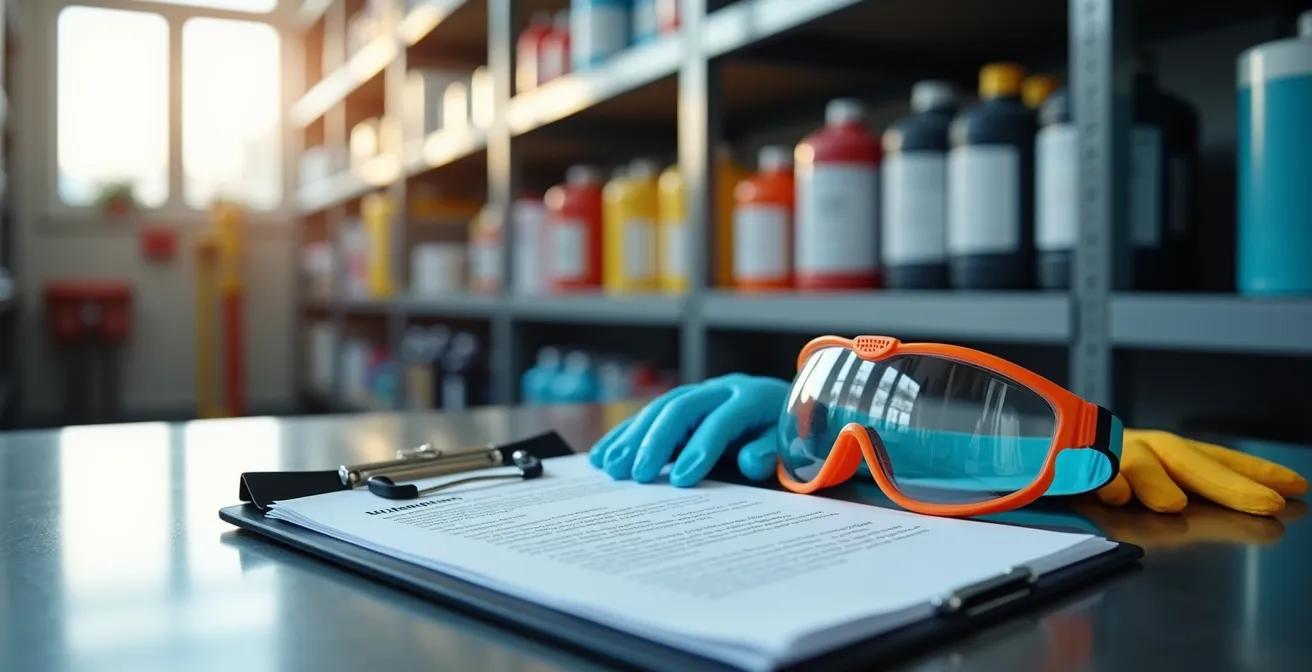
Your legal responsibility for workplace safety in Quebec doesn’t end when you hire a cleaning contractor; it just becomes a shared liability that can expose your business to significant risk.
- The CNESST holds you, the business owner, accountable for your contractor’s compliance failures, from missing Safety Data Sheets to improper employee training.
- Implementing an auditable documentation system for chemicals, training, and incidents is your primary defense against fines and litigation arising from vicarious liability.
Recommendation: Shift from passively trusting your cleaning service to actively verifying their compliance with a systematic, documented internal audit process.
As a Quebec business owner, you delegate tasks to focus on your core operations. Hiring a professional cleaning service seems like a straightforward way to ensure a safe and presentable environment, offloading the work and the worry. However, a dangerous assumption often accompanies this delegation: that you’ve also offloaded the legal responsibility. The truth is, under Quebec’s robust workplace health and safety laws, your liability is intertwined with that of your subcontractors. A simple oversight by your cleaning crew—a missing document, an expired certification, an improperly stored chemical—can result in a CNESST inspector issuing a fine directly to you.
Most business owners focus on the visible outcomes of cleaning: spotless floors and sanitized surfaces. Yet, CNESST inspectors are trained to look beyond the shine. They audit the process, the documentation, and the underlying safety systems. Common advice revolves around having safety data sheets and training staff, but this barely scratches the surface of true compliance. These are not just items on a checklist; they are components of a comprehensive safety program for which you retain ultimate accountability.
This guide changes the perspective. The key to protecting your business isn’t just ensuring your workplace is clean, but proving that the *process* of cleaning is compliant. It’s about moving beyond trust and into verification. We will not just list the rules; we will provide an auditor’s framework for examining your cleaning service’s operations. We will delve into the critical areas where contractors often fail, exposing your business to vicarious liability. This is about building an auditable system that demonstrates your due diligence and shields you from the consequences of your contractor’s potential non-compliance.
This article breaks down the essential compliance points you must audit. It provides a clear roadmap to verify your contractor’s procedures, identify red flags, and implement a system that will stand up to CNESST scrutiny. Let’s explore the key areas of risk and how you can proactively manage them.
Summary: A Business Owner’s Guide to Auditing Cleaning Contractor CNESST Compliance
- Why Do Missing SDS Sheets Result in Immediate Penalties During Inspections?
- How to Verify That Your Cleaning Staff Has Valid WHMIS 2015 Training?
- Ergonomic Tools vs Standard Mops: Which Reduces Workplace Injury Claims?
- The Ventilation Mistake in Janitorial Closets That Violates Safety Codes
- How to Maintain an Incident Log That Protects You in Case of Litigation?
- How to Organize Safety Data Sheets (SDS) Digitally for Instant Access?
- How to Place Wet Floor Signs Correctly to Minimize Legal Liability?
- WHMIS 2015 Compliance: Is Your Cleaning Chemical Inventory Audit-Ready for CNESST?
Why Do Missing SDS Sheets Result in Immediate Penalties During Inspections?
Safety Data Sheets (SDS), or Fiches de Données de Sécurité (FDS) in French, are the cornerstone of Quebec’s “right to know” legislation regarding hazardous materials. Their absence is not a minor administrative error; it’s a fundamental breach of safety protocol that CNESST inspectors treat with zero tolerance. An inspector’s primary question is: can a worker immediately access information about a hazardous product they are using, especially in an emergency? If the answer is no, a penalty is almost certain. The logic is simple: without an SDS, workers cannot know the risks, the proper handling procedures, or the first aid measures for a chemical spill or exposure. This creates an unacceptable level of risk.
The penalties for non-compliance are substantial, reflecting the seriousness of the violation. A business can be fined for failing to ensure that its contractor adheres to these rules. According to recent CNESST enforcement data, fines for compliance failures can range from $1,000 to $10,000 per violation. Missing SDS sheets for multiple products can result in multiple fines, quickly escalating the financial impact. This is not a risk worth taking. Your “due diligence” defense relies on being able to demonstrate that you have a system in place to ensure these documents are present and accessible.
For a business owner, this means you cannot simply assume your cleaning service has it covered. You must actively verify. During a routine check, ask your cleaning team’s supervisor to produce the SDS for a specific product currently in use. Their ability (or inability) to do so within seconds is a direct indicator of your company’s compliance level and exposure to risk.
Your 5-Minute CNESST Inspection Drill: SDS Verification
- Location Check: Can the cleaning staff immediately point to the location of the SDS binder or digital access point without hesitation?
- Language and Inventory Match: Open the binder. Are the SDS provided in French for all hazardous products listed on your inventory? Do they match the containers in the closet?
- Date Verification: Spot-check three SDS. Are they current (updated by the supplier within the last 3 years)? Outdated sheets are a common red flag.
- Accessibility Test: Ask a worker to locate the SDS for a specific, less-common chemical. This tests the organization of the system. Can they find it in under a minute?
- Documentation Gaps: Note any missing, inaccessible, or outdated SDS. These represent immediate penalties waiting to happen and must be rectified by your contractor instantly.
How to Verify That Your Cleaning Staff Has Valid WHMIS 2015 Training?
WHMIS (Workplace Hazardous Materials Information System), or SIMDUT in French, is the national standard for communicating information about hazardous products in the workplace. WHMIS 2015 aligns with the global GHS standard. Having cleaning products on your premises means your workplace falls under these regulations, and anyone who may be exposed to these products, including your contractor’s staff, must have valid training. This is a non-negotiable legal requirement. From an auditor’s perspective, untrained staff handling hazardous chemicals is a major liability. It demonstrates a systemic failure in the safety program that CNESST will penalize.
Your responsibility as the business owner is to ensure that any individual working with hazardous materials on your site is competent to do so safely. This means you must verify, not just trust, that your cleaning service’s employees have received proper and current WHMIS 2015 training. A simple “yes, they are trained” from your contractor is insufficient. You need proof. This proof comes in the form of training certificates for each employee. These certificates should clearly state the worker’s name, the date of completion, and that the training covers WHMIS 2015/GHS. An older WHMIS 1988 certification is no longer valid.
Furthermore, compliance is an evolving field. It’s critical to note that Quebec workplaces must be fully compliant with the latest updates. For instance, there is a mandatory deadline of December 14, 2025, for all Quebec workplaces to comply with new WHMIS requirements incorporating the 7th revised edition of the GHS. This underscores the need for ongoing verification, not a one-time check. Ask your cleaning service provider to supply you with a training matrix—a simple spreadsheet listing all their employees who work at your site, along with their WHMIS 2015 training completion and expiry dates. This becomes part of your auditable documentation trail and demonstrates proactive oversight to an inspector.
Ergonomic Tools vs Standard Mops: Which Reduces Workplace Injury Claims?
Workplace injuries are a primary focus for the CNESST, with musculoskeletal disorders (MSDs) being a leading cause of claims. While you might not think about the type of mop your cleaning crew uses, it has a direct impact on your potential liability. Repetitive motions with poorly designed equipment, such as traditional mops and buckets, are a known cause of back, shoulder, and wrist injuries. When a contractor’s employee is injured on your site, it can trigger a CNESST investigation and potentially impact your own insurance premiums, especially if unsafe conditions are found to be a contributing factor.
This is not a minor issue in the Quebec workforce. Studies show that MSDs affect a significant portion of workers, with prevalence rates around 20% in small businesses and nearly 25% in medium-sized ones. Investing in or requiring your contractor to use ergonomic tools is a form of proactive prevention. Ergonomic equipment—such as lightweight mops with adjustable handles, dual-bucket systems that reduce lifting, and backpack vacuums—is specifically designed to reduce physical strain. By minimizing the risk of injury for the cleaning staff, you are also minimizing your own risk of being implicated in a workplace injury claim.
This paragraph introduces the visual comparison of cleaning equipment. The illustration below highlights the design differences between standard and ergonomic tools, showing how features like adjustable handles and better grip design contribute to worker safety.

As the image demonstrates, the focus of ergonomic design is on fitting the tool to the worker, not forcing the worker to adapt to the tool. While your cleaning contract might not specify the type of equipment to be used, opening a dialogue with your provider about ergonomics is a key part of demonstrating due diligence. Ask them what measures they take to prevent MSDs. Their answer will reveal their level of sophistication and commitment to safety—a direct reflection of the risk they bring to your business.
The Ventilation Mistake in Janitorial Closets That Violates Safety Codes
The janitorial closet is often the most overlooked space in a facility, yet it’s one of the highest-risk areas from a CNESST perspective. These small, enclosed spaces frequently store a cocktail of potent chemicals. The single most common and dangerous mistake is inadequate ventilation. When cleaning chemicals are stored in a confined area without proper air exchange, volatile organic compounds (VOCs) can accumulate to hazardous levels. This poses a serious inhalation risk to the cleaning staff and can even allow fumes to seep into adjacent office spaces, affecting your own employees.
Quebec’s safety regulations are clear on this point. Storing chemicals in an unventilated room is a direct violation. A compliant janitorial closet is not just a cupboard; it’s a controlled environment. It must have mechanical ventilation capable of a minimum number of air changes per hour to prevent the buildup of toxic fumes. Furthermore, chemicals must be stored correctly—incompatible substances like acids and bleach must be physically separated to prevent dangerous reactions. The absence of these controls is a significant red flag for an inspector and a clear sign of a deficient safety program.
As the business owner, you are responsible for the physical space where these chemicals are stored. Even if the chemicals belong to your contractor, the closet is part of your facility. You have a duty to ensure it is equipped to handle them safely. Verify that the closet has active ventilation (not just a passive vent), that chemicals are stored on appropriate shelving (not on the floor), and that incompatible products are segregated. This is a critical part of your proactive prevention strategy.
To ensure your facility’s janitorial storage is compliant, your contractor should adhere to a strict set of rules. A compliant closet should feature:
- Mechanical ventilation providing at least 10 air changes per hour.
- Clear separation of incompatible chemicals (e.g., acids from bases, oxidizers from flammables).
- A minimum of 3 feet of clearance around chemical storage areas for safe access.
- Bilingual hazard signage posted on the exterior of the door.
- A fully stocked spill kit and an emergency eyewash station within a 10-second reach.
How to Maintain an Incident Log That Protects You in Case of Litigation?
In the world of compliance, what isn’t documented didn’t happen. An incident log is your company’s official record of safety-related events, and it is one of your most powerful tools for demonstrating due diligence. This log should not only record injuries but also “near misses”—events that could have caused an injury but didn’t. For a CNESST inspector or a lawyer in a litigation case, a well-maintained incident log is evidence of a proactive safety culture. It shows that you identify, track, and learn from potential hazards. Conversely, a missing or poorly kept log suggests negligence.
The responsibility for maintaining this log is a critical point of discussion with your cleaning contractor. While their staff will be the ones experiencing the incidents, the ultimate liability often rests with you, the property owner. Therefore, you must have a system in place where your contractor is obligated to report every single incident and near-miss to you in a timely manner. This information should then be entered into your master incident log. This creates a complete documentation trail that protects your business. Relying on your contractor to maintain their own separate log, to which you have no access, leaves you vulnerable.
The log should be detailed. Each entry must include the date, time, location of the event, persons involved, a factual description of what happened, any first aid administered, and, most importantly, the corrective actions taken to prevent a recurrence. This last part is what transforms the log from a simple record into a proactive safety tool.

As shown in the image, a modern, organized approach to safety documentation is key. Whether you use a dedicated binder or a digital system, the log must be organized, legible, and readily accessible. In the event of a serious incident, this log will be one of the first documents requested by investigators. A detailed and consistent record can be the deciding factor in proving that you took all reasonable precautions to ensure a safe workplace, thus mitigating your liability.
How to Organize Safety Data Sheets (SDS) Digitally for Instant Access?
The CNESST’s requirement for “readily accessible” SDS doesn’t mean they must be in a physical binder, though that is a common method. In today’s workplace, digital systems are not only permitted but often more efficient, provided they meet the core requirement: any employee must be able to access the information immediately, without barriers. A digital system where SDS are stored on a password-protected computer in a locked office does not meet this standard. However, a well-implemented digital system can significantly improve compliance.
There are several digital approaches, each with pros and cons for a Quebec business. The key is to choose a system that guarantees access at the point of use. This could involve cloud-based software accessible via a tablet stationed in the janitorial closet, or an internal server solution. It is also crucial that any digital system can provide information in French and has a backup plan for power or internet outages. CNESST inspectors will test this; if the Wi-Fi is down and there’s no backup, you are non-compliant.
Case Study: Quebec SME Implements a QR Code SDS System
A Montreal-based cleaning company demonstrated an excellent approach to digital access. They implemented a hybrid system where each chemical container was affixed with a weatherproof QR code. When scanned with a company-provided tablet stationed in each janitorial closet, the code immediately opens the full, bilingual SDS for that specific product. This system satisfies the “readily accessible” rule perfectly. As a backup for critical failures, they also maintain printed copies of the SDS for their top 10 most frequently used chemicals, showcasing a robust and resilient auditable system.
When evaluating digital options, consider the specific needs of your facility and the technical savvy of the cleaning staff. The table below compares common approaches for managing digital SDS, providing a framework for discussion with your cleaning contractor.
| Feature | Cloud-Based System | Local Server | Hybrid Approach |
|---|---|---|---|
| French Language Support | Full bilingual | Depends on software | Full bilingual |
| Offline Access | Limited/App required | Always available | Both options |
| CNESST Compliance | Meets requirements | Meets requirements | Exceeds requirements |
| Cost (Annual) | $500-1500 | $2000-5000 | $1000-2500 |
| Setup Complexity | Simple | Complex | Moderate |
How to Place Wet Floor Signs Correctly to Minimize Legal Liability?
A “wet floor” sign seems like a simple safety measure, but its incorrect placement is a common source of liability in slip-and-fall lawsuits. In Quebec, simply placing one sign near a wet area is often legally insufficient. The courts look for a comprehensive effort to warn anyone who might approach the hazard from any direction. If your cleaning contractor’s staff mops a hallway but only places a single sign, and someone enters from an unmarked side corridor and falls, your business can be found negligent.
As noted by legal safety experts, your duty to warn is a critical component of premises liability. A citation from the CFIB’s Quebec OHS guidelines highlights the legal stakes:
Under Quebec’s Civil Code Article 1457, improper safety signage can establish negligence in slip-and-fall lawsuits. Courts have consistently ruled that single signs are insufficient for areas with multiple access points.
– Quebec Legal Safety Standards, CFIB Quebec OHS Guidelines
This means your audit of the cleaning process must include observing how they manage wet floor safety. A compliant protocol involves a 360-degree approach to signaling a hazard. You must verify that your contractor’s staff are trained to identify all potential entry points to a wet zone and place signs accordingly. The signs themselves must be bilingual (French/English) to be compliant in Quebec. This attention to detail is a hallmark of a professional, low-risk contractor and is a key element in your due diligence defense.
To mitigate this significant liability, insist that your cleaning service adopts and follows a strict sign placement protocol. The following points should be part of their standard operating procedure:
- Place bilingual (French/English) signs at ALL entry points to the wet area, including doorways, intersecting hallways, and elevator lobbies.
- Position signs approximately 6 feet before the hazard zone begins, giving people adequate time to react.
- Use a minimum of three signs for any open area larger than 100 square feet to ensure visibility from all angles.
- Deploy signs BEFORE any wet work begins and remove them only after the surface is completely dry and has passed a slip-resistance check.
- For high-traffic areas, document sign placement times and even take a quick photo as part of the daily log for liability protection.
Key Takeaways
- Shared Liability is Real: As a Quebec business owner, you are legally accountable for the CNESST compliance of your cleaning contractors working on your premises.
- Documentation is Your Defense: A lack of records for training, chemical inventories, and incidents is viewed as negligence. An auditable paper trail is your best protection.
- Proactive Auditing is Non-Negotiable: Shift from trusting your service provider to actively verifying their safety systems through regular, systematic checks.
WHMIS 2015 Compliance: Is Your Cleaning Chemical Inventory Audit-Ready for CNESST?
An “audit-ready” chemical inventory is more than just a list of products; it’s a living system where every container, every document, and every employee’s training record are aligned and up-to-date. When a CNESST inspector audits your WHMIS/SIMDUT program, they are looking for a cohesive system, not just individual components. They will cross-reference the chemicals in the janitorial closet with your SDS binder and the training records of the staff. Any discrepancy is a red flag that can trigger a fine. Your contractor’s disorganization can become your legal problem.
A common point of failure is secondary containers. When a cleaner dilutes a concentrated product into a spray bottle, that new container must have a “workplace label.” This label must identify the product, list safe handling precautions, and reference the SDS. A collection of unmarked spray bottles is one of the fastest ways to fail an inspection. Furthermore, this inventory must be actively managed. As new products are introduced or old ones are phased out, the inventory list and the SDS collection must be updated immediately. The province requires that employers must submit updates to CNESST on their hazardous substance registers every three years, demonstrating the importance of maintaining current records.
Mock CNESST Audit Success Story
A Quebec facility management company showcased the power of being audit-ready by conducting its own quarterly mock inspections. This proactive approach allowed them to identify and fix minor issues before they became major liabilities. During an actual CNESST inspection, the officer was impressed to find their chemical inventory fully compliant. Every secondary container had a proper WHMIS workplace label, and the up-to-date, French-language SDS for every product was immediately accessible. The inspector specifically commended their proactive system, which included monthly spot-checks where a supervisor would randomly pick a chemical and verify its complete documentation trail in under 60 seconds.
To help you audit your contractor’s inventory, the following table outlines the key differences between a compliant (“Green Flag”) system and a non-compliant (“Red Flag”) one that exposes you to risk.
| Aspect | 🚩 Red Flags | ✅ Green Flags |
|---|---|---|
| Container Labeling | Unlabeled spray bottles, consumer products | Workplace labels on all secondary containers |
| Chemical Storage | Incompatible chemicals stored together | Segregated by hazard class |
| SDS Management | Outdated or missing SDS | Current SDS for every product |
| Documentation | No inventory list | Updated inventory matching SDS binder |
| Training Records | Expired or no certificates | Valid WHMIS 2015/GHS training for all staff |
To effectively mitigate risk, your role must evolve from a client to that of an auditor. Begin by scheduling a compliance review with your cleaning service provider. Use the points in this guide as your agenda. Ask for their documentation, review their procedures, and observe their staff in action. This proactive approach is your most effective strategy for ensuring safety, maintaining compliance, and protecting your business from the significant financial and legal consequences of vicarious liability.
Frequently Asked Questions on CNESST Compliance and Cleaning Services
What’s the difference between a First Aid Register and an Incident/Near-Miss Log?
A First Aid Register only records injuries requiring treatment, while an Incident/Near-Miss Log captures all safety events including close calls that didn’t result in injury, showing proactive prevention to CNESST inspectors.
Who is responsible for maintaining the incident log with third-party cleaning services?
The business owner retains ultimate responsibility under the Act respecting occupational health and safety (AOHS). The cleaning service must report all incidents, but the business owner must maintain the master log and ensure proper documentation.
How long must incident logs be retained for CNESST compliance?
Incident logs must be retained for a minimum of 5 years, with electronic backups recommended. These serve as your ‘black box’ defense in litigation or CNESST investigations.