
Persistent staff overtime is not a personnel problem; it’s a system problem caused by hidden waste in your cleaning routines.
- Wasted motion from backtracking and inefficient routing can account for up to 20% of a cleaner’s shift.
- Standardizing tools, chemicals, and processes using Lean 5S principles eliminates guesswork and rework.
Recommendation: Start by mapping the physical path of a single cleaning task. Identify and eliminate every unnecessary step, turn, and return trip to immediately uncover time savings.
As a maintenance supervisor in Quebec, you face a constant balancing act: maintaining impeccable hygiene standards while managing operational costs. When staff overtime creeps up, the common reaction is to push for more speed or cut non-essential tasks. However, this often leads to burnout, corner-cutting, and a decline in quality. The real issue isn’t that your team is slow; it’s that their workflow is likely filled with “systemic waste”—inefficiencies baked into the process itself.
While standard advice focuses on creating simple to-do lists, this approach merely itemizes work without optimizing it. The path to a sustainable 15% reduction in overtime doesn’t lie in working harder, but in working smarter. It requires a shift in perspective, moving from a task manager to a process architect. This means applying proven Lean Management principles to identify and eliminate the non-value-added activities that consume your team’s time and your budget.
This guide provides a systematic framework for redesigning your cleaning checklists. We will move beyond simple task lists to build intelligent, data-driven systems tailored to the unique demands of Quebec facilities, from bilingual communication needs to harsh winter conditions. By focusing on eliminating waste in motion, materials, and methods, you can empower your team to achieve more in less time, enhancing both accountability and job satisfaction.
In this article, we’ll deconstruct the common inefficiencies that plague cleaning operations and provide actionable strategies to build a lean, effective, and cost-efficient system. Explore the sections below to transform your approach to cleaning management.
Summary: A Lean Management Framework for Cleaning Efficiency
- Why Do Cleaners Waste 20% of Their Time backtracking in Large Offices?
- How to Prioritize Cleaning Tasks When Staff Is Short-Handed?
- Feather Dusters vs Microfiber Cloths: Which Is More Efficient for Routine Tasks?
- The “More Is Better” Mistake That Leaves Residues and Wastes Budget
- How to Organize a Janitorial Cart to Speed Up Room Turnover?
- The “Too Many Steps” Mistake That Causes Staff to Cut Corners
- Digital Inspection Apps vs Paper Checklists: Which Improves Accountability?
- How Does Certified Hygiene Impact Employee Absenteeism Rates in Open Plan Offices?
Why Do Cleaners Waste 20% of Their Time backtracking in Large Offices?
The single greatest source of wasted time in large facilities is not slow work; it’s wasted motion. Cleaners backtracking across a floor to grab a forgotten tool, returning to a missed spot, or following an illogical route can easily consume up to 20% of their shift. This is pure non-value-added work. The root cause is a lack of a clear, optimized path—a problem solved by implementing a zone-based cleaning system. Instead of assigning tasks, you assign zones with a pre-defined, linear workflow from a designated start to end point.
This “value-stream mapping” approach for cleaning routes ensures that every step moves the cleaner forward. It eliminates the mental load of deciding “what’s next?” and prevents the crisscrossing patterns that inflate labour hours. In large institutional settings, this is often supercharged with technology. For example, a recent implementation at Queen’s University saw the expansion of the WandaNEXT digital cleaning management platform, which uses data to optimize routes and confirm zone completion, effectively engineering backtracking out of the system. By treating the cleaning path with the same logistical rigour as a factory assembly line, supervisors can unlock significant efficiency gains.
To implement this, you must first visualize the waste. Map out your facility and trace the typical journey of a cleaner for one shift. You will likely find chaotic “spaghetti diagrams” of movement. The goal is to straighten those lines. A well-designed zone system creates a predictable, repeatable, and highly efficient process that forms the foundation of a lean cleaning operation.
Your Action Plan: Implementing Zone Cleaning in Quebec Offices
- Map Your Facility: Divide the building into logical zones based on traffic patterns and layout. Crucially, account for Quebec’s unique winter challenges by creating specific protocols for entrance areas to contain salt and slush.
- Create Zone-Specific Checklists: Develop clear, visual, and bilingual (English/French) checklists for each zone to support multicultural teams and ensure universal understanding.
- Implement a ‘Two-Sided’ Cart: Organize janitorial carts with supplies for “entrance tasks” (e.g., floor drying) on one side and “exit tasks” (e.g., final wiping) on the other to support a linear workflow.
- Establish Winter Protocols: Isolate salt and slush management tasks at the very beginning and end of a shift to prevent cross-contamination and rework in other zones.
- Track and Optimize: Use automated scheduling systems or digital apps to optimize cleaning routes based on real-time data and track progress, identifying bottlenecks for continuous improvement.
How to Prioritize Cleaning Tasks When Staff Is Short-Handed?
When you’re down a team member, the default is often to do a “light” clean everywhere. This is a mistake. It ensures that nothing is cleaned properly and critical hygiene tasks are missed. A lean approach demands ruthless prioritization based on risk and impact, not just visibility. The goal is to allocate limited resources to the tasks that matter most for health, safety, and client perception. This requires a structured framework that moves beyond a simple “high-traffic areas first” mindset.
A powerful model for Quebec facilities is a prioritization matrix aligned with CNESST (Commission des normes, de l’équité, de la santé et de la sécurité du travail) guidelines. This framework categorizes tasks not by area, but by risk level. Critical tasks are those that mitigate immediate health and safety hazards, such as sanitizing high-touch surfaces or cleaning up spills. These are non-negotiable. Essential tasks relate to client-facing areas that shape brand perception, like reception and main washrooms. Only after these are completed should staff move on to less critical areas.
This data-driven approach ensures that even on a short-staffed day, you are fulfilling your most important obligations. It protects the organization from liability, maintains a positive public image, and ensures the health of building occupants remains the top priority. This is far more effective than spreading resources thinly and achieving a uniform level of mediocrity.
The following table illustrates how a CNESST-based approach redefines priorities compared to a more traditional, less strategic method, ensuring that even with limited staff, the most crucial work gets done. As an analysis from Agendrix on employee overtime suggests, clear prioritization is a key lever in managing workloads and preventing burnout.
| Priority Level | CNESST-Based Approach | Traditional Approach |
|---|---|---|
| Critical (Must Do) | Safety hazards: wet floors, chemical storage, hallway clutter | High-traffic areas only |
| Essential (Should Do) | Client-facing areas: reception, main washrooms, conference rooms | All visible areas equally |
| Important (Nice to Have) | Areas used that day (based on occupancy data) | All areas regardless of use |
| Optional (If Time) | Deep cleaning tasks, restocking supplies | Personal offices, storage areas |
Feather Dusters vs Microfiber Cloths: Which Is More Efficient for Routine Tasks?
The choice of cleaning tools is not a matter of preference; it’s a critical decision that impacts efficiency, health, and your budget. The classic feather duster is a prime example of systemic inefficiency. It excels at one thing: moving dust from one surface to another. This creates rework, as the displaced particles settle elsewhere or become airborne, requiring subsequent vacuuming or wiping. It creates the illusion of clean while actually increasing the total workload.
In contrast, microfiber technology is fundamentally more efficient because it removes, rather than displaces, contaminants. The material’s split fibers create a positive charge that attracts and traps negatively charged dust, dirt, and allergens. This “remove, don’t move” principle means the task is done right the first time. Scientific evidence supports this; some research shows that a proper cleaning regimen using HEPA filters and microfiber can result in a 70% reduction in airborne allergens, directly contributing to a healthier indoor environment.

The argument for microfiber extends to cost-effectiveness, a key concern for any Lean operation. While initially more expensive, their durability is a significant factor. A 2022 CDC-compliant study published in the American Journal of Infection Control provided crucial data on this. It demonstrated that even after 200 reprocessing cycles, properly laundered microfiber cloths maintained cleaning efficacy equivalent to new ones. For budget-conscious Quebec facilities, this proves that investing in high-quality, reusable microfiber is a far more strategic long-term decision than relying on disposable or ineffective tools that create more work than they complete.
The “More Is Better” Mistake That Leaves Residues and Wastes Budget
In cleaning, the “more is better” philosophy is a costly mistake. Overusing chemical concentrates does not result in a cleaner surface; it results in sticky residues that attract more dirt, require extra rinsing (wasted time), and can even damage finishes over time. This is the Lean waste of “over-processing” and “excess inventory” in action. Every drop of concentrate used beyond the manufacturer’s recommended dilution ratio is literally money down the drain.
The solution is to remove human guesswork from the equation entirely by implementing a portion control system. This is not about micromanaging your staff; it’s about providing them with a foolproof system that guarantees perfect dilution every time. Wall-mounted dilution dispensers are the gold standard. They connect directly to water lines and automatically mix the precise amount of concentrate, creating a ready-to-use solution at the push of a button. This standardizes a critical variable, ensuring consistent cleaning performance while drastically cutting chemical consumption.
For a Quebec facility supervisor, this system must be adapted to local conditions. For instance, the mineral content in local water supplies can affect chemical performance. Training staff on how Quebec’s hard water might require slight adjustments to dilution ratios—within the system’s parameters—is a sign of expert process management. Furthermore, all systems and training must be bilingual, with clear, color-coded labels that align with your zone cleaning system to prevent errors. By tracking chemical usage before and after implementation, you can precisely calculate the ROI and demonstrate significant budget savings. This is a tangible win that directly impacts the bottom line.
How to Organize a Janitorial Cart to Speed Up Room Turnover?
A janitorial cart is not just a bucket on wheels; it’s a mobile workstation. An unorganized cart is a major source of wasted time, forcing cleaners to hunt for supplies or make multiple trips back to the janitor’s closet. Applying the 5S principle of “Set in Order” (Situer) to the cart transforms it into a tool for speed and efficiency. Every item should have a designated place, and the layout should mirror the cleaning workflow.
The most effective cart organization strategy follows a “top-to-bottom, front-to-back” logic. Supplies for high dusting and surface wiping are at the top, while floor care items are at the bottom. The front of the cart holds items needed first upon entering a room (e.g., fresh cloths, all-purpose cleaner), while the back holds items for final tasks (e.g., trash bags, vacuum wands). This creates an ergonomic, intuitive flow that minimizes bending, reaching, and searching, shaving seconds off every single task, which adds up to significant time savings across a shift.
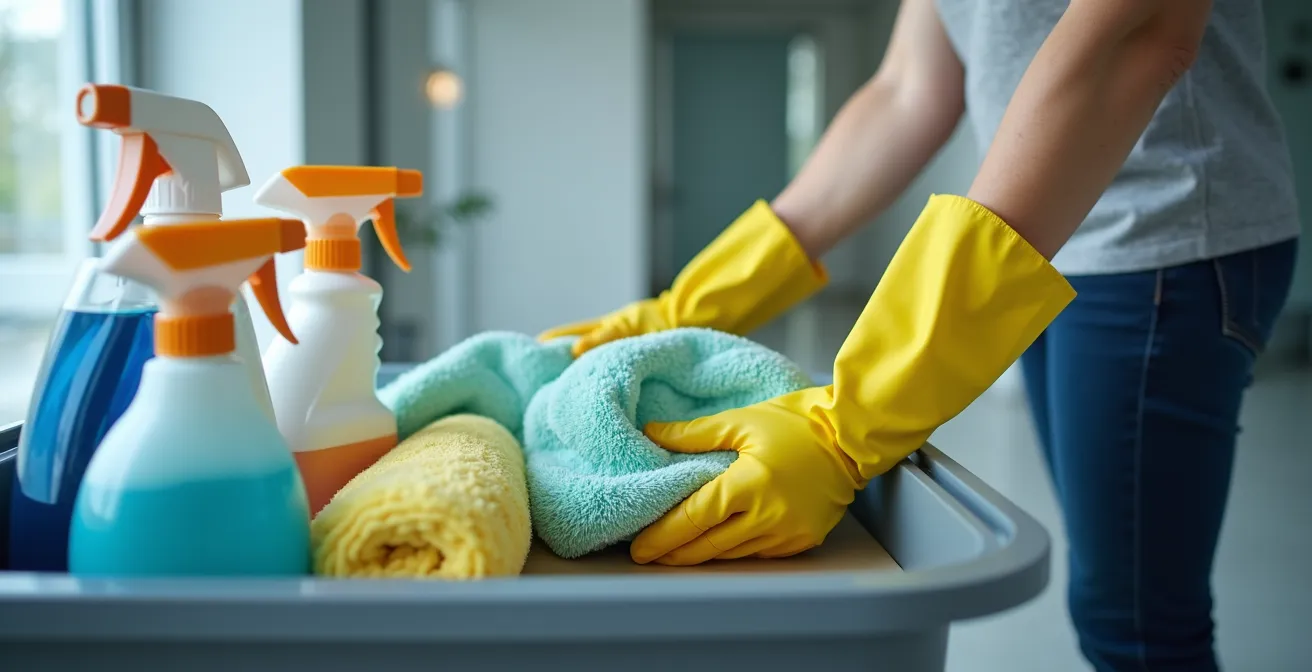
In Quebec, this system requires a specialized adaptation for winter. Leading facilities in cities like Montreal have developed modular cart systems with dedicated winter compartments. These hold salt removers, extra absorbent mats, and specialized floor tools needed to tackle slush and calcium chloride residue at entry points. One case study noted this optimization reduced trips to the janitor’s closet by 40% during peak winter months. With floor care representing a massive part of the workload, this hyper-specific organization is not a minor tweak; it’s a strategic response to a major operational challenge.
The “Too Many Steps” Mistake That Causes Staff to Cut Corners
When a checklist is too long, complex, or illogical, human nature takes over: staff will find shortcuts. This isn’t laziness; it’s a rational response to an inefficient process. If a checklist demands ten steps to clean a simple washroom, but staff know they can get a visually acceptable result in six, they will eventually skip the four “unnecessary” steps. The problem isn’t the staff; it’s the checklist. This is a classic symptom of a process that hasn’t been optimized through the lens of Lean Management.
The solution is to apply the 5S methodology directly to the checklist’s design. This Japanese framework for workplace organization is perfectly suited for streamlining cleaning processes and eliminating the waste of “excess motion” and “over-processing.” By systematically analyzing each task, you can build a shorter, smarter, and more effective checklist that staff will actually follow.
The 5S principles provide a clear roadmap for this optimization:
- Sort (Supprimer): Eliminate redundant or valueless steps. For example, instead of separate “spray surface” and “wipe surface” instructions, combine them into a single step: “Wipe surface with a pre-dampened microfiber cloth.”
- Set in Order (Situer): Sequence tasks to follow a natural physical path through the space (e.g., top to bottom, clockwise) to prevent backtracking.
- Shine (Scintiller): Focus the checklist on tasks that deliver immediate, visible results. This builds momentum and job satisfaction.
- Standardize (Standardiser): Use clear, consistent, bilingual action verbs for every task across all checklists (e.g., “Wipe,” “Scrub,” “Polish”). This removes ambiguity.
- Sustain (Suivre): Regularly review the process. A/B test different checklist versions and use time tracking to see which is faster and more effective, fostering a culture of continuous improvement.
By building your checklist on this foundation, you create a process that is not only efficient but also logical and easier to perform, which dramatically increases adherence and quality.
Digital Inspection Apps vs Paper Checklists: Which Improves Accountability?
For decades, the paper checklist has been the primary tool for managing cleaning tasks. While simple, it has fundamental flaws in a modern, data-driven operation. Paper-based systems are reactive; issues are only discovered at the end of a shift, if they’re reported at all. Time tracking is manual and prone to error, and there is no objective way to verify task completion. This lack of real-time data and accountability makes it difficult to manage quality, justify overtime, or comply with regulations.
Digital inspection applications represent a paradigm shift from task management to quality assurance. Using a smartphone or tablet, cleaners can check off tasks with an automatic timestamp. More importantly, they can instantly document issues with time-stamped, geotagged photos and send alerts to supervisors. This transforms accountability. A missed task is no longer an oversight; it’s a data point that can be addressed immediately. As noted by industry software experts, this technology is about holistic management. According to Aspire Software, a leading provider in the space:
Aspire lets you manage your entire business from one cloud-based platform. Its mobile functionality enables accurate time tracking and ensures your team completes on-site cleaning checklists and audits properly
– Aspire Software, Commercial Cleaning Business Software Guide
For a supervisor in Quebec, the advantages are even more pronounced, particularly regarding compliance. The automatic time tracking simplifies adherence to Normes du travail for calculating overtime. Instant photo-documentation provides robust evidence for CNESST incident reporting. And critically, choosing a platform that is PIPEDA (Personal Information Protection and Electronic Documents Act) compliant is non-negotiable to protect data privacy. The ability to toggle between French and English interfaces also removes communication barriers for a diverse workforce.
While paper has a lower upfront cost, digital apps provide a clear return on investment through reduced overtime claims, improved quality, and bulletproof compliance documentation. The table below outlines the key differences for a Quebec-based business.
| Feature | Digital Inspection Apps | Paper Checklists | Quebec Compliance Impact |
|---|---|---|---|
| Real-time Reporting | Instant photo-tagged issue alerts to managers | End-of-shift reporting only | Faster CNESST incident documentation |
| Time Tracking | Automatic timestamps for overtime calculation | Manual time entry prone to errors | Simplified Normes du travail compliance |
| Data Privacy | Must be PIPEDA-compliant | Physical security concerns | Critical for Canadian legal requirements |
| Multilingual Support | Easy French/English toggle | Separate forms needed | Essential for Quebec’s bilingual workforce |
| Cost | $20-50/user monthly | $5-10 monthly supplies | ROI through reduced overtime claims |
Key Takeaways
- Systemic waste, especially backtracking and rework, is the primary driver of cleaning staff overtime, not individual performance.
- Applying Lean principles like 5S and Zone Cleaning to your checklists eliminates non-value-added steps and creates a more efficient, logical workflow.
- Data-driven decisions—from choosing microfiber over feather dusters to using digital inspection apps—are essential for improving accountability, ensuring quality, and proving ROI.
How Does Certified Hygiene Impact Employee Absenteeism Rates in Open Plan Offices?
An efficient cleaning system does more than just save time and money; it creates a healthier building. For the business you service, this translates into a direct and measurable financial benefit: reduced employee absenteeism. In open-plan offices, where viruses and bacteria can spread rapidly, a certified, consistent hygiene program is a frontline defense. It’s not just about looking clean; it’s about measurably reducing the presence of pathogens on high-touch surfaces like doorknobs, elevator buttons, and shared kitchen equipment.
The link between professional cleaning and employee health is well-documented. Research published in the American Journal of Infection Control has shown that a structured hygiene intervention in offices can achieve a significant reduction in sick days and surface contamination. By focusing your prioritized cleaning plan on these critical vector points, your team is actively interrupting the chain of transmission. This transforms the perception of your cleaning service from a simple cost center into a strategic partner in employee wellness and productivity.
This growing awareness is reshaping the commercial cleaning market in Canada. Businesses are no longer just buying a service; they are investing in health outcomes. The Canadian cleaning services market reached USD 1.42 billion in 2024, driven by a heightened focus on hygiene and employee well-being. In major hubs like Montreal and Toronto, office towers are increasingly requiring hygiene certifications and locking in long-term contracts with providers who can demonstrate a tangible impact on health. As a supervisor, communicating this value—that your efficient, well-designed system directly contributes to a healthier, more productive workforce—is your most powerful sales and retention tool.
By shifting your focus from managing tasks to engineering efficient systems, you can break the cycle of overtime and reactive problem-solving. Start by applying these Lean principles to one small area of your operation, measure the results, and build from there. Your journey toward a 15% reduction in overtime begins with the first step of waste you eliminate from the process.