
Restaurateurs and food producers in Quebec face hefty MAPAQ fines not from malice, but from common, misunderstood details about sanitization. Believing you are compliant while making critical errors in dilution, temperature, or testing is a costly risk. This guide moves beyond the label instructions to explain the critical nuances—like chemical volatility, residual films, and procedural drift—that inspectors target, turning compliance from a guessing game into a science to protect both your customers and your business.
As a food business operator in Quebec, your greatest fear isn’t just an empty dining room. It’s the subtle, soapy aftertaste in a signature dish that leads to a one-star review, or worse, the unexpected arrival of a MAPAQ inspector who finds a critical violation. You believe your team is doing everything right: you buy the approved chemicals, you tell them to clean the surfaces, and you hope for the best. The common wisdom is to “follow the label,” but this advice dangerously oversimplifies the reality of food safety.
The truth is, compliance is not about following instructions; it’s about understanding the underlying science. The difference between a passing grade and a multi-thousand-dollar fine often lies in details that are never printed on the bottle. It’s about the chemistry that makes a sanitizer effective or inert, the “procedural drift” that degrades your team’s practices over time, and the micro-environments in your own facility that can breed contamination from the ceiling down.
But what if the key to bulletproof compliance wasn’t in working harder, but in understanding these hidden failure points? This guide is not another generic checklist. It is an inspector’s-eye view of sanitization. We will dissect the most common yet overlooked mistakes that lead to violations, from the chemical reactions happening in your sink to the documentation integrity an inspector demands. We will provide the framework to transform your sanitation protocol from a routine chore into a verifiable, scientific process that guarantees food safety and satisfies MAPAQ’s stringent requirements.
This article will provide a detailed breakdown of the critical areas MAPAQ inspectors focus on, giving you the knowledge to build a truly resilient food safety program. Explore the topics below to master each aspect of sanitization compliance.
Summary: Mastering Food-Safe Sanitizer Compliance in Quebec
- Why Does Improper Rinsing of Sanitizers Cause Food Tasting Issues?
- How to Use Quat Test Strips Correctly to Avoid Health Code Violations?
- No-Rinse vs Rinse-Required Sanitizers: Which Is Best for Busy Prep Tables?
- The Hot Water Mistake That Evaporates Chlorine Before It Sanitizes
- How to Store Cleaning Chemicals Away from Food to Meet Safety Standards?
- Chemical Etching vs Anti-Slip Coatings: Which Is Safer for Commercial Kitchens?
- Why Does Ceiling Condensation Become a Food Safety Hazard in Factories?
- Passing the Hygiene Inspection: The Top 5 Violations Inspectors Look For in Quebec?
Why Does Improper Rinsing of Sanitizers Cause Food Tasting Issues?
The most immediate sign of a sanitization error is not a failed inspection, but a customer complaint about a “chemical” or “bitter” taste. This is often caused by a residual film left by quaternary ammonium compounds (Quats), a common and effective type of sanitizer. While many Quat-based products are marketed as “no-rinse,” this classification comes with critical caveats. If the sanitizer is mixed too strong, it leaves behind a higher concentration of chemicals that can bind to surfaces and later transfer to food, altering its flavor profile. This is especially true for delicate items and acidic foods.
To prevent this, precision in dilution is non-negotiable. The standard isn’t a “glug” from the bottle; it’s a measured dose. For instance, according to MAPAQ’s official hygiene guidelines, a typical ratio is 2 ml of sanitizer per liter of water to achieve the correct concentration. Anything more creates a risk of both taste issues and a technical violation. Even at the correct dilution, a rinse may be required in specific situations to guarantee food integrity. The “no-rinse” rule assumes correct application and concentration; when in doubt, especially with certain food types, a final potable water rinse is your safest bet.
You must be particularly vigilant with certain surfaces and equipment where residual film is more likely to cause issues. An inspector will look closely at these areas. Always rinse after sanitizing in the following scenarios:
- Surfaces that will be in direct contact with highly acidic foods, such as tomato-based sauces or citrus preparations.
- Porous surfaces like wooden cutting boards, which can absorb and then leach chemicals.
- Equipment used for food tasting, such as spoons or quality control instruments.
- Glassware, where even a minute residual film can create a bitter aftertaste in beverages.
- Any food contact surface exposed to a quaternary ammonium solution for more than 60 seconds, as this increases the likelihood of chemical binding.
How to Use Quat Test Strips Correctly to Avoid Health Code Violations?
Maintaining the correct sanitizer concentration is a cornerstone of MAPAQ compliance, but telling an inspector “we follow the directions” is insufficient. You must provide proof. This is the role of quaternary ammonium (Quat) test strips. However, simply dipping a strip in the solution is not enough; improper testing technique is a frequent source of violations, leading to false readings that give a dangerous sense of security. As one Montreal case demonstrates, hygiene violations are taken extremely seriously.
Case Study: Montreal Restaurant’s Costly Lesson
In a stark reminder of the financial consequences, Ram Sweet Shop in Montreal faced $26,300 in fines for a series of hygiene violations documented during 2024 inspections. The infractions, including improper sanitation procedures, resulted in severe penalties, illustrating MAPAQ’s zero-tolerance policy for failures in this critical area.
To avoid this fate, your team must treat the testing process with scientific rigor. Procedural drift—where staff develop small, incorrect habits over time—is your biggest enemy. This is where precise training and supervision are paramount. The color change on the strip is a chemical reaction that is sensitive to time, temperature, and storage conditions.
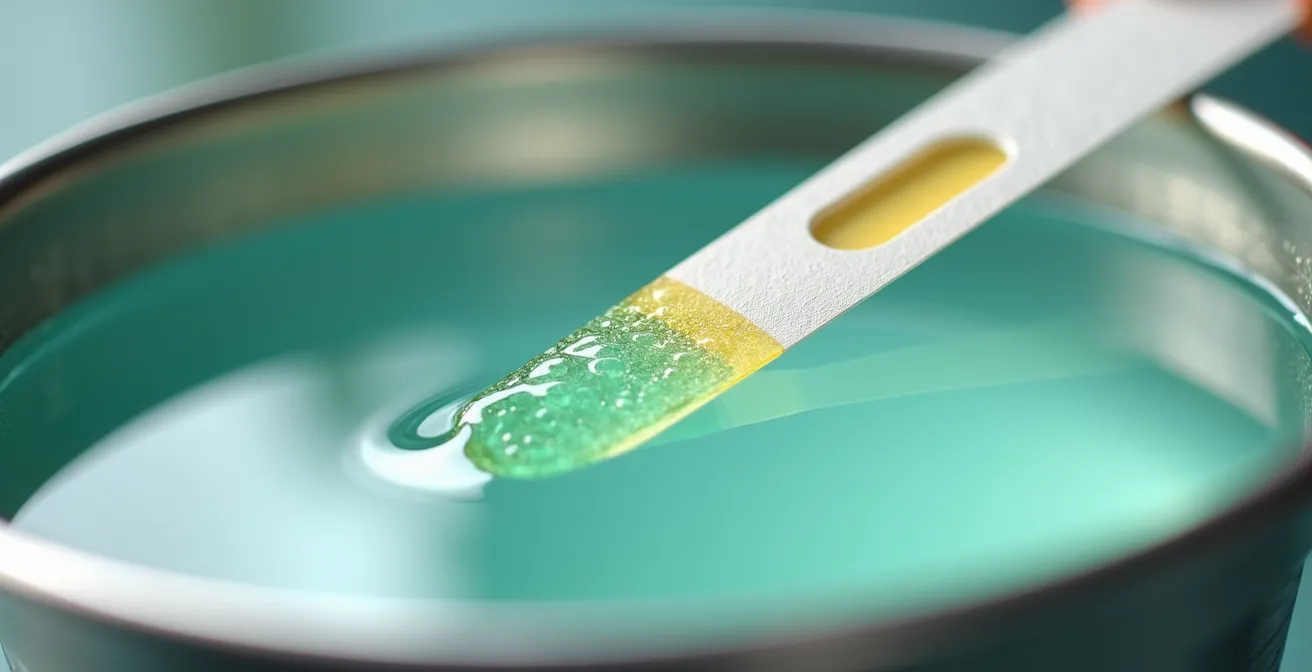
The image above captures the crucial moment of the chemical reaction. Achieving this correct reading requires eliminating common errors. The table below outlines the most frequent mistakes inspectors see and the correct procedures you must enforce.
| Common Mistake | Consequence | Correct Procedure |
|---|---|---|
| Testing with hot water (>30°C) | False low readings | Use room temperature water (20-25°C) |
| Not waiting full time before reading | Inaccurate concentration reading | Wait exactly 10 seconds (or as specified) |
| Storing strips above sink/humid areas | Strips degrade, give false readings | Store in cool, dry location in sealed container |
| Using expired test strips | MAPAQ violation risk | Check expiry monthly, replace as needed |
No-Rinse vs Rinse-Required Sanitizers: Which Is Best for Busy Prep Tables?
In the high-pressure environment of a commercial kitchen, every second counts. This makes “no-rinse” sanitizers, typically Quat-based, seem like the obvious choice for high-turnover areas like prep tables. Their primary advantage is workflow efficiency; by eliminating the final rinse step, staff can return surfaces to service faster. This is possible because quaternary ammonium sanitizers require at least a 10-second contact time to be effective, after which they can be left to air dry, providing a lasting antimicrobial barrier.
However, rinse-required sanitizers, most commonly chlorine-based (bleach), still hold a crucial place in a comprehensive sanitation plan. They are often more economical and highly effective for specific applications like commercial dish machines, where the rinse cycle is already built into the process. The decision is not about which is universally “better,” but which is strategically applied. For a busy prep line handling various ingredients, a no-rinse Quat solution saves critical labor time. For end-of-day deep cleaning of non-porous equipment, a more potent, rinse-required chlorine solution might be more appropriate.
Your choice must be documented in your food safety plan and understood by all staff. An inspector will verify not only that you are using an approved product, but that you are using the *right product for the right task* and following the specific procedure it requires. The following table breaks down the key factors to consider for your Quebec-based operation.
| Factor | No-Rinse Sanitizers (Quats) | Rinse-Required (Chlorine) |
|---|---|---|
| Cost per liter | Higher initial cost | Lower cost |
| Labor time saved | Significant (approx. 30 seconds per surface) | Requires additional rinse step |
| Effectiveness duration | Stable residual activity | Loses potency quickly (approx. 15 mins) |
| Best for | High-turnover prep areas, cutting boards | Dish machines, soaking, general disinfection |
| MAPAQ compliance | Approved when used at proper concentration | Approved, but rinsing is mandatory |
The Hot Water Mistake That Evaporates Chlorine Before It Sanitizes
One of the most counter-intuitive yet critical errors in sanitation involves water temperature. Many staff members instinctively believe “hotter is cleaner.” When it comes to chlorine-based sanitizers, this assumption is not just wrong—it’s dangerous. Chlorine is a volatile chemical. When mixed with hot water, it rapidly “gasses off,” or evaporates into the air. This means the concentration of active sanitizer in your solution plummets, rendering it ineffective long before it touches a surface. You are left with a bucket of hot water that offers a false sense of security.
MAPAQ regulations are very specific about this. While hot water is required for the final sanitizing rinse in a three-compartment sink or dish machine (typically at or above 77°C), the water used for *mixing* the chemical sanitizer solution itself must be at room temperature. The official MAPAQ guidelines specify using water around 24°C for mixing chlorine solutions to ensure their stability and efficacy. This principle of chemical volatility is a key concept inspectors expect you to understand and implement.
Furthermore, the instability of chlorine solutions is not just about temperature. They have a very short active life. As experts in sanitation confirm, this is a major operational challenge. According to American Sanitary Supply Co. in their guide on sanitizing solutions:
Chlorine-based sanitizers lose their potency quickly. In as little as 15 minutes after the solution is mixed, it may drop to below the limits required by the health department.
– American Sanitary Supply Co., Best and Safest Sanitizing Solutions for a Commercial Kitchen
This means chlorine solutions must be mixed in small batches, tested frequently, and replaced often throughout a shift. Using a large bucket mixed in the morning is a guaranteed violation by lunchtime. Your protocol must account for this rapid degradation.
How to Store Cleaning Chemicals Away from Food to Meet Safety Standards?
The risk of chemical contamination is one of the most severe food safety hazards. A single drop of sanitizer or degreaser falling onto a prep surface or into a container of ingredients can have dire consequences. For this reason, MAPAQ has strict, non-negotiable rules about the physical separation of cleaning chemicals from food, food-contact surfaces, and packaging materials. The guiding principle is simple: chemicals are always stored below food, never beside or above. This vertical hierarchy prevents accidental drips or spills from causing a contamination event.
A designated, well-organized, and secure storage area is not a recommendation; it is a requirement. This area should ideally be separate from food storage and preparation zones, and concentrated chemicals should be kept in a locked cabinet. All containers, especially secondary containers (like spray bottles) filled from a larger concentrate, must be clearly labeled. In Quebec, this means bilingual labeling (French and English) is required to ensure all employees can identify the contents and associated hazards. The consequences of failing to adhere to these storage protocols are significant, as shown by a recent case involving a major brand.
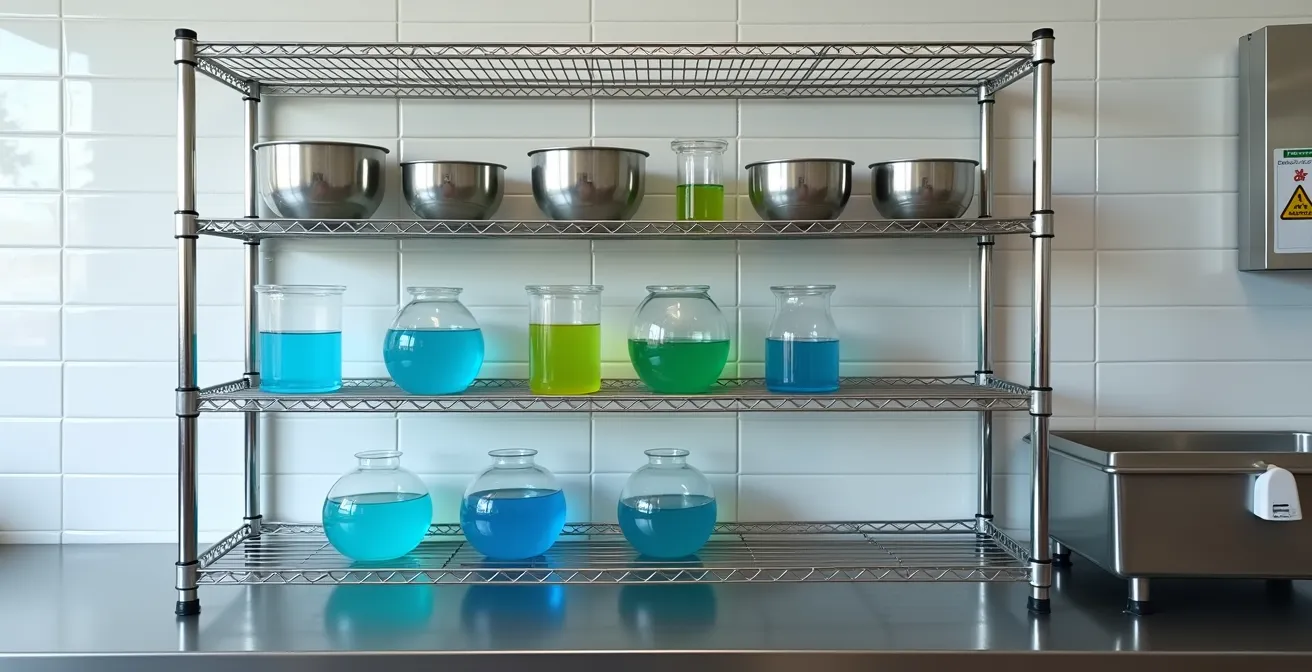
A Tim Hortons in Montreal was fined $6,000 for violations that included improper storage leading to contamination risks. This case underscores that inspectors will scrutinize your storage practices, looking for any potential for cross-contamination. Your storage must be designed to be foolproof. Here is a hierarchy of storage rules you must implement to meet MAPAQ standards:
- Store all chemicals on the lowest shelves, and never on shelves above food, food prep equipment, or single-use items like napkins and containers.
- Label all secondary containers accurately in both French and English, as is mandatory in Quebec. The label should identify the chemical and its primary hazards.
- Maintain a separate, and preferably locked, storage area for all concentrated chemicals to prevent unauthorized or improper use.
- Keep Safety Data Sheets (SDS), or Fiches de Données de Sécurité (FDS) in French, readily accessible for every chemical on-site, also in both official languages.
- Install physical barriers like drip trays under chemical storage shelves to contain any potential leaks and prevent them from reaching the floor or lower areas.
Chemical Etching vs Anti-Slip Coatings: Which Is Safer for Commercial Kitchens?
An often-overlooked aspect of facility hygiene is the floor itself. A safe floor in a commercial kitchen must satisfy two competing demands: it must be non-slip to comply with CNESST worker safety standards, and it must be smooth and non-porous enough to be easily and effectively sanitized, a MAPAQ requirement. Choosing the right anti-slip treatment is a critical decision that balances these two needs.
Two common solutions are anti-slip coatings and chemical etching. Coatings are epoxy-like layers applied to the floor surface, often containing aggregates for texture. While they provide excellent initial slip resistance, they can wear down over time, especially in high-traffic areas. More importantly from a sanitation perspective, as they wear, they can develop micro-cracks and pores that harbor bacteria, making them difficult to clean and sanitize completely. This can become a hidden reservoir of contamination.
Chemical etching, by contrast, is a treatment that permanently alters the floor’s surface, creating a microscopic, textured tread. It doesn’t add a layer but rather subtracts from the existing tile or concrete. This micro-texture provides durable, long-lasting slip resistance without creating pores that trap dirt and bacteria. It is generally easier to clean and sanitize than a textured coating. While the initial cost may be higher, its longevity and superior sanitizability often make it the safer long-term choice for satisfying both CNESST and MAPAQ regulations. An inspector will assess not just the slip resistance, but the cleanability of your flooring choice.
Why Does Ceiling Condensation Become a Food Safety Hazard in Factories?
In a food processing facility, hazards can come from above. Ceiling condensation, a common issue especially in climates like Quebec’s, is a serious food safety threat. The problem occurs when warm, moist air inside the facility comes into contact with a cold ceiling surface, often cooled by the outside temperature. This is particularly prevalent when in Quebec’s winter climate, facilities experience temperature differences of 20°C or more between the interior and exterior. Water droplets form, and this is where the danger begins.
These droplets are not pure water. They can collect airborne particles, including dust, mold spores, and bacteria, creating a contaminated cocktail. When this condensation drips onto food products, packaging, or food-contact surfaces below, it becomes a direct vector for micro-environment contamination. An inspector will look up as well as down; signs of water staining, mold growth, or active dripping from ceilings or overhead pipes are major red flags that can lead to immediate action and significant penalties, as a Montreal bakery discovered.
A European bakery in the city was hit with over $13,000 in fines for violations that included contamination from environmental sources. Inspectors linked unclean equipment and contaminated products back to poor environmental controls within the facility, demonstrating how issues like ceiling condensation can directly lead to product contamination and costly fines. Preventing this requires a multi-pronged approach: improving ventilation to reduce humidity, ensuring proper insulation to keep ceiling surfaces warm, and implementing a regular cleaning and inspection schedule for all overhead structures. Your sanitation plan must extend vertically to the entire production environment.
Key Takeaways
- MAPAQ compliance is not just about cleaning; it’s about mastering the science of sanitization, including dilution, temperature, and contact time.
- Documentation is non-negotiable. Using test strips and logging temperatures is not optional; it is the required proof of your due diligence.
- Violations often stem from “procedural drift” and common-sense errors, like using hot water for chlorine or storing chemicals above food. Constant training is the only solution.
Passing the Hygiene Inspection: The Top 5 Violations Inspectors Look For in Quebec?
When a MAPAQ inspector walks through your door, they are operating from a framework of risk assessment. They focus on the critical control points where failures are most likely to lead to foodborne illness. While they will assess your entire operation, their attention will be sharply focused on a handful of the most common and most dangerous violations. Understanding this “top 5” list is the key to preparing for and passing your inspection. Recent enforcement data shows the financial stakes are high, with recent MAPAQ enforcement data shows fines ranging from $3,000 to $5,000 per violation for serious infractions.
The inspection is a formal audit of your systems. As the Canadian Institute of Food Safety notes, you must be prepared for this process. They state clearly:
Inspectors will request to see Food Handler Certificates and your Food Safety Plan. Be prepared for Inspectors to visit your business before its opening and then every four to six months after.
– Canadian Institute of Food Safety, Quebec Food Safety Laws and Requirements
This underscores that compliance is a continuous process, not a one-time event. To ensure you are always prepared, your internal audits should focus on the same areas an inspector will. The following checklist details the most frequent violations seen in Quebec establishments.
Your Pre-Inspection Audit Checklist: The 5 Critical Points
- Sanitizer & Temperature Control: Verify sanitizer concentrations with test strips and log the results. Check and log all refrigerator and freezer temperatures. Are your logs current and accurate?
- Cross-Contamination Prevention: Audit your kitchen flow. Are separate cutting boards and utensils used for raw and ready-to-eat foods? Are cleaning cloths used appropriately and sanitized between tasks?
- Personal Hygiene Stations: Check all handwashing sinks. Are they fully stocked with soap, paper towels, and hot water? Are they unobstructed and used regularly by staff?
- Pest Control Evidence: Conduct a thorough search for any signs of pests. Look for droppings, gnaw marks, or insects in storage areas, under equipment, and along walls. Is your pest control log up to date?
- Documentation Integrity: Gather your Food Safety Plan, staff training certificates (Food Handler), and all temperature/sanitizer logs. Are they complete, accurate, and readily available for review?
Ultimately, achieving and maintaining MAPAQ compliance is not a matter of luck or simply “being clean.” It is the result of a deliberate, system-wide culture of precision. It requires understanding the science behind the rules, providing your team with rigorous and continuous training, and implementing a system of verification and documentation that proves your diligence. The true goal is not just to pass an inspection, but to operate with the unwavering confidence that you are protecting the public and your business’s reputation every single day. The next logical step is to formalize these practices into your daily operations. Implement a mandatory, documented pre-shift audit using the checklist above to make compliance an active, continuous process rather than a reaction to an inspection.
Frequently Asked Questions about Facility Safety in Quebec
Can a slippery floor trigger a MAPAQ inspection?
Yes. If a workplace accident occurs due to a slippery floor and the CNESST investigates, they will often coordinate with MAPAQ for a concurrent inspection of the entire facility’s hygiene and safety practices.
What coefficient of friction is required for commercial kitchen floors?
While there isn’t a single mandated number, the CNESST strongly recommends a minimum static coefficient of friction of 0.5 for wet areas in commercial kitchens to be considered acceptably slip-resistant and prevent workplace accidents.
How often should anti-slip treatments be tested?
It is best practice to have the slip resistance of your floors professionally tested annually. This documentation should be kept on file and made available during both CNESST and MAPAQ inspections to demonstrate ongoing due diligence in maintaining a safe environment.