
A Drug Identification Number (DIN) isn’t just a label; it’s your business’s license to operate safely and legally within Quebec’s strict regulatory environment.
- US-based products with only an EPA registration are not automatically legal for commercial use in Quebec and can be seized at the border.
- Maintaining an updated, bilingual Safety Data Sheet (SDS/FDS) system is as critical as the DIN itself for CNESST compliance.
Recommendation: Shift from simple product purchasing to a comprehensive compliance strategy that includes active DIN verification, rigorous SDS management, and thorough supplier vetting.
For any Quebec business that uses cleaning and sanitizing products, the eight-digit Drug Identification Number (DIN) on a label feels like a simple seal of approval. The common wisdom is clear: if a product has a DIN, it’s been approved by Health Canada and is safe to use. While true on the surface, this view dangerously oversimplifies the reality of regulatory compliance. Viewing the DIN as a mere checkbox is an operational blind spot that exposes your business to significant risk, from costly product recalls and customs seizures to serious sanctions from the CNESST.
The DIN is not a one-time pass. It is the cornerstone of a complex compliance ecosystem. This ecosystem involves not only the product’s initial approval but also its ongoing market status, the accuracy of its label claims, and the rigorous documentation required to support its use in a professional setting. For a Quebec-based buyer, navigating this system means understanding the critical differences between Canadian and US regulations, mastering the tools for verification, and implementing robust internal processes for managing Safety Data Sheets (SDS), especially concerning French language requirements.
This guide moves beyond the basic “look for the DIN” advice. As a regulatory consultant, my goal is to illuminate the hidden complexities and provide a strategic framework for Quebec businesses. We will deconstruct what Health Canada’s approval truly guarantees, explore the tools to verify these guarantees, and outline the practical steps to build a resilient, CNESST-ready compliance program. The focus is on risk mitigation and turning regulatory obligations into a competitive advantage.
To navigate the intricacies of product compliance in Quebec, it’s essential to understand each component of this regulatory framework. The following sections break down the critical areas of concern, from product verification and cross-border purchasing to data management and correct application.
Summary: Health Canada Approved: What Does the DIN Number Actually Guarantee About a Product?
- Why Are Some “Natural” Disinfectants Recalled by Health Canada?
- How to Use the Drug Product Database (DPD) to Verify Product Claims?
- EPA Registered vs Health Canada DIN: Can You Use US Products Legally in Quebec?
- The Cross-Border Purchase Mistake That Could Seize Your Cleaning Supplies at Customs
- How to maintain an Updated SDS Binder That Matches Your DIN Inventory?
- EcoLogo vs Green Seal: Which Certification Matters Most for Quebec Businesses?
- How to Organize Safety Data Sheets (SDS) Digitally for Instant Access?
- Choosing the Right DIN Disinfectant: How to Match the Product to the Pathogen?
Why Are Some “Natural” Disinfectants Recalled by Health Canada?
The term “natural” on a disinfectant label can be misleading. It often implies safety and purity, but in the context of regulated products, it has no official standing. A DIN guarantees one thing above all: that the product’s formulation and efficacy claims have been reviewed and validated by Health Canada. When a product is marketed as “natural” but contains undeclared active ingredients or fails to meet its sanitizing claims, it breaks this fundamental trust. This discrepancy is a primary reason for recalls, and multiple sanitizing products have been recalled for precisely these issues, such as missing disinfectant ingredients.
This issue highlights a critical aspect of the compliance ecosystem: transparency. The DIN process is designed to ensure what’s on the label is in the bottle. A stark example is the case of All Clean Ultra Disinfectant Wipes, which were recalled in Canada. The product was found to contain undeclared ingredients, including Quaternary ammonium compounds and Isopropyl alcohol. This situation demonstrates how products with a “natural” marketing angle can fail to meet the strict transparency and formulation requirements mandated by Health Canada, leading to regulatory action and removal from the market.
The visual appeal of a “green” or “natural” product can mask underlying compliance failures. It’s a reminder that a product’s marketing is secondary to its regulatory status.
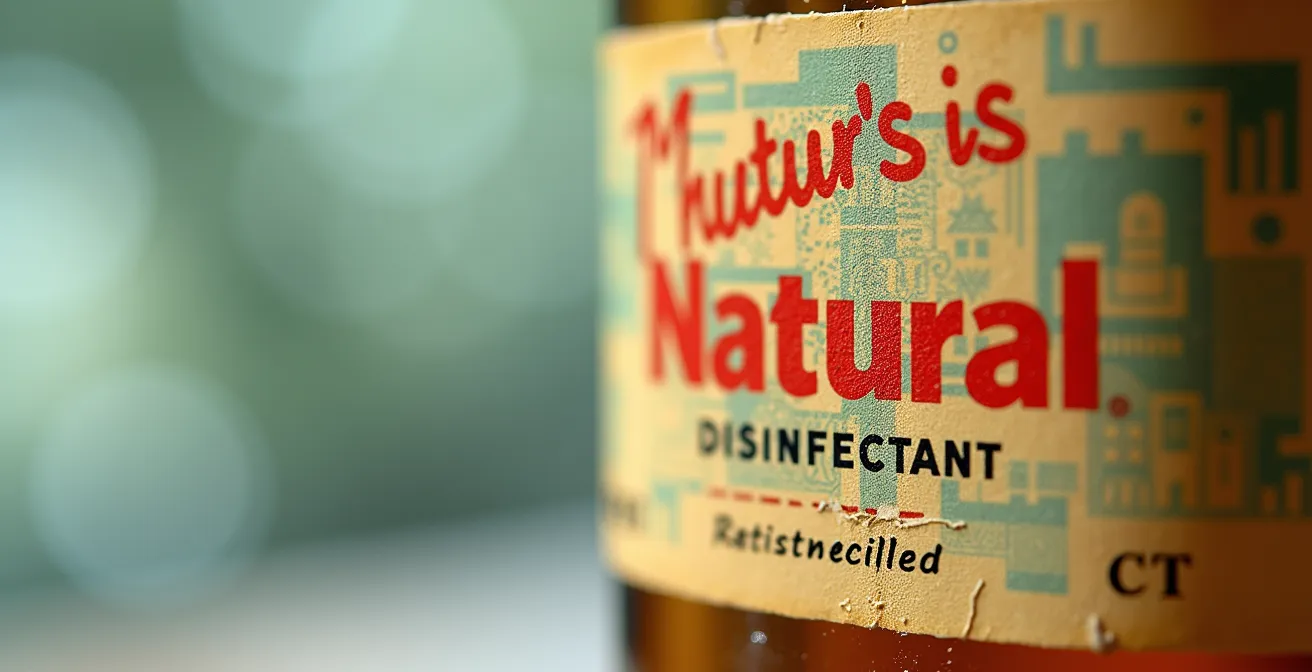
As this image suggests, a closer inspection often reveals imperfections. For a business, this means the procurement process must rely on verifiable data, not marketing claims. The presence of a DIN is the starting point, but its active status and the integrity of the product’s declared formula are what truly matter. Relying on superficial labels without verification is a direct path to compliance risk.
How to Use the Drug Product Database (DPD) to Verify Product Claims?
The Health Canada Drug Product Database (DPD), or Base de données sur les produits pharmaceutiques (BDPP) in French, is the single source of truth for verifying any disinfectant’s legal status in Canada. It’s not just a list; it’s a dynamic tool that provides critical information about a product’s entire lifecycle. Using this database effectively is a non-negotiable skill for any professional responsible for purchasing or managing chemical supplies in Quebec. The process involves more than just finding a DIN; it’s about interpreting the product’s current status.
A product’s status in the DPD directly impacts its legality for sale and use. A “Marketed” status confirms the product is currently approved and legal. However, statuses like “Cancelled Post-Market” or “Dormant” mean the product is no longer approved. Using a “Cancelled” product, even if you still have it in inventory, puts your business in a state of non-compliance during a CNESST inspection. This is a common operational blind spot where businesses assume that because they purchased a product legally, it remains legal indefinitely. Regular verification is the only way to close this gap.
This table translates the abstract DPD statuses into concrete compliance implications for your Quebec operations, as outlined by Health Canada’s disinfectant drug guidance.
| DIN Status | Legal for Sale in Quebec | CNESST Compliance | Action Required |
|---|---|---|---|
| Marketed | Yes | Compliant | None – continue use |
| Cancelled Post-Market | No | Non-compliant | Immediately remove from inventory |
| Dormant | No | Non-compliant | Replace with approved alternative |
| Not Found | No | Non-compliant | Product lacks DIN – illegal for commercial use |
To ensure your inventory is always compliant and ready for a CNESST audit, integrating a verification workflow into your procurement and safety procedures is essential.
Your Action Plan: DIN Verification Audit Workflow
- Access the Health Canada Drug Product Database (DPD) online portal.
- Search for the 8-digit DIN number found on your product label.
- Verify the ‘Status’ field shows ‘Marketed’ – avoid products showing ‘Cancelled Post-Market’.
- Download and archive the DPD verification for your CNESST compliance records.
- Ensure a French-language Safety Data Sheet (SDS/FDS) is available, as required by Quebec law.
EPA Registered vs Health Canada DIN: Can You Use US Products Legally in Quebec?
This is one of the most common and costly mistakes made by Canadian businesses: assuming that a disinfectant registered with the U.S. Environmental Protection Agency (EPA) is automatically legal for use in Canada. This is fundamentally incorrect. The two regulatory systems are entirely separate. An EPA registration number holds no legal standing in Canada. For a disinfectant to be legally sold and used commercially in Quebec, it must undergo a specific Canadian assessment.
As Health Canada’s official guidance clearly states, “Disinfectant drugs require a pre-market assessment and assignment of a drug identification number (DIN) prior to being sold in Canada.” This is a non-negotiable requirement. There is no equivalency agreement for disinfectants that allows an EPA number to substitute for a DIN. Importing and using a product without a valid DIN is not just a paperwork error; it is the use of an unauthorized drug product, which carries significant legal and safety implications.
The consequences of this mistake are particularly severe in Quebec, where the CNESST enforces strict workplace safety regulations. Using unapproved disinfectants can be viewed as a failure to provide a safe working environment, a critical issue given the over 80,000 workplace injuries reported in Quebec in 2020. This statistic highlights the intense focus on safety compliance. In the event of an inspection or a workplace incident, the use of a non-DIN product could lead to fines, stop-work orders, and increased liability for your business. The risk far outweighs any potential cost savings from sourcing U.S. products.
The Cross-Border Purchase Mistake That Could Seize Your Cleaning Supplies at Customs
Building on the distinction between EPA and DIN registration, the physical act of importing U.S.-based disinfectants creates immediate financial risk exposure at the border. When a Quebec business orders products from a U.S. website, it automatically becomes the importer of record. This legal designation means your business, not the U.S. seller, is fully responsible for ensuring the goods meet all Canadian regulations upon entry. This includes having a valid DIN.
The Canada Border Services Agency (CBSA) is mandated to enforce Health Canada’s regulations at all points of entry, including the busy Lacolle crossing in Quebec. Shipments of commercial goods, including cleaning supplies, are subject to inspection. If a CBSA officer inspects a shipment of disinfectants and finds they lack a valid DIN searchable in the DPD, the agency is authorized to seize the entire shipment. This is not a warning or a fine; it is the confiscation of your property. The financial loss is total: you lose the money spent on the products, the shipping costs, and you must then rush-order compliant replacements from a Canadian supplier, often at a premium.
This scenario illustrates the direct financial consequence of overlooking the “DIN-only” rule. A simple online purchase can quickly turn into a significant financial write-off and an operational disruption.

The only way to mitigate this risk is to shift procurement policies. Sourcing from reputable Canadian suppliers who pre-verify the DIN status of their inventory eliminates the risk of border seizures. Before placing any order with a U.S.-based supplier, a mandatory DIN verification through the DPD must be the first step. Furthermore, businesses must ensure any imported product meets Canadian bilingual labeling and WHMIS/SIMDUT requirements, adding another layer of complexity to cross-border purchasing.
How to maintain an Updated SDS Binder That Matches Your DIN Inventory?
Achieving compliance doesn’t end once a DIN-approved product is on your shelf. In Quebec, the CNESST places enormous emphasis on the accessibility and accuracy of Safety Data Sheets (SDS), known as Fiches de Données de Sécurité (FDS) in French. Your SDS management system must be a living part of your compliance ecosystem, perfectly synchronized with your physical inventory. A binder full of outdated or incorrect SDS is just as much a violation as using a non-DIN product.
The core challenge is maintenance. A product’s formulation can change, or more critically, its DIN status can be cancelled. When a DIN is moved to “Cancelled Post-Market” in the DPD, two actions are required immediately: the physical product must be removed from use, and its corresponding SDS must be removed from your active binder. Keeping an SDS for a banned product creates confusion and risk. A CNESST inspector expects to see a one-to-one match between the chemicals in your janitor’s closet and the documents in your binder. Any discrepancy is a red flag.
Choosing the right system to manage this is crucial for Quebec businesses. While traditional physical binders are still acceptable, digital and hybrid systems offer superior efficiency for tracking updates and ensuring accessibility, a key requirement during inspections.
| System Type | CNESST Compliance | Best For | Key Requirements |
|---|---|---|---|
| Digital Cloud-Based | Compliant if accessible in 60 seconds | Multi-site operations | French interface, offline backup, mobile access |
| Physical Binders | Traditional compliance method | Small single-location shops | French documents, organized by DIN, quarterly updates |
| Hybrid QR Code System | Modern compliance solution | Multilingual workforce | QR codes link to French/English SDS, laminated quick sheets |
Regardless of the system chosen, a quarterly audit is a best practice. This involves cross-referencing your entire chemical inventory against the DPD to confirm all DINs are still “Marketed” and verifying that you have the correct, French-language SDS for each product readily accessible. This proactive approach turns your SDS binder from a passive document repository into an active risk management tool.
EcoLogo vs Green Seal: Which Certification Matters Most for Quebec Businesses?
Beyond the mandatory requirement of a DIN, many businesses look to voluntary environmental certifications to guide their purchasing decisions. In the North American market, two prominent labels are Green Seal (U.S.-based) and UL ECOLOGO (Canadian-based). While both signify that a product has met stringent environmental and performance standards, for a business operating in Quebec, one carries significantly more weight in a commercial context: ECOLOGO.
The primary reason for this is its deep integration into Canadian, and specifically Quebecois, procurement standards. The ECOLOGO certification is not just a nice-to-have; it’s often a specified requirement in public and private sector tenders. For janitorial service companies or any business bidding on contracts, having ECOLOGO-certified products in your arsenal can be a decisive competitive advantage. In fact, the UL ECOLOGO certification is specified in the majority of Quebec government RFPs, making it a critical factor for market access in the public sector.
While Green Seal is a reputable and rigorous standard, its recognition is far more prevalent in the United States. A Quebec-based CNESST inspector or procurement officer is much more likely to recognize and value the ECOLOGO mark. Therefore, when evaluating two otherwise equal DIN-approved products, the one bearing the ECOLOGO certification offers a dual benefit: it meets the mandatory Health Canada safety and efficacy standards (the DIN) and aligns with the preferred environmental standards of the local market.
This doesn’t render Green Seal irrelevant, but it does establish a clear hierarchy for Quebec businesses. The strategic choice is to prioritize products that carry both a DIN and the ECOLOGO certification to maximize both compliance and commercial opportunities within the province.
How to Organize Safety Data Sheets (SDS) Digitally for Instant Access?
The CNESST’s requirement for “readily accessible” SDS has evolved in the digital age. While a physical binder meets the letter of the law, it can be cumbersome and inefficient, especially for multi-site operations or in situations requiring immediate information. A well-organized digital SDS system is the modern solution for ensuring instant access and simplified management, provided it’s set up correctly to meet Quebec’s specific requirements, including language.
The goal of a digital system is to meet the unofficial “60-second rule”—the ability to pull up any SDS, in French, within a minute of an inspector’s request. This requires more than just dumping PDFs into a folder. A compliant digital system is built on a standardized naming convention and a logical folder structure. For example, creating primary folders by physical location (‘Janitor_Closet_A’, ‘Kitchen_Storage’) and using a consistent file name format like ‘DIN_01234567_FR.pdf’ makes retrieval intuitive and fast. Using the DIN as part of the filename is a best practice that directly links the document to the verifiable product.
Case Study: CNESST Inspection Readiness with a QR Code System
Recent changes to Quebec’s LSST (Act respecting occupational health and safety) require employers to maintain a detailed register of hazardous materials. As a legal analysis by Fasken highlights, this register is a focal point of CNESST enforcement. In response, forward-thinking Quebec businesses are implementing hybrid digital systems. By placing laminated QR code stickers in each chemical storage area, employees and inspectors can scan the code with a phone or tablet to instantly access a cloud folder containing the French and English SDS for every product stored there. This method has proven to drastically reduce inspection compliance time and improve worker access to critical safety information.
To implement such a system, follow these key steps:
- Use cloud storage with offline sync: Services like Dropbox, Google Drive, or OneDrive are ideal. The offline sync feature is critical to ensure access even during an internet or power outage.
- Establish a strict file naming and folder structure: Organize by location and use the DIN in filenames. Maintain separate sub-folders for French (FDS) and English (SDS) versions.
- Implement a QR code system: Generate unique QR codes that link directly to the specific folder for each physical storage location.
- Set quarterly review reminders: A recurring calendar event to audit the system, verify all DINs are still “Marketed,” and remove old documents is essential.
Key Takeaways
- A DIN is mandatory; an EPA registration from the U.S. is not valid for commercial use in Quebec.
- The Health Canada DPD is the only reliable source to verify if a product’s “Marketed” status is active.
- Your business is the “importer of record” for U.S. purchases, making you liable for compliance and potential CBSA seizures.
Choosing the Right DIN Disinfectant: How to Match the Product to the Pathogen?
The final layer of the compliance ecosystem is ensuring the DIN-approved product you’ve carefully selected and documented is actually the right one for the job. A DIN confirms a product is an effective disinfectant, but “effective” against what? Different pathogens require different chemical agents and contact times to be neutralized. Using a general-purpose disinfectant in a high-risk environment can create a false sense of security and fail to protect against specific threats.
The key is to match the product’s efficacy claims, found on its label and in the DPD, to the specific pathogens of concern in your facility. For example, non-enveloped viruses like Norovirus (a common nightmare in daycares) are harder to kill than enveloped viruses like the one that causes COVID-19. As Health Canada explains, “Non-enveloped viruses are more resistant than enveloped viruses.” Therefore, a daycare requires a disinfectant with a specific “non-enveloped virus” claim, while an office might not. Similarly, a long-term care facility (CHSLD) battling C. difficile requires a product with a “sporicidal” claim, which has a much longer contact time (e.g., 10 minutes) than a food-contact sanitizer used in a restaurant kitchen (e.g., 30 seconds).
This table illustrates how disinfectant requirements vary dramatically based on the specific environment within Quebec, dictating the necessary claims on the DIN-approved product label.
| Facility Type | Priority Pathogens | Contact Time Limit | Required Claims on DIN Label |
|---|---|---|---|
| Montreal Daycare | Norovirus, Rotavirus | Max 2 minutes | ‘Non-enveloped virus’ claim required |
| CHSLD Long-term Care | C. difficile spores | Can accommodate 10 minutes | ‘Sporicidal’ or ‘C. difficile’ specific |
| Restaurant Kitchen | E. coli, Salmonella | Max 30 seconds | ‘Food contact surface sanitizer’ |
| Healthcare Facility | MRSA, VRE | 2-5 minutes typical | ‘Hospital disinfectant’ designation |
True compliance and safety are achieved not just by having a DIN, but by deploying the correct DIN product for the specific microbial risks of your environment. This requires reading labels carefully, training staff on correct contact times, and building a disinfection plan based on a risk assessment of your facility.
By viewing the DIN not as a simple approval but as the gateway to a holistic compliance system, your business can effectively mitigate risk and ensure a safe environment. The next logical step is to audit your current inventory and procedures against these regulatory benchmarks.
Frequently Asked Questions About DIN and SDS Compliance in Quebec
What are the French language requirements for SDS in Quebec?
The Commission des normes, de l’équité, de la santé et de la sécurité du travail (CNESST) oversees workplace safety in Quebec. A key part of this oversight is the enforcement of language laws. The CNESST requires that all Safety Data Sheets (SDS/FDS) for products used in the workplace must be readily available in French for all employees who may be exposed to the product.
How quickly must an SDS be accessible during a CNESST inspection?
During a CNESST inspection, an SDS must be produced almost immediately upon request. While there is no official stopwatch, the industry best practice and general expectation is that the document should be accessible within 60 seconds, whether it is stored in a physical binder or on a digital system. Any delay can be considered a compliance failure.
What happens if a product’s DIN is cancelled?
When Health Canada changes a product’s DIN status to “Cancelled Post-Market,” it is no longer legal for sale or commercial use in Canada. From a compliance perspective, the business must take immediate action. The physical product must be flagged, removed from inventory, and disposed of according to local environmental regulations. Concurrently, its corresponding SDS must be removed from the active safety binder to prevent any confusion.