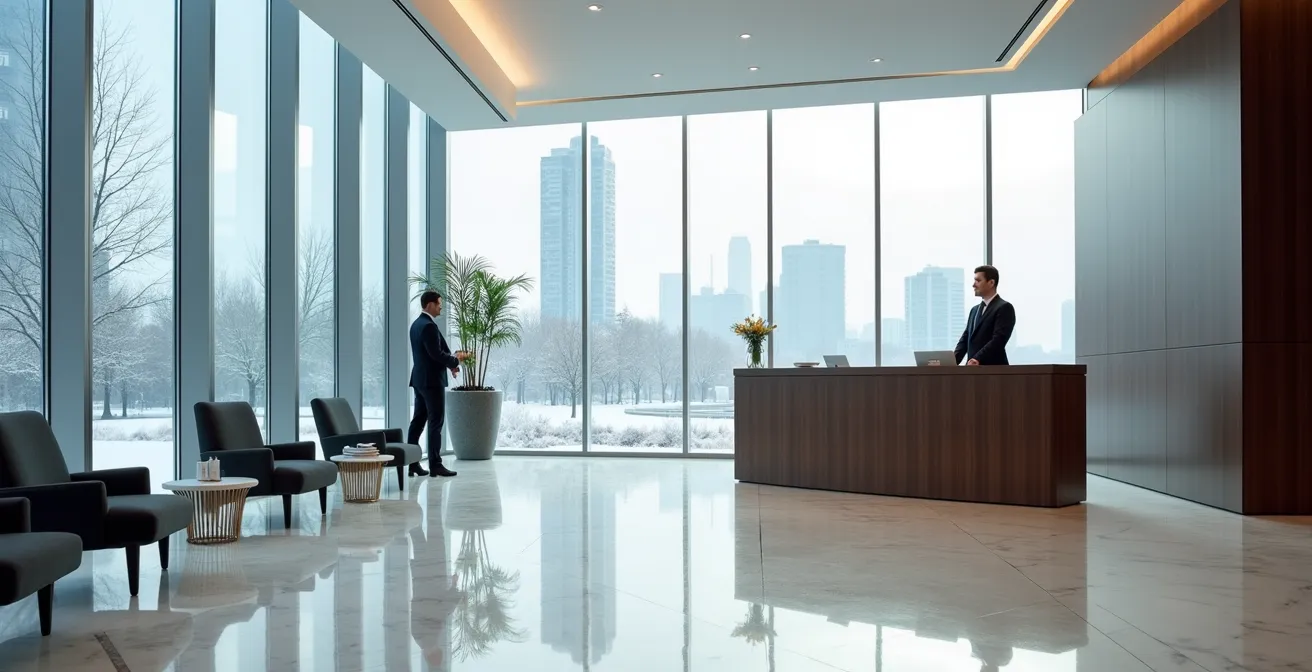
For a financial firm, office sanitation is not an expense; it is a critical, non-verbal signal of your operational diligence and a core component of brand integrity.
- Poor hygiene, even if invisible, directly undermines the subconscious trust clients place in your ability to manage their assets securely.
- Implementing strategic, context-aware protocols (especially for Quebec’s climate) provides a tangible ROI by mitigating health risks and reinforcing a premium brand image.
Recommendation: Shift your perspective from viewing cleaning as a janitorial task to a strategic risk management function that actively communicates your firm’s commitment to excellence and security.
As a director in Quebec’s competitive financial sector, you understand that trust is not merely built on market performance or sound advice; it is a complex tapestry woven from countless signals. Clients walk into your office seeking security and diligence. While you focus on presenting robust financial strategies, their subconscious is performing its own due diligence on their surroundings. A gleaming portfolio is easily undermined by a sticky boardroom table or a lingering odour in the reception area. This is where the true influence of daily sanitation protocols reveals itself.
The conventional approach is to see cleaning as a simple matter of appearance. Most firms ensure floors are swept and surfaces are wiped, believing this is sufficient for a “professional” look. However, this superficial view misses the profound psychological connection between spatial integrity and perceived competence. It fails to account for the invisible threats that signal a lack of thoroughness—the very quality clients expect when entrusting you with their financial futures. In an industry built on meticulous attention to detail, can you afford for your physical environment to communicate anything less?
The real key to leveraging sanitation as a brand asset lies in shifting from reactive cleaning to proactive hygiene strategy. This means understanding that for a financial firm, sanitation isn’t a janitorial task; it is a strategic risk management tool that communicates fiscal diligence and builds subconscious client trust. Every uncleaned surface, every overlooked detail, is a potential breach in your brand’s promise of security. This is not about being clean; it is about demonstrating an unwavering commitment to a higher standard in every facet of your operation.
This article will guide you through the strategic pillars of a sanitation protocol designed for the unique demands of a financial firm. We will explore the hidden bacterial threats on seemingly clean surfaces, compare operational service models for busy offices, and offer specific, actionable strategies to manage the unique environmental challenges of Quebec, such as slush season. By the end, you will have a clear framework for transforming your cleaning routine into a powerful tool for client trust and brand reinforcement.
Summary: The Strategic Role of Sanitation in Building Client Trust
- Why Do “Clean” Desks Still Harbor More Bacteria Than Restroom Seats?
- How to Sanitize Shared Keyboards and Touchscreens Without Damaging Electronics?
- Day Porter vs Night Cleaning: Which Service Model Suits Busy Offices Better?
- The Trash Bin Error That Causes Unpleasant Odors in Client Meeting Rooms
- How to Maintain a Spotless Reception Area During Slush Season?
- Why Do Viruses Spread 3x Faster in Offices with Poor Spatial Hygiene Protocols?
- Why Do Unpleasant Odors Trigger Immediate Distrust in Workplace Safety?
- How to Eliminate Persistent Odors in Public Restrooms Instead of Just Masking Them?
Why Do “Clean” Desks Still Harbor More Bacteria Than Restroom Seats?
The perception of cleanliness is a powerful, yet often deceptive, signal. In a financial office, a desk may appear immaculate—free of clutter, wiped down, and organized. However, this visual tidiness masks a microscopic reality that directly contradicts the diligence your brand aims to project. The startling truth is that the average office desk is a significant bacterial hotspot, often far exceeding areas we typically associate with germs. This discrepancy between what clients see and what exists creates a hidden “trust deficit.”
The core of the issue lies in the difference between cleaning for appearance and sanitizing for health. While a nightly wipe-down removes dust, it often fails to eliminate the microorganisms that thrive on high-touch surfaces. Keyboards, mice, and phones are constantly in contact with hands, which carry bacteria from various sources. Food particles from desk-side lunches create a nourishing environment for germ proliferation. The result is an invisible risk that undermines the very foundation of security your firm represents. For instance, a 2023 College Rover study revealed that common tables could host up to 60,000 times more bacteria than a toilet seat.
This problem is compounded in shared workspaces or client meeting rooms. A polished boardroom table may look impressive, but without proper disinfection, it becomes a transfer point for germs between your staff and your most valued clients. The same study noted that library desks, similar to shared client tables, had 2.6 times more bacteria than a kitchen sink. For a financial manager, this isn’t a simple janitorial issue; it’s a matter of spatial integrity. When a client signs a contract on a surface that is biologically compromised, the unspoken message is a failure in due diligence—a stark contrast to the meticulous care you promise for their investments.
How to Sanitize Shared Keyboards and Touchscreens Without Damaging Electronics?
In the modern financial office, technology is the interface of trust. Clients interact with touchscreen kiosks, sign documents on digital pads, and your advisors work on keyboards that process millions of dollars in transactions. These high-touch electronic surfaces are critical brand touchpoints, yet they present a unique sanitation challenge. Using harsh chemicals can damage sensitive screens and void warranties, while neglecting them creates a significant vector for germ transmission. The solution requires a protocol that is both effective and electronics-safe.
A strategic approach focuses on using the right tools and methods. Standard office cleaners containing alcohol or ammonia can strip away oleophobic (anti-fingerprint) coatings on screens and degrade the plastics of keyboards over time. Instead, professional protocols rely on EPA-registered disinfectants specifically formulated for electronics. These are applied with non-abrasive microfiber cloths, which trap and remove particles without scratching surfaces. This attention to detail signals a level of care that extends beyond the superficial.
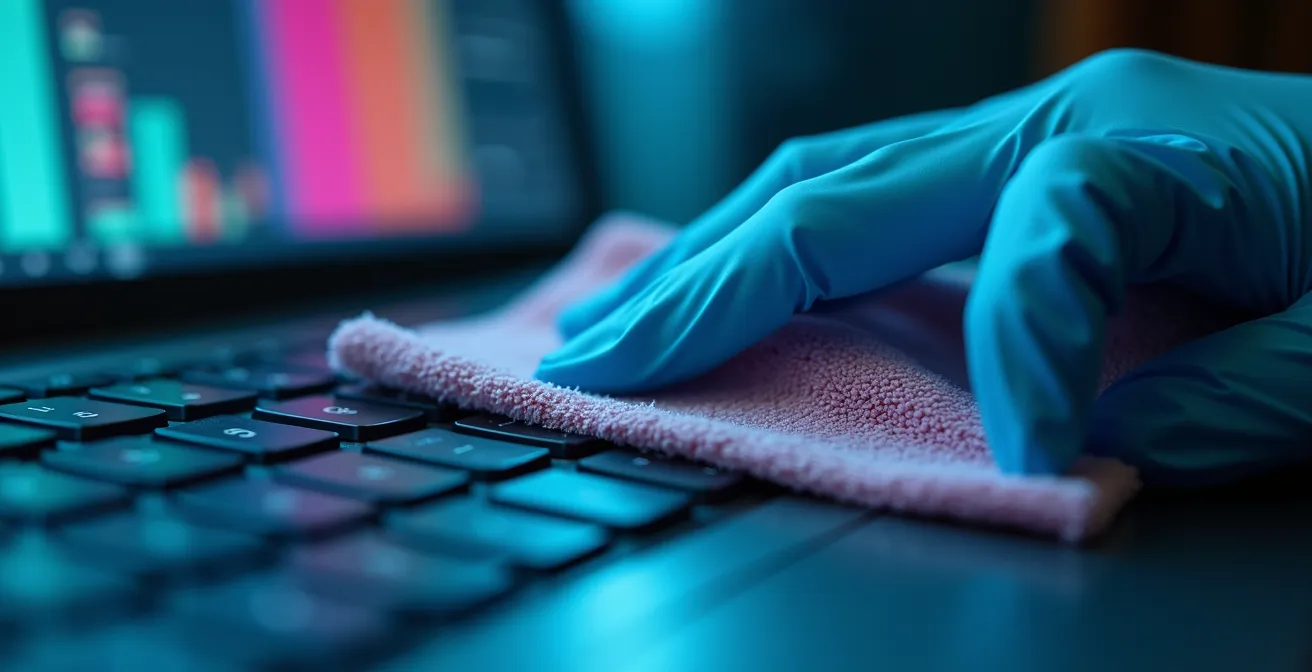
As the image above illustrates, true sanitation goes beyond a quick wipe. It involves meticulous attention to the spaces between keys and around the edges of screens, where germs accumulate. A systematic protocol is essential for ensuring consistency and preventing cross-contamination, especially in a busy firm. The following steps form the basis of a professional, electronics-safe disinfection process:
- Step 1: Use electronics-safe disinfectants specifically designed for touchscreens and keyboards, avoiding harsh chemicals that can damage equipment.
- Step 2: Focus on high-touch surfaces, including PIN pads and touchscreen kiosks that see hundreds of daily interactions.
- Step 3: Implement disinfectants selected for compatibility with delicate surfaces like OLED screens and glass partitions.
- Step 4: Use a color-coded cloth system to prevent cross-contamination between restrooms, general surfaces, and sensitive electronics.
- Step 5: Schedule cleaning workflows strategically to minimize disruption during business hours while maintaining the confidentiality essential to financial operations.
Day Porter vs Night Cleaning: Which Service Model Suits Busy Offices Better?
Choosing a cleaning service is not just an operational decision; it’s a strategic choice that directly impacts your brand’s image and your office’s real-time hygiene. The two dominant models, day porter services and traditional night cleaning, offer fundamentally different approaches to maintaining a financial institution. Understanding their distinct advantages is crucial for aligning your sanitation strategy with the high-traffic, client-facing nature of your business, especially in the context of Quebec’s demanding climate.
Night cleaning is the traditional model: a comprehensive, deep clean performed after hours. Its primary benefit is the lack of disruption to your daily operations. However, its limitation is its reactive nature. A spill in the reception area at 10 a.m. or a tracked-in mess during a winter storm at 2 p.m. remains unaddressed until the next day, continuously degrading the client experience. A Day Porter service, in contrast, provides a visible, immediate response. This on-site professional acts as a brand ambassador, continuously maintaining high-traffic areas like lobbies, restrooms, and meeting rooms during business hours. Their presence signals a proactive commitment to a pristine environment.
As Clean Method Commercial Cleaning, a provider of services for financial institutions, notes, the value of a day porter lies in their focused, real-time impact: “Day porters help ensure a safe and healthy environment while in the presence of your staff and customers. Prioritizing your high-traffic areas, we stay laser-focused on our job, so you can do yours.” This visibility is especially critical for a financial firm, where every detail contributes to the client’s perception of control and order. The following comparative analysis highlights the strategic trade-offs.
| Service Aspect | Day Porter Service | Night Cleaning |
|---|---|---|
| Visibility to Clients | High – Acts as brand ambassador | None – After hours only |
| Response Time | Immediate for spills/issues | Next business day |
| Best For | High-traffic areas, reception, restrooms | Deep cleaning, disruption-free tasks |
| Quebec Winter Priority | Essential Nov-April for salt/slush | Cannot address daytime tracking |
| Security Considerations | Works alongside staff | Requires after-hours access protocols |
| Cost Structure | Higher hourly rate, focused tasks | Lower rate, comprehensive cleaning |
For a busy financial agency in Quebec, a hybrid model is often the optimal solution: night cleaning for deep sanitization and a day porter for maintaining brand standards throughout the day. This dual approach ensures your firm not only starts clean but stays clean, reinforcing client trust with every interaction.
The Trash Bin Error That Causes Unpleasant Odors in Client Meeting Rooms
Few things can shatter the perception of a premium, well-managed firm faster than an unpleasant odor. While you are discussing complex financial instruments in a state-of-the-art meeting room, a subtle, foul smell can trigger a primal, subconscious signal of neglect and decay in your client’s mind. Often, the source is not a major janitorial failure but a simple, overlooked error: the improper management of waste, particularly food waste, in office trash bins.
In a busy office, it’s common for employees to dispose of lunch remnants, fruit peels, or old coffee in the nearest bin, including those in or near client-facing areas. These organic materials begin to decompose quickly, releasing volatile organic compounds that create offensive odors. These odors then migrate through the HVAC system, settling in conference rooms and reception areas. This is more than a nuisance; it’s a direct assault on the sensory due diligence your clients perform. The issue is not just the smell itself but the bacteria that cause it; research on bacterial contamination found that poorly maintained areas can harbor millions of colony-forming units, the source of persistent malodors.
Masking these smells with air fresheners is a common but misguided tactic. It often creates a cloying, chemical scent that signals a cover-up rather than a solution, further eroding trust. A true solution requires a systematic approach to waste management that separates odor-causing waste from general office trash and ensures it is dealt with swiftly. For a financial firm, this system must also integrate with protocols for handling sensitive documents, ensuring that hygiene and data security are addressed in tandem.
Your Action Plan: Odor Prevention Protocol
- Document Segregation: Implement separate, clearly marked disposal systems for confidential documents versus general and food waste to prevent both odor and visual data breaches.
- Centralized Food Waste: Establish a centralized food waste disposal station in a breakroom or kitchen, far from client areas, to contain odors at the source.
- Targeted Sanitization: Schedule regular, deep sanitization of breakroom surfaces, focusing on microwave handles, fridge doors, and bin lids where bacteria multiply.
- Odor Neutralization: Use EPA-approved disinfectants specifically designed to neutralize odor-causing bacteria at a molecular level, rather than simply masking them with perfume.
- Checklist Consistency: Create a documented cleaning checklist for all high-risk odor zones (kitchens, copy rooms, restrooms) to ensure consistent and focused daily attention.
How to Maintain a Spotless Reception Area During Slush Season?
For any financial firm in Quebec, the period from November to April presents a unique and relentless challenge to maintaining a pristine brand image: slush season. The constant tracking in of snow, salt, and grime can turn an elegant reception area into a hazardous, unsightly mess within minutes. This isn’t just an aesthetic problem; a wet, slippery floor is a safety liability, and the visible lack of control over the environment sends a powerful negative signal about your firm’s overall management capabilities.
Standard cleaning protocols are simply no match for the persistent assault of a Quebec winter. A single mop-up in the morning is rendered useless by the first ten clients who walk through the door. Effective management requires a dynamic, multi-layered defense system. The first line of defense is a professional-grade three-zone matting system: a heavy-duty scraper mat outside to remove large debris, a combination scraper/wiper mat in the vestibule, and a final large wiper mat inside to absorb any remaining moisture and dirt. This system proactively traps the majority of slush and salt before it ever reaches your polished floors.
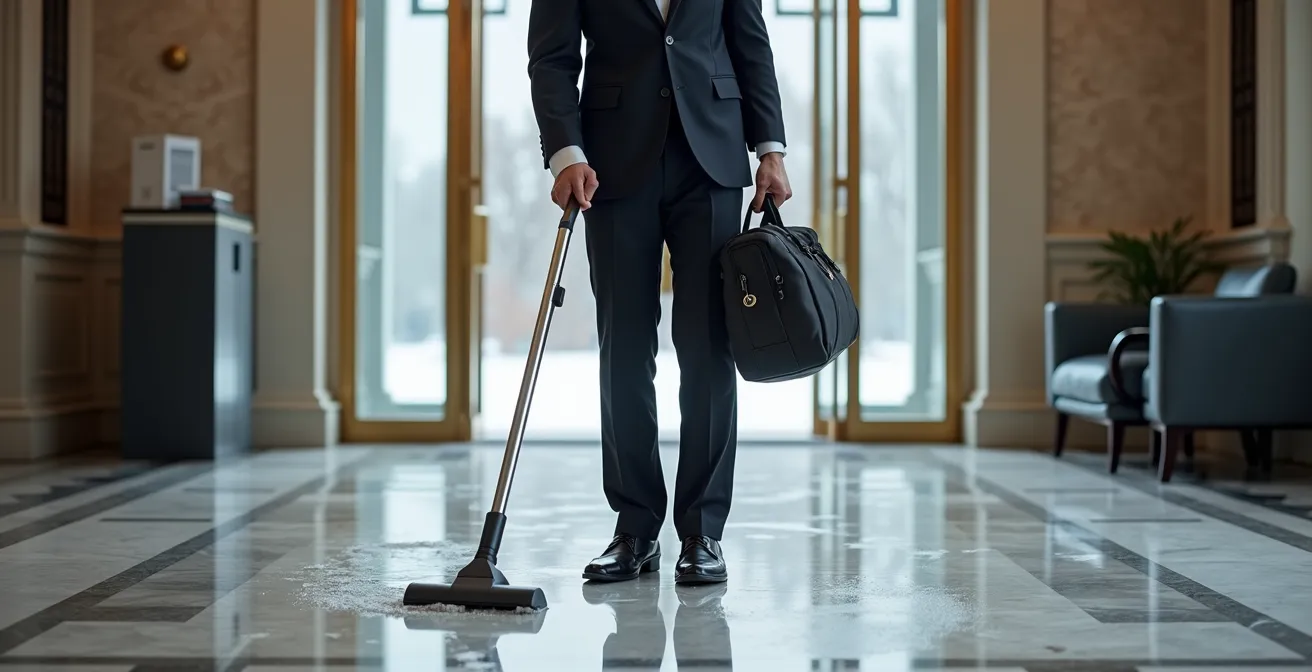
However, even the best matting system will become saturated. This is where a visible, proactive human element—typically a day porter—becomes indispensable. As depicted, their role is not just to clean but to visibly *maintain* standards. They embody your firm’s commitment to safety and excellence, turning a potential negative into a positive brand moment. A successful slush season protocol, as outlined by commercial cleaning experts, integrates both passive and active measures.
- Install a three-zone matting system (scraper, scraper/wiper, wiper) at all entrances.
- Implement a “5-Minute Reset” protocol, where a day porter performs an hourly quick mop, mat adjustment, and surface wipe during periods of bad weather.
- Use pH-neutral salt stain removers that are specifically safe for high-end flooring like marble, polished concrete, or hardwood to prevent permanent damage.
- Position a day porter visibly in the reception area from November through April as a cornerstone of your slush management and brand assurance strategy.
- Maintain a backup set of entrance mats for quick rotation when the primary set becomes saturated, ensuring continuous protection.
By investing in a robust winter maintenance strategy, you demonstrate foresight and a commitment to client safety and comfort, reinforcing the very trust your business is built on.
Why Do Viruses Spread 3x Faster in Offices with Poor Spatial Hygiene Protocols?
While client perception is a primary driver for maintaining a clean office, an equally critical factor is the tangible risk to health and business continuity. An office with inadequate “spatial hygiene”—a systematic approach to disinfecting shared spaces—becomes a perfect incubator for viruses and bacteria. Pathogens can spread with alarming speed, leading to increased employee absenteeism, operational disruptions, and a direct threat to the well-being of both your staff and your clients. This isn’t just a health issue; it’s a significant, quantifiable business risk.
The speed of transmission is a matter of contact and consistency. In a typical office, high-touch surfaces act as transmission superhighways. A study from the University of Arizona found that a single virus on one doorknob or tabletop can spread to 40-60% of workers and visitors within just two to four hours. The top “hot zones” in a financial office where this contact accelerates transmission include coffee machine touchscreens, boardroom door handles, shared calculators, and even the pens used for signing contracts. Without a professional protocol that sanitizes with intention, these points are often missed by routine cleaning, allowing viruses to thrive and spread exponentially.
Investing in a premium sanitation program has a clear return. The cost of just one financial advisor being out sick for three days—including lost client meetings and delayed trades—can easily exceed the annual cost of a comprehensive, professional cleaning program. Furthermore, in Quebec, this issue carries legal weight. Inadequate hygiene protocols can be seen as a failure in an employer’s duty of care under the standards set by the CNESST (Commission des normes, de l’équité, de la santé et de la sécurité du travail), creating tangible legal and financial risks. As professional cleaning teams for financial institutions demonstrate, the goal is a proactive approach using EPA-approved disinfectants and documented checklists. This consistency reduces the chance of outbreaks and, most importantly, shows clients and staff that their well-being is treated with the same meticulous care as their financial data.
Why Do Unpleasant Odors Trigger Immediate Distrust in Workplace Safety?
The human sense of smell is one of our most primitive and powerful instincts. It is directly linked to the parts of the brain that process emotion and memory, bypassing rational thought. When a client or employee enters your office and detects an unpleasant odor—be it stale air, lingering food smells, or musty carpets—their brain receives an immediate, subconscious signal: “Something is wrong here.” This reaction is not an oversensitivity; it is a hardwired threat-detection mechanism. An odor signals decay, lack of cleanliness, and potential danger, instantly creating a “trust deficit” that no amount of verbal reassurance can easily overcome.
This is the core of the neuroscience connection: olfactory signals trigger primal threat responses. A bad smell is interpreted not just as unpleasant, but as a sign of neglect. For a financial firm, where the entire brand promise is built on diligence, security, and meticulous management, this sensory signal is catastrophic. It suggests that if the firm cannot manage its own physical environment, how can it be trusted to manage complex financial assets? Strong chemical air fresheners are not the answer; they are often perceived as a cover-up, deepening the suspicion that something is being hidden.
True scent management is about elimination, not masking. It is about building trust through genuine hygiene. As the branding and facilities experts at MNSS Limited state, this has a direct impact on business outcomes.
A clean and pristine financial firm is a good response to this issue. Office cleaning not only helps with client retention but also improves employee’s morale and attitude.
– MNSS Limited, How Do Financial Firms Benefit from Daily Office Cleaning?
Building a positive sensory environment involves a strategy focused on root causes. This includes robust ventilation with HEPA/carbon filtration systems, strict waste management protocols, and deep cleaning schedules that target odor-causing bacteria. Some firms even employ subtle scent marketing with clean, luxurious scents like white tea or sandalwood to actively signal a premium, well-managed environment. Ultimately, staff must be trained to recognize that an odor complaint is not a minor issue—it is a critical trust signal that requires an immediate and thorough response.
Key Takeaways
- Client trust in a financial firm is subconsciously linked to the perceived cleanliness and order of the physical office space.
- Strategic sanitation goes beyond appearance, focusing on eliminating invisible threats (bacteria, viruses) and unpleasant odors that signal neglect.
- Context-specific protocols, such as those for Quebec’s slush season and for sanitizing electronics, are essential for demonstrating true diligence and risk management.
How to Eliminate Persistent Odors in Public Restrooms Instead of Just Masking Them?
The public restroom is often the ultimate test of a firm’s commitment to hygiene. No other space is judged as harshly, and persistent odors can leave a lasting negative impression on both clients and employees. Simply masking these smells with air fresheners is a temporary fix that fails to address the root cause and can even signal a lack of genuine cleanliness. True odor elimination in a high-traffic restroom requires a shift from surface-level cleaning to a deep, systemic approach that addresses bacteria, ventilation, and user-generated contamination.
Persistent odors almost always stem from the buildup of odor-causing bacteria in porous surfaces like grout, around the base of toilets, and in drains. Standard cleaning might miss these areas, allowing bacteria to flourish. An effective strategy uses enzymatic cleaners that digest organic waste, eliminating the source of the smell at a microscopic level. For prestigious older buildings, such as those in Old Montreal’s financial district, odor issues can also be structural. Aging plumbing and inadequate ventilation systems may require solutions that go beyond cleaning, such as regular enzymatic drain treatments and HVAC system upgrades that incorporate HEPA and carbon filters.
A forward-thinking strategy also involves investing in technology that minimizes contact and contamination in the first place. Touchless fixtures are not just a matter of convenience; they are a powerful tool for odor prevention and a visible statement of your firm’s investment in health and modernity. Reducing the number of surfaces people touch directly lowers bacterial transfer and buildup, which in turn reduces the sources of malodor. The following table from an analysis by experts in financial institution cleaning outlines the clear return on investment.
| Technology Type | Initial Investment | Odor Prevention Impact | Brand Perception Benefit |
|---|---|---|---|
| Touchless Toilets | High | Reduces bacterial transfer by 70% | Signals modern, premium facility |
| Automatic Faucets | Medium | Prevents water accumulation | Shows attention to hygiene detail |
| Touchless Soap Dispensers | Low | Eliminates soap residue buildup | Demonstrates health consciousness |
| Automatic Paper Towel | Medium | Reduces moisture on surfaces | Creates seamless client experience |
| HVAC with HEPA/Carbon | Very High | Continuous air purification | Investment in long-term quality |
By viewing sanitation through the lens of a brand consultant, it becomes clear that your cleaning protocol is one of the most powerful, albeit silent, communicators of your firm’s values. It is a daily referendum on your diligence, your attention to detail, and your commitment to the well-being of those you serve. For your next step, we recommend commissioning a comprehensive hygiene audit of your facilities to identify gaps and build a strategy that transforms this operational cost into a tangible brand asset.