
Implementing a structured, certified hygiene system is a direct operational strategy to reduce absenteeism, not just a cleaning expense.
- Poor hygiene is a quantifiable productivity drain, especially in Quebec where workplace absence rates are significantly high.
- Systematic protocols like color-coded zones and verifiable standards (CIMS, ATP testing) transform cleaning into a measurable process with a clear ROI.
Recommendation: Shift your perspective from viewing cleaning as a cost center to leveraging strategic hygiene as an investment in your operational resilience and human capital.
For any Director of Operations in Quebec, managing employee absenteeism is a constant battle against a significant drain on productivity. The immediate assumption is that open-plan offices, while fostering collaboration, are unavoidable incubators for illness. Standard responses often involve simply increasing the frequency of cleaning or posting reminders about handwashing. However, these efforts rarely move the needle on absenteeism rates because they fail to address the core issue: the lack of a systemic, measurable approach to hygiene.
The reality is that “looking clean” has no correlation with being hygienically safe. A truly effective strategy moves beyond superficial actions and treats workplace hygiene as an operational system, complete with protocols, verifiable metrics, and clear performance indicators. It’s about engineering an environment where pathogens cannot easily survive or spread. This requires a shift in mindset—from seeing cleaning as a janitorial task to understanding it as a critical component of risk management and productivity assurance.
This article will deconstruct how a certified, systematic approach to hygiene directly impacts absenteeism. We will explore how to implement foundational protocols, why certification is a worthy investment, how to avoid common but critical mistakes, and ultimately, how to design a program that not only protects your employees but also enhances your operational efficiency. It’s time to stop fighting symptoms and start building a resilient workplace from the ground up.
This guide breaks down the essential components of building a high-performance hygiene program. Below is a summary of the key areas we will cover, providing a clear roadmap to transform your facility’s cleaning from a cost into a strategic asset.
Summary: A Strategic Approach to Hygiene and Absenteeism
- Why Do Viruses Spread 3x Faster in Offices with Poor Spatial Hygiene Protocols?
- How to Implement Color-Coded Cleaning Zones to Prevent Cross-Contamination?
- CIMS-GB Certification: Is It Worth the Investment for Your Facility Management?
- The Storage Closet Mistake That Turns Your Cleaning Tools into Germ Incubators
- How to Reorganize Office Layouts to Facilitate Daily Disinfection Routines?
- Why Do “Clean” Desks Still Harbor More Bacteria Than Restroom Seats?
- Why Do Unpleasant Odors Trigger Immediate Distrust in Workplace Safety?
- Designing a Routine Cleaning Checklist That Reduces Staff Overtime by 15%?
Why Do Viruses Spread 3x Faster in Offices with Poor Spatial Hygiene Protocols?
Open-plan offices are designed for collaboration, but their very nature creates a superhighway for pathogens. With fewer physical barriers, airborne droplets from a single cough or sneeze can travel further, and shared high-touch surfaces like conference tables, door handles, and kitchen equipment become contamination hotspots. When hygiene protocols are weak or inconsistent, these environments don’t just allow germs to survive; they actively facilitate their rapid transmission from one employee to the next, leading to cascading sick days.
The financial impact is not trivial. For businesses in Quebec, this problem is particularly acute. Statistics Canada data reveals that 10.8 days are lost per full-time employee annually in Quebec due to illness or disability, a rate significantly higher than the national average. This isn’t just a “cost of doing business”; it’s a critical operational bottleneck that directly impacts project deadlines, team morale, and your bottom line. Without a robust system to break the chain of transmission, your office layout is inadvertently working against your productivity goals.
The key takeaway is that the risk is not the open office itself, but the absence of a systemic decontamination process designed to mitigate its inherent vulnerabilities. This is where moving beyond simple “cleaning” to implementing structured hygiene protocols becomes essential. During Quebec’s long winter months, when people are confined indoors for extended periods, the risk of transmission is even higher, making a proactive strategy non-negotiable.
Case Study: Pinpointing Contamination Hotspots in a Montreal Office
Air Labs Montreal, a specialist in environmental testing, utilizes ATP testing to provide immediate, quantifiable data on surface contamination. By using a luminometer, their teams can measure active microorganism levels on high-touch surfaces in Quebec offices. This data reveals the true hygiene state of an office, identifying critical virus transmission hotspots that visual inspection misses entirely. This approach allows facility managers to target disinfection efforts where they are most needed, optimizing resource allocation and demonstrably reducing health risks.
How to Implement Color-Coded Cleaning Zones to Prevent Cross-Contamination?
One of the most significant failures in conventional cleaning is cross-contamination: using the same cloth or mop to wipe down a restroom sink and then an employee’s desk or kitchen counter. This practice doesn’t clean; it simply transfers pathogens from a high-risk area to a low-risk one. The single most effective, low-cost strategy to eliminate this risk is implementing a color-coded cleaning system. This intuitive method assigns a specific color of cleaning equipment (cloths, mops, buckets) to a designated zone, making it visually impossible to misuse tools.
The system divides your facility into logical zones based on risk level. For example, red is universally reserved for the highest-risk areas like restrooms, while yellow is used for kitchen and food-prep areas. Blue is typically for general office spaces like desks and conference rooms, and green for low-risk common areas. This approach is not just a best practice; it is a foundational element of any professional hygiene protocol and is endorsed by organizations like the Canadian Centre for Occupational Health and Safety (CCOHS).
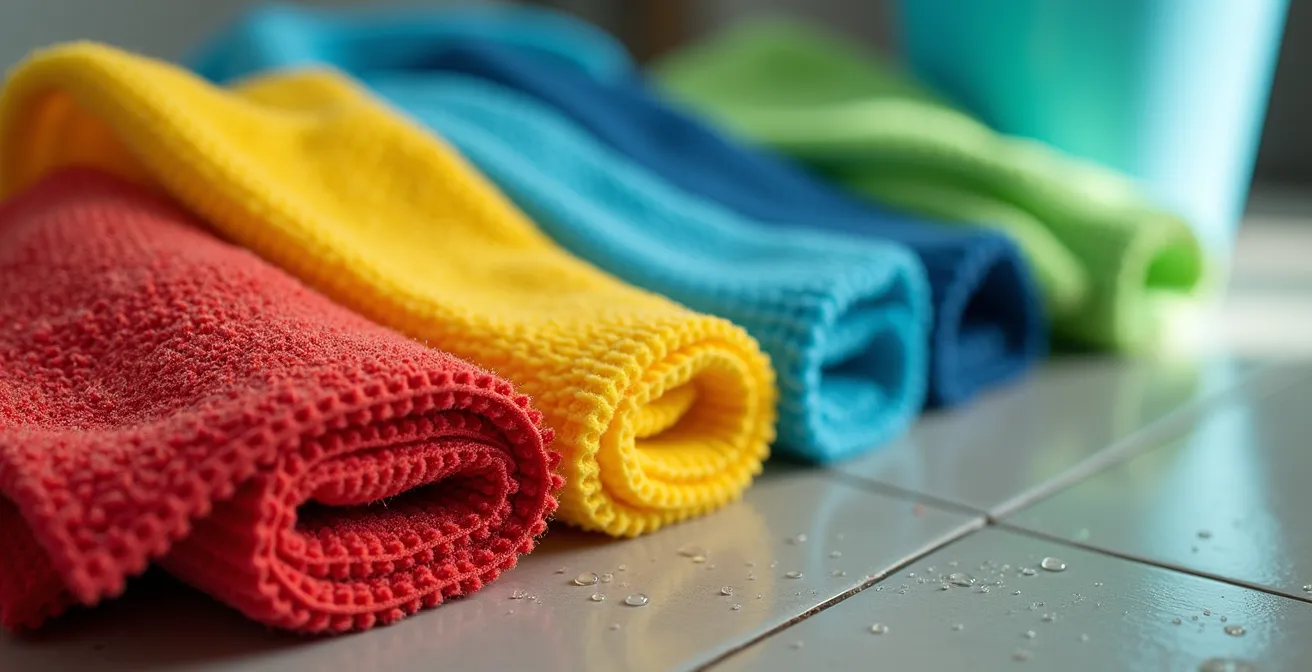
As the image demonstrates, organizing supplies by color creates an unmistakable visual guide for cleaning staff. It simplifies training, ensures consistency, and builds a powerful barrier against the spread of germs. For a Director of Operations, this system provides a simple, auditable process that significantly elevates the standard of hygiene with minimal investment.
This table, based on CCOHS guidelines, provides a clear framework for establishing a color-coded system in a Quebec office setting. Implementing it requires dedicating specific equipment to each zone, a small upfront cost that pays immense dividends in risk reduction.
| Zone Color | Area Type | CCOHS Guidelines | Equipment Required |
|---|---|---|---|
| Red | Restrooms & High-Risk | Highest contamination risk | Dedicated mops, cloths, buckets |
| Yellow | Kitchen & Food Areas | Food safety protocols apply | Separate cleaning supplies |
| Blue | General Office Areas | Standard cleaning protocols | Multi-use safe equipment |
| Green | Low-Risk Areas | Minimal contamination risk | General purpose supplies |
CIMS-GB Certification: Is It Worth the Investment for Your Facility Management?
Once you have foundational protocols like color-coding, the next logical step is to formalize your commitment to quality through certification. The Cleaning Industry Management Standard (CIMS), and its “Green Building” (GB) component, is the gold standard. CIMS is not about prescribing *how* to clean; it’s a management framework that validates your cleaning organization’s ability to deliver consistent, high-quality service. It focuses on documented systems, quality control, employee training, and other pillars of a well-run operation.
For a Director of Operations, pursuing CIMS or hiring a CIMS-certified provider is a strategic decision with a clear ROI. First, it serves as a powerful third-party validation of your commitment to a healthy workplace, a significant factor for employee retention and talent acquisition. Second, it de-risks your operations by ensuring your cleaning protocols meet an internationally recognized standard, which can be a crucial point in discussions with unions or regulatory bodies like the CNESST. The cost of not having such a system is substantial; infectious diseases lead to an estimated $1 billion annually in lost productivity in Canada.
Furthermore, the CIMS-GB designation is specifically designed to help facilities achieve points toward LEED-EB: O&M (Leadership in Energy and Environmental Design for Existing Buildings: Operations & Maintenance) certification. This directly aligns your hygiene program with broader corporate sustainability goals. As ISSA Canada, the governing body, states:
CIMS-GB certification is an optional add-on to traditional CIMS certification that closely tailors to provide customers with precisely what they need to secure LEED-EBOM points while greening their operations overall
– ISSA Canada, ISSA Cleaning Industry Management Standard Guide
This makes CIMS-GB not just a cleaning standard, but an integrated facility management tool that adds measurable value to your property and corporate reputation.
Case Study: GSF Canada Sets the Standard in Montreal
GSF Canada Inc., a cleaning service provider based in Montreal, has achieved CIMS HONORS certification. As one of the few Quebec-based firms with this distinction, they serve as a benchmark for excellence in the province. By adopting the CIMS framework, they demonstrate a verifiable commitment to quality management and sustainable cleaning practices, helping their clients not only achieve a higher standard of hygiene but also enhance their corporate social responsibility profile and meet provincial sustainability targets.
The Storage Closet Mistake That Turns Your Cleaning Tools into Germ Incubators
Even the most advanced cleaning systems and certified providers can be completely undermined by one commonly overlooked area: the janitorial storage closet. A damp, poorly ventilated, and disorganized closet is not a storage space; it’s a bacterial incubator. When mop heads are left in dirty water, wet cloths are balled up on a shelf, and tools are stored on the floor, they become breeding grounds for mold, mildew, and pathogens. The next time these tools are used, they don’t clean—they actively spread contamination throughout your facility.
This issue is particularly critical in Quebec’s climate, with its humid summers and dramatic temperature shifts that can lead to condensation and moisture buildup in enclosed spaces. A disorganized closet where clean and dirty tools are mixed, or where chemical solutions are not properly labeled and stored, also poses a significant compliance risk, especially in unionized environments where workplace safety protocols are heavily scrutinized. The integrity of your entire hygiene program rests on the integrity of the tools used to execute it.
Implementing a strict protocol for janitorial closet management is non-negotiable. This includes ensuring proper ventilation, using ventilated shelving to store tools off the floor, and enforcing a daily sanitization routine for all equipment. All disinfectants must have a Health Canada-issued Drug Identification Number (DIN) to ensure they are effective and safe for use.
Action Plan for Janitorial Closet Decontamination
- Install proper ventilation systems to manage Quebec’s seasonal humidity and prevent stagnant air.
- Use dehumidifiers during humid summers and monitor moisture levels closely, especially in below-grade storage areas.
- Store all cleaning tools and supplies on ventilated, non-porous shelving, ensuring nothing is left on the floor.
- Implement a daily tool sanitization protocol using Health Canada DIN-approved disinfectants, following manufacturer contact times.
- Document all tool maintenance and sanitization schedules to ensure compliance and provide a clear record for audits or union reviews.
How to Reorganize Office Layouts to Facilitate Daily Disinfection Routines?
Strategic hygiene extends beyond chemicals and protocols; it encompasses the physical environment itself. The layout of your open-plan office can either hinder or facilitate effective cleaning. Cluttered desks, narrow pathways, and poorly placed furniture create obstacles for cleaning staff, increasing the time required to service an area and creating hard-to-reach spots where dust and germs accumulate. Reorganizing your office layout with “cleaning efficiency” as a key design principle is a powerful, yet often ignored, strategy.
This involves creating clear, wide corridors that allow cleaning carts and equipment to pass easily. It means arranging desk pods into accessible clusters rather than a dense maze. This approach borrows from ‘Lean’ manufacturing principles, a concept well-understood in Quebec’s industrial sector, by focusing on eliminating wasted movement and optimizing workflow—in this case, for the cleaning staff. The goal is to design a “flow” that allows for systematic, top-to-bottom, left-to-right cleaning without backtracking or navigating an obstacle course.
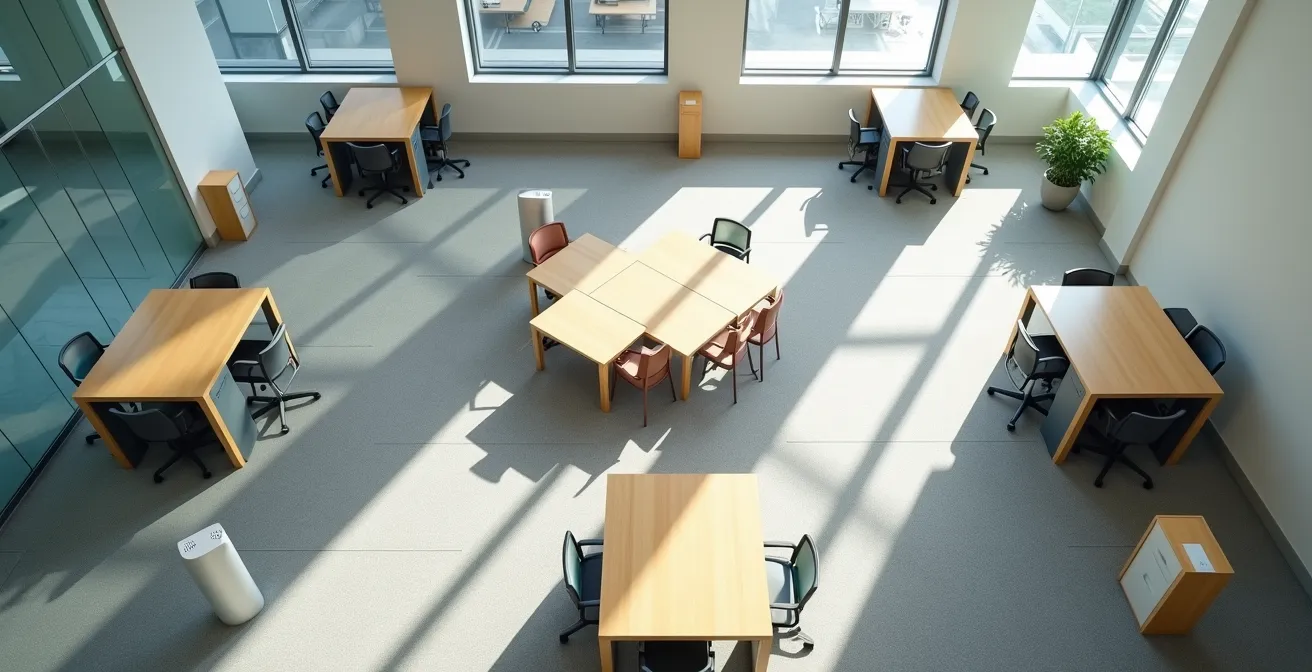
An optimized layout, as shown above, also includes strategically placing hygiene infrastructure, such as unbranded, aesthetically pleasing hand sanitizer stations at key entry/exit points and near common areas. By making hygiene easy and accessible, you encourage better habits among employees while streamlining the daily disinfection routines for your cleaning team. This turns the physical space into an active participant in your health and safety program.
Case Study: Lean Cleaning in the Quebec Manufacturing Sector
Applying ‘Lean’ principles to office cleaning, several Quebec manufacturing facilities have implemented zone-based checklists that group tasks by physical area. This minimizes travel time and wasted motion for cleaning staff, a core tenet of Lean efficiency. By creating logical cleaning paths and standardized work for each zone, these facilities have reported reductions in cleaning time per square meter by up to 15% while simultaneously improving the consistency and quality of the cleaning service. This proves that a well-designed layout directly contributes to operational efficiency.
Why Do “Clean” Desks Still Harbor More Bacteria Than Restroom Seats?
One of the most powerful arguments for a systematic hygiene program is a single, shocking fact: visual appearance has zero correlation with hygienic safety. An office desk that appears spotless to the naked eye is often a minefield of bacteria. The reason is simple: desks are “high-touch” surfaces that are rarely disinfected properly. We eat at them, cough near them, and touch them constantly after handling phones, keyboards, and doorknobs. In contrast, restrooms are typically subjected to rigorous, chemically-driven cleaning routines precisely because they are perceived as “dirty.”
This perception gap leads to staggering results. Landmark research from the University of Arizona demonstrates that the average office desk harbors 400 times more bacteria than the average toilet seat. This statistic single-handedly debunks the idea that “if it looks clean, it is clean” and underscores the need for a protocol-driven approach that focuses on disinfection, not just tidiness. Your employees’ desks, keyboards, and phones are the most likely points of cross-contamination in the entire office.
This is why the concept of measurable cleanliness is becoming the new standard. Instead of relying on subjective visual inspections, leading facility managers are using scientific tools like ATP (adenosine triphosphate) testing. ATP is a molecule found in all living cells, and ATP meters can detect its presence on a surface, providing an immediate numerical reading of the microbial load. It turns an invisible threat into a quantifiable metric.
Case Study: The Rise of ATP Testing in Downtown Montreal
In the competitive market for Class A office buildings in downtown Montreal, proving a superior tenant experience is key. Professional cleaning companies servicing these properties are increasingly using ATP testing to provide landlords with scientific proof of hygiene levels. An ATP meter gives an instant result in Relative Light Units (RLU); a reading over 100 RLU typically indicates that a surface requires more thorough cleaning. This method provides quantifiable, objective data that justifies cleaning budgets and gives tenants verifiable assurance of a healthy work environment, a standard that visual inspection could never meet.
Why Do Unpleasant Odors Trigger Immediate Distrust in Workplace Safety?
Beyond the measurable presence of germs, there is a powerful psychological component to workplace hygiene: the sense of smell. An unpleasant odor in the office—whether it’s stale air, a musty carpet, or a poorly maintained restroom—does more than cause discomfort. It triggers a primal, immediate sense of distrust in the safety of the environment. This reaction is not an oversensitivity; it’s a hardwired evolutionary response.
This biological mechanism is a critical factor in employee perception. As a Director of Operations, you can have the best disinfection logs and ATP scores in the city, but if your office has a persistent malodor, employees will perceive it as unclean and unsafe. This erodes trust and can contribute to “presenteeism” anxiety, where employees are physically at work but mentally preoccupied with their health concerns.
The olfactory system has direct connections to the limbic system, which processes emotions and memories, causing bad smells to bypass rational thought and trigger a primal threat response.
– Dr. Charles Gerba, Professor of Microbiology, University of Arizona
Effectively managing odors is therefore not about using air fresheners, which merely mask the problem. It is about diagnostic odor control. This involves identifying and eliminating the source, which in a Quebec climate often relates to moisture and ventilation issues. Common culprits include inadequate air circulation from windows sealed for the winter, moisture trapped in carpets from melting snow, or even mold growth in HVAC systems exacerbated by summer humidity. Addressing these root causes is essential for maintaining both actual and perceived safety.
A persistent odor issue can even become a matter for the CNESST (Commission des normes, de l’équité, de la santé et de la sécurité du travail) if it’s perceived as indicative of poor air quality or an unsafe working condition. A proactive diagnostic approach, including checking ventilation, inspecting for moisture, and ensuring proper drainage, is a crucial part of a holistic hygiene strategy.
Key Takeaways
- Employee absenteeism in Quebec is a significant operational cost, and a systemic hygiene protocol offers a direct, measurable solution.
- Move beyond visual cleaning by implementing structured systems like color-coded zones, CIMS certification, and scientific ATP testing.
- True hygiene management requires a holistic view, addressing everything from janitorial closet protocols to office layout and the psychological impact of odors.
Designing a Routine Cleaning Checklist That Reduces Staff Overtime by 15%?
The culmination of a strategic hygiene program is a well-designed, routine cleaning checklist. This is not simply a list of tasks; it is an operational tool that synthesizes all the principles we’ve discussed. A smart checklist is zone-based, task-grouped, and time-allotted. By organizing the workflow logically—grouping all tasks within one area (e.g., a specific department’s zone) before moving to the next—you dramatically reduce wasted travel time and motion for cleaning staff. This is the essence of “working smarter, not harder.”
This efficiency has a direct impact on your budget. In facilities that have adopted these ‘Lean’ cleaning principles, reductions in total cleaning time and associated staff overtime can reach up to 15%. For a Director of Operations, this is a powerful argument: the system not only elevates health and safety but also creates operational savings. This is particularly effective in unionized settings, as it frames efficiency as a way to reduce physical strain on workers while achieving better results. The checklist becomes a tool for consistency, accountability, and efficiency.
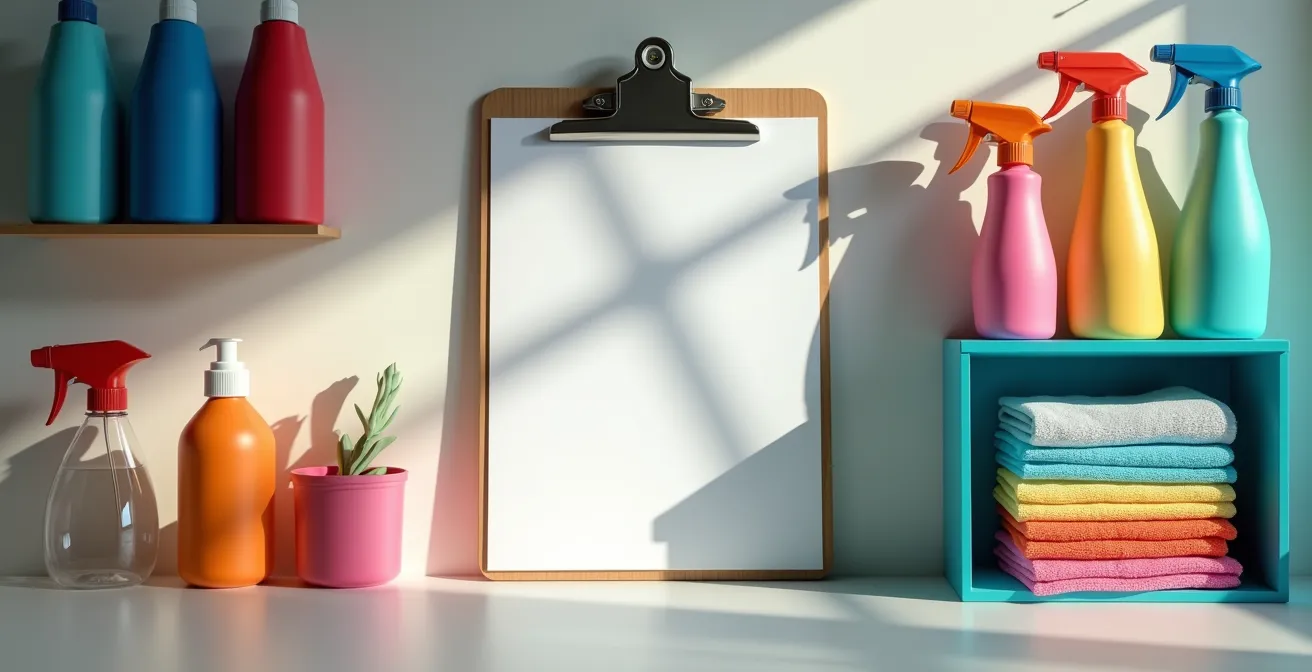
Ultimately, the goal of this entire system is to produce a measurable outcome: a healthier workforce. The link between hygiene and absenteeism is undeniable. Studies published by the Canadian Journal of Public Health found companies that encourage and facilitate regular hand hygiene saw a 30-40% drop in sick-related absenteeism. When you combine this with systematic disinfection, cross-contamination prevention, and proper tool maintenance, you create a multi-layered defense that delivers a substantial return on investment through recovered productivity.
By shifting your perspective and treating hygiene as a core operational function with measurable inputs and outputs, you can directly reduce the financial drain of absenteeism and build a more resilient, productive, and trusted workplace. The next step is to assess your current protocols against these best practices and identify areas for systematic improvement.
Frequently Asked Questions About Workplace Hygiene and Compliance
What is a DIN and why is it required?
A Drug Identification Number (DIN) means the disinfectant has been approved for use in Canada and meets Health Canada’s safety and efficacy standards. Using DIN-approved products is mandatory for regulatory compliance.
How long should disinfectants remain on surfaces?
You must follow the manufacturer’s instructions for contact time—the period the surface must remain wet to be effective. This is typically 30 seconds to 2 minutes for most DIN-approved products to kill pathogens.
Can bleach solutions be stored overnight?
No. According to CCOHS guidelines, bleach solutions lose their disinfectant properties within 24 hours. They must be mixed fresh daily to ensure efficacy.