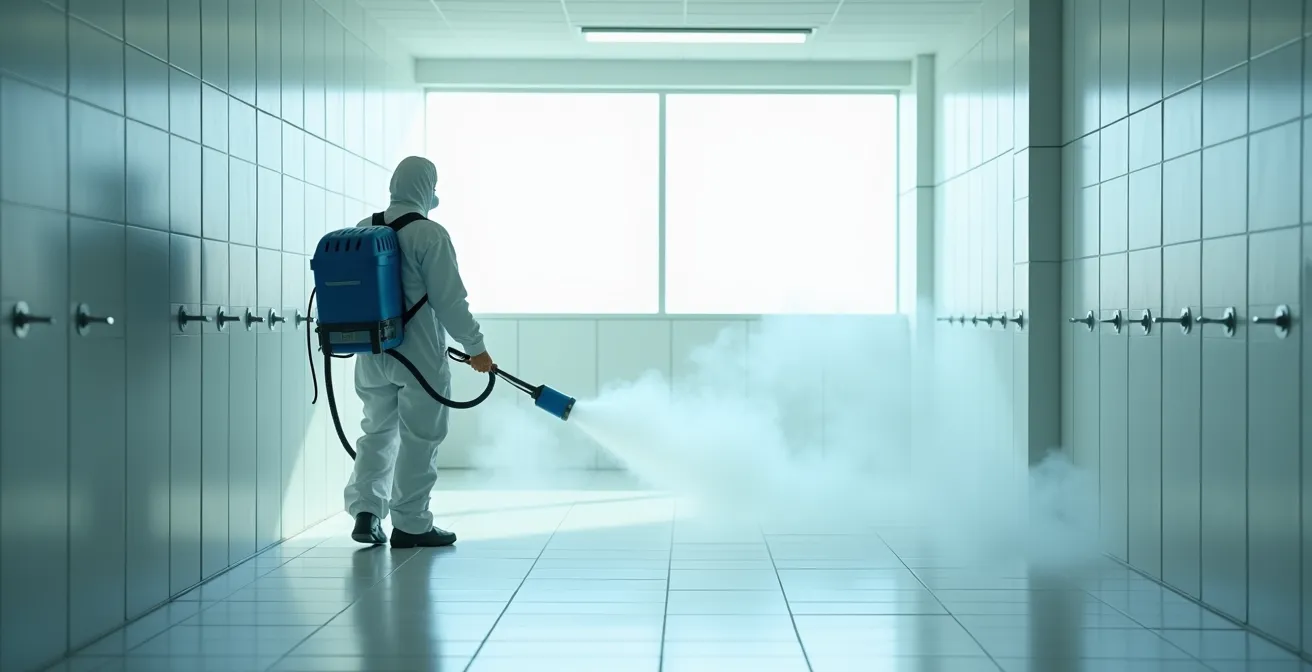
The lingering malodors in your restrooms are not a simple cleaning issue; they are a systems failure that damages your business’s reputation.
- Persistent smells are caused by uric acid crystals and bacterial biofilms deeply embedded in porous surfaces like grout, which conventional cleaning cannot remove.
- A strategic shift from masking odors to source elimination involves using bio-enzymatic treatments, touch-free cleaning technology, and data-driven schedules.
Recommendation: Adopt a proactive sanitation strategy that targets these invisible microbial strongholds to permanently resolve odor issues, improve hygiene, and protect your brand.
As a manager of a high-traffic facility in Quebec, you know the frustration. You invest in regular cleaning, your staff follows the checklist, and yet a persistent, unpleasant odor clings to the restrooms, especially on humid summer days. You’ve tried stronger air fresheners and more frequent mopping, but the smell always returns, a silent indictment of your facility’s hygiene standards. This problem is more than an annoyance; it’s a direct threat to your reputation, as customers increasingly equate cleanliness with safety.
The common approach is to treat the symptom—the smell—with chemical masking agents. But this is a losing battle. The true source of the problem is often invisible, hiding in microbial strongholds that standard disinfectants can’t reach. We’re talking about uric acid crystals that have soaked deep into the grout lines and stubborn biofilms that act as a shield for odor-causing bacteria. Simply cleaning the surface is like painting over rust; it ignores the corrosion happening underneath.
But what if the solution wasn’t about cleaning harder, but cleaning smarter? The key is a strategic shift: moving away from a reactive, surface-level cleaning schedule to a proactive, scientific system of deep sanitation. This means understanding the chemistry of odors, leveraging technology to remove contaminants without spreading them, and using data to deploy your resources precisely when and where they’re needed most.
This guide will walk you through that strategic shift. We will deconstruct the science behind persistent odors and provide a blueprint for building a sanitation system that eliminates them at their source. You will learn not just what to clean, but why certain methods fail and which advanced strategies deliver lasting results, ensuring your restrooms reflect the high standards of your establishment.
Explore our comprehensive guide to building a modern, effective sanitation strategy for your facility. Below is a summary of the key areas we will cover to help you move from simply masking odors to eliminating them permanently.
Table of Contents: A System for True Restroom Hygiene
- Why Does Urine Scale in Grout Lines Cause Smells That Won’t Go Away?
- How to Implement Touch-Free Cleaning Systems to Improve Sanitary Standards?
- Paper Towels vs Hand Dryers: Which Solution Actually Reduces Bacteria Spread?
- The Ventilation Oversight That Encourages Mold Growth in Restroom Ceilings
- How to Use Traffic Counters to Schedule Restroom Cleaning Just-in-Time?
- Why Does Soap Scum Build Up Faster on Textured Tiles vs Smooth Surfaces?
- Why Do Elevator Buttons Transmit More Pathogens Than Toilet Seats?
- How to Remove Biofilms That Shield Bacteria from Chemical Attacks?
t
Why Does Urine Scale in Grout Lines Cause Smells That Won’t Go Away?
The persistent “restroom smell” that plagues facilities isn’t from a lack of cleaning; it’s from cleaning the wrong thing. Standard mops and surface disinfectants are ineffective against the true culprit: uric acid crystals. When urine is left on the floor, it breaks down, forming non-soluble crystals that embed themselves deep within porous surfaces, most notably the grout between floor tiles. These crystals are a constant food source for bacteria, which in turn release the ammonia-like gases responsible for the foul odor. Mopping the floor merely spreads these bacteria around and wets the crystals, temporarily amplifying the smell without removing the source.
This creates a significant gap between effort and result, a reality reflected in public perception. Despite the best efforts of facility managers, a global survey by Tork revealed that only 20% of public restrooms meet hygiene expectations, even though a vast majority of users expect high cleanliness. The problem lies in the porous substrate of grout, which acts like a sponge. Facility maintenance studies indicate that this grout porosity creates 3x more bacterial growth surface area compared to smooth, non-porous materials. Until you break down and extract these embedded crystals, the odor will always return.
The solution is not more bleach, but better chemistry. A switch to bio-enzymatic cleaners is essential. Unlike traditional chemicals that only work on the surface, these cleaners contain specific bacteria and enzymes that are formulated to digest organic waste. When applied to grout, the enzymes break down the hard uric acid crystals into a liquid form, allowing the beneficial bacteria to consume the waste, effectively destroying the odor at its molecular source. This method doesn’t mask the smell; it permanently eliminates the fuel for the odor-causing bacteria.
How to Implement Touch-Free Cleaning Systems to Improve Sanitary Standards?
The traditional mop and bucket, a staple of cleaning for generations, is one of the biggest contributors to cross-contamination in a restroom. Every time a mop is dipped back into the bucket, it contaminates the cleaning solution. The dirty water is then spread across the floor, moving bacteria from one area to another rather than removing them. This process is not only ineffective for source elimination but also creates a significant health and safety risk for cleaning staff, who are in direct contact with contaminants. It’s a flawed system that prioritizes the appearance of clean over actual sanitation.
Implementing touch-free cleaning systems, often called “spray-and-vac” systems, represents a fundamental upgrade in restroom hygiene. These all-in-one units allow staff to apply a properly-diluted cleaning solution to all surfaces (floors, walls, fixtures), pressure-rinse them with fresh water, and then completely vacuum the dirty water and contaminants away. This method ensures that dirty water is never re-used and that soils are physically removed from the environment, not just smeared around. It breaks the cycle of cross-contamination and reaches into grout lines and crevices that mops can’t.
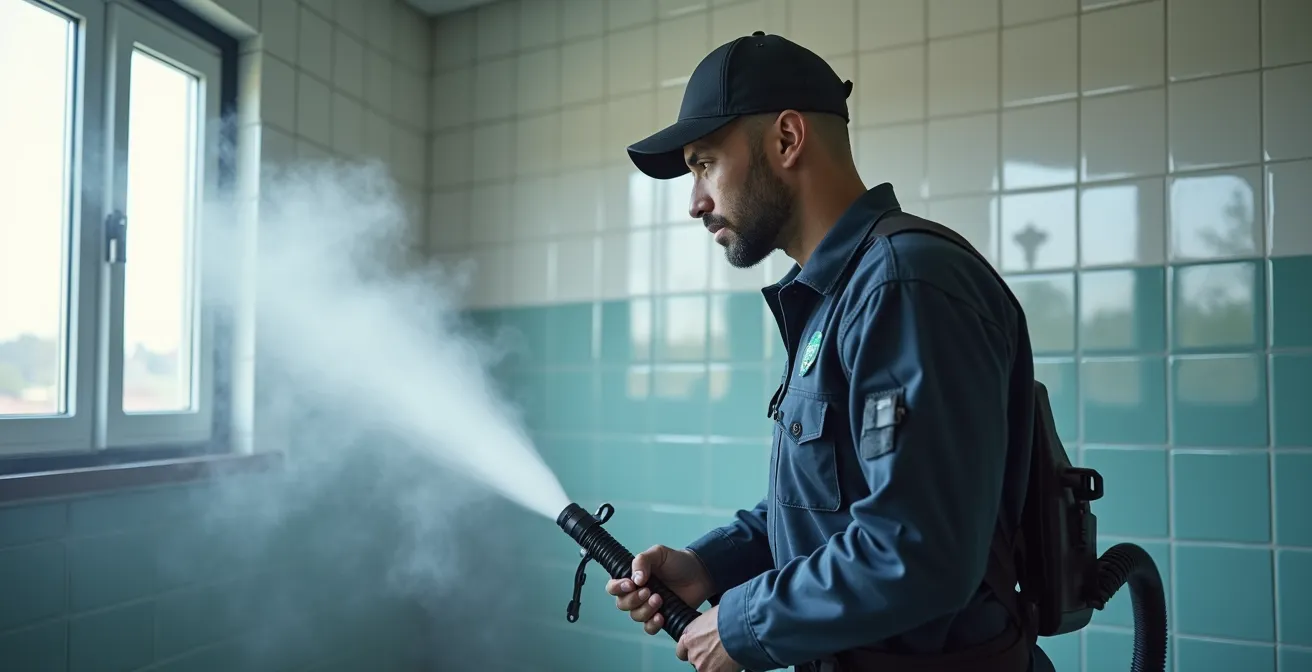
The benefits extend far beyond just cleanliness. For a facility manager in Quebec, the business case is compelling. These systems significantly reduce labor time, chemical consumption, and water usage. More importantly, they achieve true source elimination of odor-causing bacteria, moving restroom maintenance from a cost center focused on masking problems to a value-driver that enhances the customer experience. The table below illustrates the clear return on investment compared to outdated methods.
This table from HCS Canada provides a clear comparison of the operational impact of adopting modern cleaning technology. It highlights the shift from spreading contaminants to complete removal.
| Factor | Traditional Mop & Bucket | Touch-Free System |
|---|---|---|
| Bacterial Spread | Spreads bacteria across surfaces | Removes bacteria completely |
| Labor Time | 30-45 min per restroom | 15-20 min per restroom |
| Worker Safety | Direct contact with contaminants | No contact with surfaces |
| Odor Removal | Temporary masking | Source elimination |
Paper Towels vs Hand Dryers: Which Solution Actually Reduces Bacteria Spread?
The choice between paper towels and hand dryers is more than a matter of cost or environmental impact; it’s a critical hygiene decision. The debate has intensified, especially as public health awareness has grown. A 2020 Dyson survey found that 75% of Canadians became more concerned about public washrooms during the pandemic, fundamentally changing their expectations. Patrons are no longer just looking for a dry hand; they are looking for the most hygienic option. While high-speed jet air dryers are marketed as modern and efficient, numerous studies have shown they can act as “aerosol-generating machines,” blowing bacteria and viruses from the air and from users’ hands onto surrounding surfaces and people.
Paper towels, in contrast, offer two key hygiene benefits. First, the physical act of wiping hands with a towel removes significantly more bacteria through friction than air drying alone. Second, they contain the pathogens within the used towel, which is then disposed of in a bin, effectively removing them from the environment. This contrasts sharply with jet dryers that can disperse microbes up to several meters away, contaminating nearby walls, floors, and the next person in line. For a high-traffic facility, this dispersal effect can undermine all other cleaning efforts by constantly re-contaminating the space.
Instead of relying on manufacturer claims, a facility manager should make a data-driven decision. The most effective way to determine the best solution for your specific environment is to conduct your own testing using an ATP (adenosine triphosphate) meter. This device measures the amount of biological activity on a surface, providing a quantitative score of its cleanliness. By taking readings from areas around both a paper towel dispenser and a hand dryer after a period of use, you can get objective, empirical data on which method contributes to a cleaner environment in your facility. This scientific approach moves the decision from a subjective debate to a clear, evidence-based choice.
Your Action Plan: ATP Testing Protocol for Hand Drying
- Establish Baselines: Test key surfaces (walls, floors, counters) with an ATP meter to get a baseline reading of microbial levels before the test period.
- Collect Paper Towel Data: After one week of use, swab the dispenser, waste bin, and surrounding surfaces to measure bacterial counts (RLUs).
- Gather Hand Dryer Data: In a separate restroom or during a separate week, swab the wall beneath the dryer, the floor, and the air intake to collect comparable RLU readings.
- Analyze the Evidence: Compare the ATP readings from both zones. The solution with consistently lower RLU counts is demonstrably more hygienic for your environment.
- Implement the Best Solution: Use your site-specific data to confidently choose and defend the hand drying solution that best protects the health of your patrons and staff.
The Ventilation Oversight That Encourages Mold Growth in Restroom Ceilings
Even with the most rigorous cleaning protocols, a restroom can still develop persistent musty or damp odors if a critical environmental factor is ignored: ventilation. In a high-traffic restroom, the air is constantly filled with moisture from flushing toilets, running sinks, and the ambient humidity of the Quebec climate. Without adequate air exchange, this moisture-laden air becomes stagnant, creating the perfect breeding ground for mold, mildew, and odor-causing bacteria. As Simple Green Professional notes in their commercial odor guide, “Excessive moisture in the air promotes microorganism growth, which can then lead to odor problems.”
The most common oversight is an improperly functioning or undersized HVAC system. Many facilities operate with ventilation that is either insufficient for the user load or, worse, creates positive air pressure. A properly configured restroom should always have negative air pressure, meaning the exhaust fan pulls more air out of the room than is supplied. This ensures that odors and airborne microbes are pulled out of the building and prevents them from escaping into adjacent hallways or commercial spaces. If the opposite is true, your restroom is actively pushing contaminated air into your facility.
aio
Managing ventilation is not a set-it-and-forget-it task; it requires a dynamic approach tailored to local climate conditions. For a facility in Quebec, this means adjusting the system seasonally. In the hot, humid summer, the system needs to work harder to exhaust moisture. In the freezing winter, it must be balanced to prevent condensation on cold surfaces while still providing adequate air exchange. Regular maintenance, including cleaning filters and ensuring fans are operating at their specified CFM (cubic feet per minute), is non-negotiable for effective odor and mold control.
Below is a checklist for adapting your HVAC strategy to the distinct seasons in Quebec, ensuring year-round control over moisture and air quality.
- Summer (June-August): Increase exhaust fan operation to combat high humidity, ensuring it runs continuously during business hours to pull a minimum of 50 CFM per fixture.
- Fall/Spring: Maintain negative pressure and adjust runtime based on fluctuating outdoor temperatures to balance air exchange and energy use.
- Winter (December-February): Balance heating with ventilation. Ensure enough air is exchanged to prevent moisture buildup and condensation on cold walls and pipes, which can lead to mold and damage from the freeze-thaw cycle.
- Monthly Checks: Inspect and clean or replace exhaust fan filters and intake vents to ensure the system is not choked and can maintain optimal airflow.
How to Use Traffic Counters to Schedule Restroom Cleaning Just-in-Time?
The traditional paper checklist on the back of the restroom door is an outdated relic. It promotes a “fixed schedule” mentality, where cleaning occurs at set times regardless of actual need. This system is inherently inefficient. A restroom might be cleaned at 10 AM when it has barely been used, only to be overwhelmed by a lunchtime rush at 12 PM and left in a poor state for hours until the next scheduled check. This reactive approach guarantees that for significant periods, your restrooms will not meet customer expectations, directly impacting your business. As research from Bunzl Canada shows, 56% of patrons will not return to a business after a single poor restroom experience.
The modern, strategic solution is to move to Just-in-Time (JIT) cleaning, powered by IoT (Internet of Things) technology. By installing discreet traffic counters at the restroom entrance, you can gather real-time data on usage patterns. Instead of cleaning on a rigid schedule, you can set triggers for your maintenance staff. For example, a cleaning alert can be sent automatically after every 150 users, or when traffic spikes by 30% over a short period. This data-driven approach ensures that labor is deployed precisely when and where it is needed, optimizing efficiency and maintaining a consistently high standard of cleanliness.
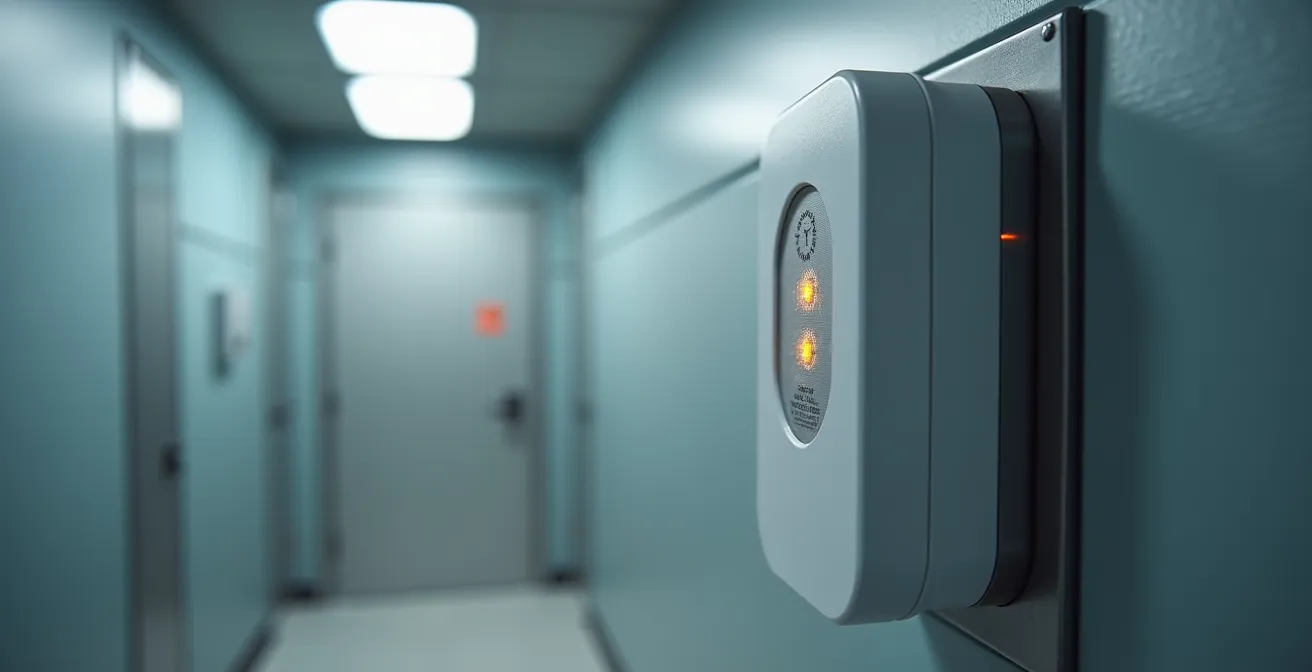
This technology can be integrated with other smart systems. Sensors can monitor the levels of paper towel and soap dispensers, sending alerts for refills before they run empty. Some systems even allow patrons to provide instant feedback. A case study on the WandaNEXT digital monitoring system, for example, showed that enabling real-time notifications from patrons to maintenance staff led to a 56% reduction in customer complaints. For a facility manager, this is not just about cleaning; it’s about resource management, predictive maintenance, and protecting brand reputation by ensuring a consistently positive customer experience.
Why Does Soap Scum Build Up Faster on Textured Tiles vs Smooth Surfaces?
Soap scum, that familiar filmy residue found on restroom surfaces, is more than an aesthetic nuisance; it’s a microbial stronghold. This buildup is a combination of mineral deposits from hard water (like calcium and magnesium), soap lipids, and body oils. Much like grout, textured tiles and other rough surfaces provide an ideal environment for this scum to accumulate. The microscopic peaks and valleys of a textured surface give the soap scum countless points to anchor onto, making it far more difficult to remove than from a smooth, glossy surface.
d
Once established, this layer of soap scum acts as a food source and a protective habitat for bacteria and mold. It creates a biofilm that shields these microorganisms from disinfectants, allowing them to thrive and produce odors. This is why a restroom with textured tiles often requires more frequent and aggressive cleaning to maintain the same level of hygiene as one with smooth, large-format porcelain or solid surface materials. The choice of surface material is a long-term strategic decision that directly impacts your cleaning budget and odor control effectiveness.
For facility managers in Quebec, who must also contend with the harsh effects of winter salts and grit being tracked indoors, the choice of flooring is even more critical. A durable, non-porous, and easy-to-clean surface is a frontline defense against both tracked-in soils and internal sources of contamination like soap scum and urine scale. While textured tiles might be chosen for their anti-slip properties, this benefit must be weighed against a lifetime of higher maintenance costs and greater hygiene challenges. Modern alternatives like large-format porcelain (with minimal grout lines) or seamless epoxy coatings offer superior performance.
The following table compares common restroom surface materials, providing a strategic overview for managers planning new builds or renovations in the demanding Quebec environment.
| Material Type | Initial Cost | Maintenance Frequency | Odor Resistance | Winter Performance |
|---|---|---|---|---|
| Textured Ceramic Tiles | Low | Daily cleaning required | Poor – traps bacteria | Susceptible to salt damage |
| Large Format Porcelain | Medium | 2-3x weekly | Good – fewer grout lines | Resistant to freeze-thaw |
| Epoxy-Sealed Surfaces | High | Weekly | Excellent – non-porous | Superior durability |
| Solid Surface Materials | Highest | Bi-weekly | Excellent – seamless | Best long-term value |
Why Do Elevator Buttons Transmit More Pathogens Than Toilet Seats?
The public perception of restroom hygiene often focuses obsessively on the toilet seat, but this is a dangerous misdirection. In reality, the toilet seat is often one of the cleaner surfaces in a commercial facility. The real threat lies in high-touch hotspots—the surfaces that are touched by dozens or hundreds of people between cleanings. Elevator buttons, door handles, light switches, and stall latches are far more likely to be vectors for pathogen transmission. The title’s premise is a hook to make a critical point: your cleaning strategy must focus on where the hands go, not just on the obvious fixtures.
A study published in the PLoS ONE journal, cited by HD Supply, confirms this, stating, “Bacterial microbes were commonly found on faucets, restroom stall and door handles, soap dispensers, toilets and floors.” These surfaces are repeatedly inoculated with microorganisms from unwashed or improperly washed hands. Unlike a toilet seat, which is typically dry and has less frequent skin contact, a damp door handle or a constantly-pressed button becomes a thriving junction for bacteria to transfer from one person to the next. Ignoring these hotspots is like locking the front door but leaving all the windows wide open.
A strategic cleaning plan must therefore prioritize these high-frequency touchpoints. This requires a shift in mindset for your cleaning staff, from a “room-based” approach to a “touchpoint-based” one. Disinfection of these hotspots should occur far more frequently than the general cleaning of the entire restroom, especially during peak hours. For a busy shopping center or restaurant, this could mean wiping down door handles and light switches hourly, while a full floor scrub might only be necessary twice a day. This targeted approach allocates resources more effectively and directly mitigates the primary risk of cross-contamination.
To implement this, it is crucial to create a priority list for your staff. The following checklist identifies the most critical and often-overlooked hotspots in a public restroom.
- Priority 1 (Highest Risk): Inside stall door locks and latches. These are touched by every user and are a primary transfer point. Disinfect every 1-2 hours during peak times.
- Priority 2: Faucet handles and soap dispenser levers/buttons. Constantly touched with contaminated hands before washing.
- Priority 3: Restroom entrance and exit door handles (especially the push plate on the way out).
- Priority 4: Sanitary disposal unit flaps and baby changing station surfaces. These require immediate disinfection after any visible use.
- Priority 5: Light switches, coat hooks, and bag hangers inside stalls.
Key Takeaways
- Persistent odors are symptoms of a systemic failure, not just a surface-level problem. Their source is often invisible biofilms and saturated porous materials.
- Effective odor control requires a shift from chemical masking to source elimination, using bio-enzymatic cleaners that destroy organic waste at a molecular level.
- Implementing a strategic system based on technology (touch-free cleaning), data (traffic counters), and science (biofilm removal) is the only way to achieve lasting hygiene and protect your reputation.
How to Remove Biofilms That Shield Bacteria from Chemical Attacks?
The ultimate enemy in the fight against restroom odors is the biofilm. A biofilm is not just a collection of bacteria; it’s a highly organized and protected colony. Bacteria secrete a sticky, slimy substance called a polysaccharide matrix, which allows them to adhere to surfaces like grout, pipes, and drains. This matrix acts like a fortress, shielding the bacteria inside from attack by traditional disinfectants and sanitizers. You can spray bleach on a biofilm all day, and it will only kill the outer layer, leaving the core colony intact and ready to regrow, often stronger than before. This is why odors return so quickly after a standard cleaning.
Eradicating a biofilm requires a two-pronged “breach and kill” strategy. You cannot kill what you cannot reach. The first step is to breach the protective shield. This is accomplished not with a disinfectant, but with a specialized surfactant or an enzyme-based cleaner. These agents are designed specifically to break down the polysaccharide matrix, dissolving the shield and exposing the vulnerable bacteria underneath. This step is often overlooked but is the most critical for success. Without breaching the shield, any disinfectant you apply is largely wasted.
Only after the biofilm has been breached can the “kill” phase begin. Once the bacteria are exposed, a high-quality, EPA-registered disinfectant must be applied and, crucially, given the proper dwell time. This is the minimum amount of time a disinfectant must remain wet on a surface to be effective, typically 10 minutes. Simply spraying and wiping immediately is useless. The disinfectant needs time to work. Following this protocol with mechanical agitation (scrubbing) ensures the complete removal of the microbial stronghold. This systematic approach is the only way to move from temporarily suppressing odors to permanently eliminating their source.
Action Plan: The ‘Breach and Kill’ Biofilm Protocol
- Identify Hotspots: Using a blacklight or visual inspection, map all key contact areas where biofilms are likely to form, including floor drains, grout lines, and under fixture rims.
- Breach the Shield: Apply a specialized enzyme-based cleaner or surfactant to all identified hotspots, letting it dwell for 10-15 minutes to dissolve the protective polysaccharide shield.
- Disrupt the Matrix: Use vigorous mechanical action, such as a stiff-bristled grout brush or a low-speed orbital scrubber, to physically break apart the biofilm structure.
- Eliminate the Colony: Apply an EPA-registered disinfectant, ensuring the surface remains wet for the full manufacturer-recommended dwell time (typically 10 minutes) to kill the exposed bacteria.
- Validate and Prevent: After rinsing, use an ATP meter to verify that microbial loads have been drastically reduced. Implement a weekly preventative treatment with an enzymatic cleaner to stop new biofilms from forming.
By shifting your perspective from simple cleaning to strategic sanitation, you transform restroom maintenance from a recurring expense into a reputation-enhancing investment. This systematic approach, founded on science and data, not only resolves persistent odor problems but also creates a healthier, safer, and more welcoming environment for your customers and staff. The next logical step is to audit your current procedures and equipment to identify the gaps. A comprehensive assessment of your surfaces, ventilation, and cleaning protocols will reveal the most impactful areas for immediate improvement.