
Salt damage isn’t an inevitable cost of doing business in Quebec; it’s a failure of your building’s defense system.
- Implement a 3-zone, 15-foot matting system to capture over 80% of salt and slush at the door.
- Use a dedicated chemical neutralizer—not just a standard cleaner—to dissolve corrosive calcium chloride residue and prevent permanent damage.
Recommendation: Shift from reactive mopping to a proactive strategy where cleaning frequency is dictated by specific winter weather thresholds.
For any Quebec business owner, the crunch of salt under a customer’s boot is the sound of winter. But it’s also the sound of your floors being slowly destroyed. Every season, you fight the same battle: a persistent white haze on your tiles, corroding metal door frames, and carpet stains that reappear no matter how much you clean. You’ve put down mats and told your staff to mop more often, but the damage continues, leading to costly repairs and a constant feeling of frustration. The problem is that these common tactics are merely reactive skirmishes in a battle that requires a full-fledged strategy.
The truth is, winter salt, especially the calcium chloride used during Quebec’s harshest freezes, is a chemical and physical assault on your property. Treating it with just soap and water is like trying to put out a chemical fire with a garden hose. To truly protect your investment, you need to stop thinking about “cleaning” and start thinking about a proactive, multi-layered defense system. This system anticipates weather events, deploys the right chemical countermeasures, and uses the physics of foot traffic to your advantage.
This guide will move beyond the basics to provide an expert framework for protecting your commercial entryways. We will deconstruct the threat and build your defense layer by layer, covering everything from weather-based cleaning triggers and effective chemical neutralization to a detailed analysis of the most crucial element in your arsenal: your matting system. It’s time to take control and win the war against winter salt damage.
To navigate this comprehensive defense strategy, this article is structured to build your expertise from the ground up. Explore the sections below to master each critical component of entryway protection for a Quebec winter.
Summary: A Proactive Defense Against Winter Salt Damage
- When to Increase Cleaning Frequency: The 3 Critical Snowfall Thresholds
- How to Use Chemical Neutralizers Effectively on Carpets Saturated with Calcium?
- The Hidden Corrosion Risk Salt Poses to Your Building’s Metal Door Frames
- Rock Salt or Ice Melt: Which Product Protects Your Concrete Walkways Better?
- How Placing 15 Feet of Matting Can Capture 80% of Debris Before It Enters?
- How to Calculate the “Rule of 15 Feet” for Your Building’s Entrance?
- How Does Foot Traffic Turn Salt Grains into Cutting Tools for Wax?
- Rental Mats vs Owned Mats: Which Solution Is Most Cost-Effective for Quebec Winters?
When to Increase Cleaning Frequency: The 3 Critical Snowfall Thresholds
The generic advice to “clean regularly” is useless in a Quebec winter, where conditions can shift from dry cold to a full-blown *verglas* (ice storm) in hours. A proactive defense requires a dynamic approach. Instead of a fixed schedule, your cleaning frequency must be dictated by specific weather-based triggers. This is threshold-based cleaning: a system where you escalate your response based on the type and intensity of the precipitation and municipal action. An effective system relies on three primary thresholds.
The first threshold is tied directly to municipal services. You should schedule a full cleaning of your entryways immediately after you see city trucks spreading salt or brine, regardless of the current snow accumulation. This pre-emptive strike removes the highly corrosive materials before they can be tracked inside in large quantities. The second threshold is activated during ice storms or when temperatures hover near freezing, leading to heavy salt application. During these events, increase cleaning frequency to every hour. The high concentration of calcium chloride demands constant removal to prevent saturation.
The final threshold addresses slushy conditions, typically when temperatures are between -2°C and +2°C. This wet, heavy mixture is particularly effective at carrying salt deep into a building. During these periods, a two-hour cleaning cycle is necessary to manage the continuous flow of liquid brine. By monitoring snow removal alerts from cities like Montreal or Quebec City and scheduling extra staff on days with heavy snowfall predictions, you transform your cleaning from a reactive chore into a strategic defense against chemical assault.
How to Use Chemical Neutralizers Effectively on Carpets Saturated with Calcium?
When the white, chalky residue of calcium chloride appears on your carpets, your first instinct might be to use a standard carpet cleaner. This is a critical mistake. Fighting this residue is a form of chemical warfare, and using the wrong weapon will only make things worse. Standard cleaners often have a high pH that fails to dissolve the low-pH, alkaline salt crystals. This leads to “wicking,” where the stain seems to disappear when wet but reappears as the carpet dries, pulling dissolved salt from the backing to the surface. The only effective weapon is a dedicated, acidic floor neutralizer.

As this magnified view shows, salt crystals embed themselves deep within carpet fibers. Using a neutralizer isn’t just about surface cleaning; it’s about dissolving these crystals completely. The process must be methodical. First, vacuum the area thoroughly to remove any loose, solid salt particles. Then, apply the floor neutralizer, diluted according to the manufacturer’s instructions (typically around 4oz per gallon for heavy slush). The most crucial step follows: allow a 10-minute dwell time. This is non-negotiable, as it gives the acid time to chemically break down the calcium chloride. After dwelling, agitate the area with a carpet brush to work the solution deep into the fibers. Finally, extract the area using only clean, hot water. Adding chemicals to your extractor will re-contaminate the carpet and undermine the entire process.
Professional Protocol for Calcium Chloride Removal
A professional 6-step protocol demonstrates the importance of proper neutralizer use. It begins with thorough vacuuming, followed by the application of a floor neutralizer with a 10-minute dwell time. A spotting brush then works the solution into fibers, followed by a clean water extraction. According to an in-depth guide on removing ice melt, this method is specifically designed to prevent the wicking effect, a common problem when calcium chloride isn’t fully dissolved and extracted from deep within the carpet pile.
The Hidden Corrosion Risk Salt Poses to Your Building’s Metal Door Frames
While floor damage is highly visible, a more sinister threat is quietly eating away at your building’s structural components: corrosion. The constant exposure to salt-laden slush and brine is particularly destructive to metal door frames, thresholds, and railings. The chloride ions in rock salt and calcium chloride accelerate the rusting of steel and cause severe pitting in aluminum. This damage is not merely cosmetic; it can compromise the integrity of the door seals, leading to energy loss, and eventually require a full frame replacement. The financial stakes are high, as what starts as minor discoloration can quickly escalate.
The cost of inaction is staggering. Annual preventative sealing and maintenance might cost around $100 per entryway, a minor operational expense. In contrast, allowing corrosion to take hold can lead to a complete commercial door frame replacement, a project that can easily cost between $5,000 and $10,000. This thousand-fold increase in cost highlights the critical importance of a proactive protection strategy. The most vulnerable area is the bottom 12 inches of any metal frame, where slush and salt accumulate.
Implementing a pre-winter protection plan is the most effective way to provide this sacrificial protection. This involves cleaning frames with a neutralizer to remove last season’s residue and then applying a barrier product. Marine-grade wax or a clear silicone sealant can create an impermeable layer that prevents chlorides from ever reaching the metal. This simple, low-cost procedure is one of the highest-return investments you can make in winter building maintenance.
Your Pre-Winter Metal Protection Checklist
- October: Inspect all metal door frames for existing corrosion or pitting and document their condition.
- Clean frames thoroughly with a neutralizer to remove any salt residue from the previous winter.
- Apply a marine-grade protective wax or silicone sealant to the bottom 12 inches of the frames.
- For aluminum frames, consider installing sacrificial zinc strips to prevent galvanic corrosion.
- Schedule a mid-winter inspection in January to check the sealant’s integrity and reapply if necessary.
Rock Salt or Ice Melt: Which Product Protects Your Concrete Walkways Better?
The first line of defense in your entryway protection system begins outside, on your walkways. The choice of de-icing product has a direct impact on how much corrosive material gets tracked inside and the long-term health of your concrete. Not all ice melters are created equal. The most common and cheapest option, rock salt (sodium chloride), is effective only down to about -9°C and is highly damaging to concrete, especially older or unsealed surfaces. It works by creating a brine that refreezes, leading to freeze-thaw cycles that cause spalling and cracking.
For the colder temperatures common in Quebec, products like calcium chloride (effective to -25°C) and magnesium chloride (effective to -15°C) are more reliable. While more expensive, they are generally less harmful to concrete. Magnesium chloride is often considered the safest option for concrete and surrounding vegetation. A growing trend, successfully piloted by Quebec’s Ministère des Transports, is the use of anti-icing liquids like beet juice blends. These are applied *before* a storm to prevent ice from bonding to the surface, reducing the total amount of salt needed by up to 75% and minimizing environmental impact.
This proactive anti-icing strategy, borrowed from municipal road crews, is a game-changer for commercial properties. By preventing the strong bond of ice to concrete, you require less chemical product to achieve safe, clear walkways, thereby reducing the amount of corrosive material available to be tracked into your business.
This comparative table, based on an analysis of de-icing product impacts, breaks down the key decision factors for a Quebec business owner.
| Product Type | Effective Temperature | Concrete Impact | Cost Factor | Environmental Impact |
|---|---|---|---|---|
| Rock Salt (Sodium Chloride) | To -9°C | High damage to older concrete | Lowest cost | High – damages vegetation |
| Calcium Chloride | To -25°C | Moderate damage | 3x rock salt cost | Less vegetation damage |
| Magnesium Chloride | To -15°C | Lowest concrete damage | 4x rock salt cost | Safest for plants |
| Beet Juice Blend | To -20°C | Minimal damage | 2x rock salt cost | Eco-friendly option |
How Placing 15 Feet of Matting Can Capture 80% of Debris Before It Enters?
If there is one silver bullet in your defense against salt damage, it is a properly configured matting system. Mats are the frontline soldiers in your defense-in-depth strategy, and their job is to capture dirt, moisture, and salt before they ever touch your interior floors. However, a single, small mat at the door is virtually useless. The key to effectiveness is length. Research consistently shows that it takes approximately 15 feet of matting to remove the vast majority of debris from the bottom of a person’s shoes. In fact, some research shows properly configured entry matting systems trap up to 90% of tracked-in soil.
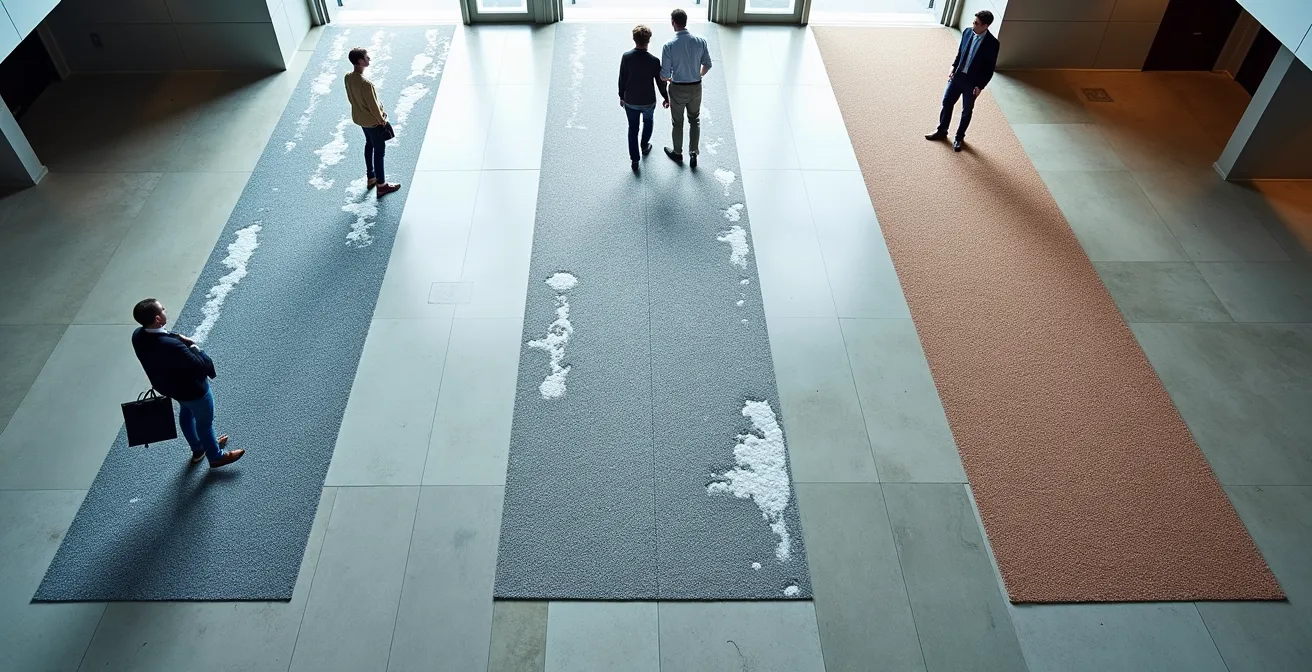
This isn’t just one long mat, but a strategic, three-zone system. As illustrated, each zone has a specific function:
- Zone 1 (Outdoor): A heavy-duty scraper mat. Its aggressive texture is designed to knock off heavy snow, ice chunks, and large debris before anyone enters the building. This should be the first 5 feet of your system.
- Zone 2 (Vestibule/Airlock): A wiper/scraper mat. This hybrid mat continues to scrape off smaller particles like salt crystals and slush while beginning to absorb moisture. This covers the next 5 feet.
- Zone 3 (Indoor): A high-absorption wiper/dryer mat. The final 5 feet of the system, its primary job is to capture any remaining moisture and fine particles, ensuring shoes are clean and dry before stepping onto your finished floors.
This 15-foot, three-zone system is the foundation of a clean and safe entryway. It ensures that by the time a customer reaches your main floor, their shoes have been scraped and wiped clean across multiple surfaces, drastically reducing the amount of corrosive salt and damaging grit that gets tracked inside.
How to Calculate the “Rule of 15 Feet” for Your Building’s Entrance?
The “Rule of 15 Feet” is the cornerstone of an effective matting strategy, but it’s a guideline, not an absolute. Calculating the optimal length for your specific building requires considering traffic volume, entryway design, and the realities of a Quebec winter. The baseline calculation is simple: the average person’s stride is about 2.5 feet, and it takes at least six steps to sufficiently wipe their shoes. This gives us our 2.5 feet/stride × 6 steps = 15 feet minimum.
However, you must adjust this baseline for your reality. If your business is in a high-traffic location, such as connected to a metro station or inside a shopping mall, you should increase the total length by at least 25%, aiming for closer to 20 feet of matting. You must also account for wheeled traffic like shopping carts, strollers, and wheelchairs by ensuring your matting covers the full width of the corridor, not just a narrow path. Don’t let a small vestibule deter you; if you lack 15 feet of interior space, create a hybrid system with 8 feet of high-performance scraper matting outside and 7 feet of absorption matting inside.
Finally, the “saturation factor” is critical. During peak winter months from December to March, or during heavy snow events, your mats will become saturated faster. Having an extra 5 feet of “overflow” matting ready to deploy can be the difference between a safe floor and a saturated, ineffective system. The goal is to provide enough surface area for effective soil removal, and facility management research confirms that 8-10 steps on matting removes 85% of tracked debris, reinforcing the need for adequate length.
How Does Foot Traffic Turn Salt Grains into Cutting Tools for Wax?
To understand why salt is so destructive to finished floors, you need to see it from a microscopic perspective. A shiny, waxed floor is protected by several thin layers of acrylic finish. When a person tracks in a dry grain of rock salt, it’s initially just a piece of debris. The moment another person steps on that grain, your floor’s finish is put under assault. The pressure from a footstep turns that tiny, crystalline salt particle into a piece of sandpaper. This is the “Abrasion Engine” at work: foot traffic provides the force that transforms harmless-looking salt into a powerful cutting tool.
The destruction occurs in predictable stages. First comes hazing. The sharp edges of the salt crystals create thousands of microscopic scratches in the top layer of the wax. This diffuses light and makes the floor appear dull and cloudy. As the abrasion continues, the process moves to the second stage: visible abrasion. Here, the protective gloss layers are completely ground away, and the scratches become deep enough to be seen with the naked eye. Your floor looks worn and tired, even if it was recently polished.
The final stage is complete stripping. The relentless grinding action of the Abrasion Engine eventually wears through all the protective layers of wax, exposing the vulnerable flooring material beneath. At this point, the salt can cause permanent staining or damage to the tile or wood itself. According to floor care experts, this process can be shockingly fast. In high-traffic Quebec businesses, uncontrolled salt exposure can reduce the lifespan of a wax finish from a full year down to just six to eight weeks, forcing costly and disruptive stripping and refinishing procedures.
Key Takeaways
- A 15-foot, three-zone matting system is your most critical defense, capturing up to 90% of salt and debris at the door.
- Always use a dedicated, acidic chemical neutralizer to dissolve calcium chloride; standard cleaners are ineffective and can worsen stains.
- Shift from a fixed cleaning schedule to a threshold-based model, increasing frequency during specific weather events like slush or *verglas*.
Rental Mats vs Owned Mats: Which Solution Is Most Cost-Effective for Quebec Winters?
Once you’ve committed to a proper matting system, the final strategic question is one of logistics and finance: is it more cost-effective to rent or own your mats? There isn’t a single right answer; the optimal choice depends on your business’s specific needs, storage capacity, and staffing. A rental service offers a compelling, low-hassle option. There is no large upfront investment, just a predictable weekly fee. Professional cleaning and replacement of worn mats are included, freeing your staff from a difficult and time-consuming task.
On the other hand, owning your mats provides ultimate control and flexibility. While it requires a significant initial investment of $500 to $2000 or more, you have the exact mats you want, available 24/7. This is a crucial advantage during a sudden snowstorm, as you can swap out a saturated mat immediately instead of waiting for a scheduled delivery from a rental service. However, ownership means you are responsible for the labor and equipment required for cleaning, as well as finding storage space for the mats during the off-season.
For many Quebec businesses, a hybrid strategy offers the best of both worlds. This involves owning your primary 15-foot, three-zone system for daily use and immediate response capability. You then supplement this with a rental service for “overflow” mats used only during the peak winter months or severe weather events. This approach balances cost, control, and convenience, ensuring you are never left unprotected. A Barrie coffee shop, facing similar harsh winter conditions, found success with this model, maintaining consistent protection while managing costs effectively.
This analysis, based on data from a leading mat rental service provider, compares the two approaches across key factors.
| Factor | Rental Mats | Owned Mats |
|---|---|---|
| Initial Investment | None – small weekly fee | $500-2000 upfront |
| Maintenance | Professional cleaning included | In-house labor + equipment |
| Replacement | No-charge when worn | Full replacement cost |
| Flexibility | Adjust quantity seasonally | Fixed inventory |
| Storage | Not required | Space needed off-season |
| Emergency Response | Limited by service schedule | Immediate swap capability |
Stop treating winter damage as an inevitable cost. Start building your defense system today. Use this guide to audit your entryways, plan your multi-zone matting, and equip your staff with the right chemicals and protocols before the first snowfall hits.