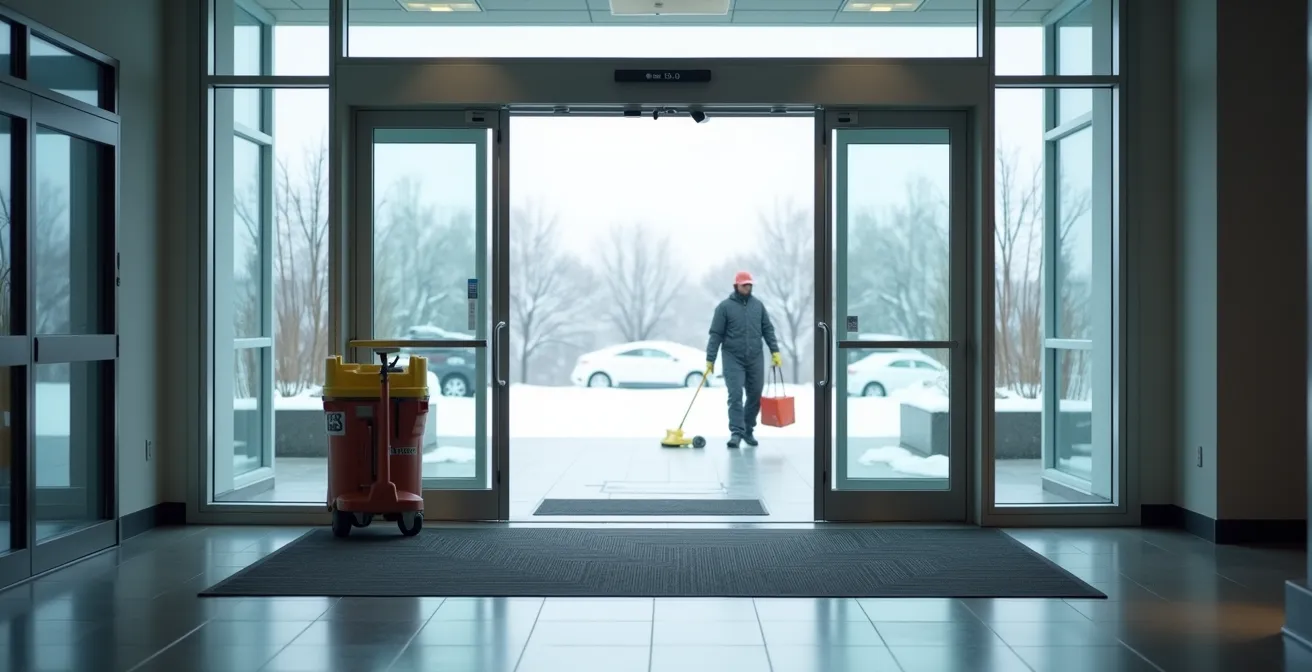
The greatest liability risk for Quebec businesses in winter isn’t the visible slush, but the invisible, slippery chemical film left behind by ice melters and improper cleaning.
- Standard mopping often fails to neutralize salt residues, creating a persistent slip hazard even on “clean” floors.
- A legally defensible safety program relies on documented procedures, precise logbooks, and strategic hazard neutralization, not just routine cleaning.
Recommendation: Shift your focus from simple wet-floor management to a systematic, documented “System of Care” that actively neutralizes chemical hazards and proves your due diligence in court.
As a Quebec business owner, the first winter snowfall brings a familiar sense of dread that has little to do with the cold. It’s the sight of slushy boot prints trailing across your entrance, each one representing a potential slip-and-fall claim. You diligently follow the standard playbook: you deploy entrance mats, your staff mops the floors regularly, and bright yellow “Wet Floor” signs become a permanent fixture until April. You believe you are doing everything right to ensure customer safety and protect your business from the costly litigation that follows an accident.
But what if this routine is creating a false sense of security? What if the very products used to keep walkways safe outside are creating a far more insidious hazard inside? The uncomfortable truth is that your legal liability doesn’t end with a clean-looking floor. In the eyes of the law, especially under Quebec’s Civil Code, your responsibility is to maintain a “reasonably safe” environment, a standard that goes far beyond surface-level appearances. The critical mistake most commercial spaces make is underestimating the chemical nature of winter floor care.
The real key to mitigating liability lies not in mopping more frequently, but in understanding and neutralizing the hazards you can’t see. This guide moves beyond the platitudes of basic maintenance. As a risk management specialist, we will deconstruct the science behind why “clean” floors remain dangerously slippery and provide a systematic framework for building a legally defensible floor safety program. We will shift your perspective from reactive cleaning to proactive hazard neutralization, focusing on the documentation, procedures, and strategic choices that will truly shield your business from liability claims.
This article provides a comprehensive roadmap for every Quebec commercial property owner. We will explore the specific legal obligations you face, the technical standards for floor safety, and the procedural missteps that can leave you defenseless after an incident. Follow along to transform your winter maintenance from a chore into a robust liability shield.
Summary: How to Reduce Slip-and-Fall Liability Claims in Quebec Commercial Spaces During Winter?
- Why Do “Clean” Floors Remain Slippery Even After Professional Mopping?
- How to Measure the Dynamic Coefficient of Friction (DCOF) on Your Floors?
- High-Velocity Floor Fans vs Extra Matting: Which Dries Entryways Faster?
- The Logbook Mistake That Makes You Defenseless in Court After an Accident
- How to Implement a Non-Slip Footwear Policy That Employees Will Actually Follow?
- Rock Salt or Ice Melt: Which Product Protects Your Concrete Walkways Better?
- How to Place Wet Floor Signs Correctly to Minimize Legal Liability?
- Preventing Slips and Falls: What Are Your Legal Obligations for Floor Maintenance in Quebec?
Why Do “Clean” Floors Remain Slippery Even After Professional Mopping?
The most frustrating scenario for a diligent business owner is a slip-and-fall incident on a floor that was just mopped. The cause is often an invisible enemy I call the “Quebec Brine Effect.” When rock salt and ice melters (sodium and calcium chloride) are tracked indoors, they dissolve in the melted snow and slush. Standard cleaning detergents are often alkaline and react with these chloride salts, creating a crystalline residue that is imperceptible to the naked eye but drastically reduces the floor’s coefficient of friction. You are, in effect, leaving a microscopic layer of slippery salt film on the surface, even after the water has evaporated.

This hazy, greasy film is the primary culprit behind winter slips on seemingly dry floors. To combat this, your cleaning protocol must evolve from simple washing to active chemical neutralization. This involves using a pH-neutral cleaner or a specific salt-neutralizing solution designed to break down chloride residues without damaging your floor’s finish. Without this crucial step, your mopping efforts, no matter how frequent, may inadvertently be making the floor more hazardous.
Case Study: Neutralizing the “Quebec Brine Effect” with Specialized Cleaners
To address this specific issue, some Canadian suppliers have developed targeted solutions. For example, Dustbane’s Film Away is an ECOLOGO-certified product formulated to tackle this problem directly. As a pH-balanced neutral detergent, it’s engineered to dissolve and remove ice melt residues without reacting negatively with them. By breaking down the salt film, it restores the floor’s original finish and slip resistance, effectively neutralizing the invisible slippery layer that persists after mopping with conventional cleaners. This demonstrates a shift from a purely aesthetic cleaning approach to a functional, risk-mitigating one.
Adopting a two-stage cleaning process—first removing debris and water, then neutralizing salt residue—is fundamental to building a defensible maintenance system. This demonstrates a higher level of care and understanding of the specific risks posed by Quebec winter conditions, a key factor in mitigating legal liability.
How to Measure the Dynamic Coefficient of Friction (DCOF) on Your Floors?
While the term “Dynamic Coefficient of Friction” (DCOF) sounds highly technical, its concept is simple: it is a quantifiable, real-world measure of a floor’s slipperiness when an object (like a person’s shoe) is in motion. For a business owner, DCOF is not an abstract scientific metric; it’s a critical piece of evidence. Proactively knowing and documenting your floor’s DCOF rating demonstrates a sophisticated approach to safety and can be a powerful tool in defending against a liability claim. It moves the conversation from a subjective “it felt slippery” to an objective, data-driven discussion.
The industry standard for this measurement is ANSI A326.3, which uses a device called a tribometer (like the BOT-3000E) to test surfaces. According to the 2022 ANSI A326.3 revision, a minimum DCOF of 0.42 is the accepted value for interior, level surfaces that are expected to be walked upon when wet. If your floors test below this threshold, they can be considered hazardous from a risk management perspective. Having your floors periodically tested and certified, especially high-traffic entranceways, provides a documented baseline of safety.
While the ANSI standard is recognized in North America for comparative analysis, other methods are used globally and may offer additional context for legal defensibility. Understanding the different testing methods allows you to have a more informed conversation with safety consultants and legal counsel.
| Test Method | Measurement Range | Legal Defensibility | Best Application |
|---|---|---|---|
| ANSI A326.3 (BOT-3000E) | 0.42-0.55 DCOF | Recognized in North America but states it ‘does not predict likelihood of slip’ | Comparative surface analysis only |
| British Pendulum DCOF | 25-36+ PTV | Used in 50+ nations with 50 years of research | Real-world slip risk assessment |
| NFSI B101.3 | High/Moderate/Low traction zones | Accepted for walkway auditing | Field testing of existing floors |
As a property owner, you aren’t expected to perform these tests yourself. However, engaging a qualified third-party walkway auditor to test your floors and provide a report is a powerful, proactive step. This report serves as documented proof that your flooring surfaces met or exceeded industry safety standards at a specific point in time, building a crucial layer of your legal defensibility.
High-Velocity Floor Fans vs Extra Matting: Which Dries Entryways Faster?
When an entryway is covered in slush and water, the primary goal is to remove the hazard as quickly as possible. The two most common tools are more mats to absorb the moisture and high-velocity fans to evaporate it. Both have a place in a comprehensive safety program, but their effectiveness depends on the situation. The choice is not simply about speed, but about managing the hazard effectively. An over-reliance on one method can introduce new risks.
Extra matting is an excellent first line of defense. A well-designed three-zone system, as recommended by suppliers like Canada Mats, is crucial. This includes an aggressive outdoor scraper mat, a transitional wet area mat, and finally an indoor anti-fatigue or runner mat. The goal is to capture the majority of debris, slush, and water before it ever reaches your primary flooring. However, mats have a saturation point. Once a mat is waterlogged, it ceases to be a solution and becomes a source of the problem, seeping water onto the surrounding floor. They also require daily maintenance—cleaning and drying—to remain effective.
High-velocity floor fans, on the other hand, are designed for rapid evaporation. They are most effective after the bulk of the water has been mopped up. Their powerful airflow can dry a damp floor in a fraction of the time it would take to air-dry, significantly reducing the duration of the hazard. However, they are not a standalone solution. They can be noisy, create a trip hazard with their cords, and are ineffective on large puddles. Their best use is as a secondary tool to quickly restore a mopped area to a safe, dry state.
In Canada, more than 42,000 workers get injured annually due to falls. Statistics show the majority (66%) are due to slips and trips on the same level
– WorkSafeNB, Winter Safety: Prevent slips, trips and falls
A truly defensible strategy integrates both. Use a robust matting system as your primary capture method, and ensure staff are trained to deploy floor fans immediately after mopping to minimize the time a floor remains wet. Documenting the use of both in your maintenance log—’Mat in Zone A replaced at 2:15 PM,’ ‘Floor fan deployed in entrance corridor at 2:20 PM’—demonstrates a multi-faceted approach to hazard management.
The Logbook Mistake That Makes You Defenseless in Court After an Accident
Nearly every business keeps some form of maintenance logbook. However, from a legal perspective, most are practically useless. The single biggest mistake is vagueness. Entries like “Cleaned entrance” or “Mopped floor in afternoon” provide no defensible details. In the event of a claim, a plaintiff’s lawyer will dismantle such a log, arguing it proves nothing about the specific conditions at the time of the incident. A logbook is not just a task list; it is your primary piece of evidence demonstrating a consistent and reasonable System of Care.
To be legally defensible, a logbook must create a clear, unambiguous record of your actions. It needs to tell a story of diligence that anyone can understand. This means replacing generalities with specific, quantifiable details. For example, instead of “mopped floor,” a strong entry would be “Mopped 1.5L of slush/water from Zone A entrance corridor.” This quantifies the hazard. Similarly, documenting the placement of safety equipment—”Placed 3 bilingual wet floor signs at entrance, middle, and exit of wet area at 2:05 PM”—establishes that you took active steps to warn visitors.

Accountability is the final pillar of a defensible log. Every entry must be tied to a specific individual through a legible signature and, ideally, an employee ID or initials. This creates a chain of accountability and shows that your safety protocols are being executed by trained staff. Vague, unsigned logs suggest a casual, undocumented process—the very thing you want to avoid projecting in a legal setting. Investing in training your staff on how to properly complete a detailed logbook is one of the highest-return investments you can make in risk management.
Action Plan: Creating Legally Defensible Maintenance Logbooks
- Record exact time and location: Use specific zone descriptions like ‘2:05 PM: Zone A entrance’ instead of vague ‘afternoon cleaning’.
- Quantify the hazard addressed: Note ‘mopped approx. 1.5L of slush/water’ rather than just ‘cleaned floor’ to show the scale of the issue.
- Document safety measures taken: Specify actions like ‘3 wet floor signs placed at entrance, middle, and exit of wet area’.
- Include corrective actions taken: Detail immediate fixes such as ‘Identified loose mat corner, secured with industrial tape immediately’.
- Require legible signatures and employee ID: Ensure each entry is signed to establish a clear chain of accountability.
How to Implement a Non-Slip Footwear Policy That Employees Will Actually Follow?
While you can’t control what your customers wear, you can and should establish a non-slip footwear policy for your employees. This is a critical component of your internal risk management for two reasons: it directly protects your staff from injury, and it demonstrates to insurers and courts that you are fostering a comprehensive safety culture. However, a policy is only effective if it’s practical and followed. The key to compliance is a combination of clear standards, employee education, and making it easy for them to participate.
First, the policy must define what “slip-resistant” means in the context of a Canadian winter. According to the Canadian Centre for Occupational Health and Safety (CCOHS), suitable footwear should feature deep tread patterns for traction, flexible soles that maintain contact with the ground in cold temperatures, and materials rated for winter conditions. For outdoor or extremely icy areas, attachable ice grippers can be mandated as part of the required Personal Protective Equipment (PPE). Your policy should clearly state these requirements, which are justified by your workplace’s hazard assessment.
Simply mandating expensive safety footwear without support is a recipe for non-compliance. To ensure employees actually follow the policy, you need to remove barriers. The most effective approach is to offer a subsidy or full reimbursement for approved footwear. If that’s not financially feasible, consider alternative programs that encourage adoption. Arranging a group purchasing discount with a local supplier or setting up a payroll deduction plan can make approved footwear much more accessible and affordable for your team. This shows you’re a partner in their safety, not just an enforcer of rules.
Finally, education is crucial. Explain *why* the policy is in place by sharing statistics on workplace falls. Demonstrate the difference between a regular shoe sole and a proper slip-resistant tread. When employees understand the personal risk they are mitigating, they are far more likely to see the policy as a benefit rather than a burden. This collaborative approach is far more effective than a top-down mandate and strengthens your overall safety posture.
Rock Salt or Ice Melt: Which Product Protects Your Concrete Walkways Better?
The choice of de-icing product for your exterior walkways has a direct impact on interior floor safety and long-term property maintenance costs. While many use the terms “rock salt” and “ice melt” interchangeably, they are chemically distinct products with different performance characteristics, costs, and side effects. Selecting the right one is a strategic decision that balances effectiveness with potential damage to your property and the risk of indoor slip hazards.
Rock salt (Sodium Chloride) is the most common and cheapest option. It is effective at melting ice at temperatures down to -9°C. However, it is highly corrosive to concrete, causing spalling and degradation over time. More importantly for interior safety, it tracks indoors easily, leaving a white, powdery residue that is the primary ingredient of the “Quebec Brine Effect,” leading to slippery floors and damaged finishes.
Ice melts, such as those based on Calcium Chloride or Magnesium Chloride, are more advanced and generally safer for your property. Calcium Chloride works at much colder temperatures (down to -25°C) and is less damaging to concrete than rock salt. Magnesium Chloride is considered one of the safest for concrete and surrounding vegetation, though it works at a slightly warmer temperature range. While these products are more expensive upfront, they significantly reduce the long-term costs of concrete repair and intensive interior floor maintenance. Montreal-based suppliers like Lalema Inc. even offer specialized detergents like NEUTRASEL to specifically combat the alkaline residues tracked in from these products.
The table below breaks down the key differences to help you make an informed, risk-based decision.
| Product Type | Effective Temperature | Concrete Damage Risk | Indoor Tracking Impact | Cost per Season |
|---|---|---|---|---|
| Rock Salt (Sodium Chloride) | -9°C to 0°C | High – causes spalling and surface degradation | High – leaves white residue, increases floor maintenance | $ |
| Calcium Chloride | -25°C to 0°C | Moderate – less corrosive than rock salt | Moderate – oily residue can be slippery | $$ |
| Magnesium Chloride | -15°C to 0°C | Low – safer for concrete and vegetation | Low – minimal residue | $$$ |
| Sand/Grit Mix | All temperatures (traction only) | None – no chemical reaction | High – significant tracking, requires frequent cleaning | $ |
From a risk management perspective, choosing a de-icer with lower tracking impact, like Magnesium Chloride, can be a cost-effective strategy. The higher initial price is often offset by reduced floor maintenance labor, lower usage of neutralizing chemicals, and a decreased risk of interior slip-and-fall incidents.
How to Place Wet Floor Signs Correctly to Minimize Legal Liability?
Placing a “Wet Floor” sign seems like the simplest part of a floor safety program, but its placement and use are often scrutinized in legal proceedings. Simply dropping a sign on a puddle is not enough to absolve you of liability. Strategic sign placement is about effectively warning individuals *before* they encounter the hazard. A poorly placed sign can be argued as being just as negligent as no sign at all.
The primary rule is to place signs at all approach paths to the wet area. Think from the perspective of a customer entering your space. Where are their typical sight lines? A sign placed around a corner or behind a display is ineffective. In Quebec, it is essential that these signs are bilingual (French and English) to be considered an adequate warning for the general public. For larger spills or areas that are actively being mopped, high-visibility cones or retractable belt barriers are a better choice as they create a physical, unmissable barrier that prevents access entirely.
Premises in which there is a higher risk of spillage require more vigilant policies and procedures
– Ontario Superior Court, Souliere v Casino Niagara case ruling
Equally important is the prompt removal of signs once the floor is dry. Leaving signs out permanently leads to “sign blindness,” where customers and staff become so accustomed to seeing them that they no longer register as a warning. This devalues their effectiveness when a real, temporary hazard exists. Your logbook should document not only when signs were placed, but also when they were removed, proving the floor was verified as dry and safe.
A legally defensible sign protocol should include these key actions:
- Place bilingual (French/English) signs at all approach paths to the wet area, not just directly on the hazard.
- Position signs based on typical sight lines from main entrances and high-traffic corridors.
- Use high-visibility cones or retractable barriers for hazardous areas requiring complete avoidance.
- Document the exact time and location of sign placement and removal in your maintenance logbook.
- Remove signs promptly as soon as the floor is confirmed to be dry to prevent “sign blindness.”
This systematic approach elevates your use of signage from a reactive gesture to a documented, strategic component of your System of Care, making it far more difficult to challenge in a legal dispute.
Key Takeaways
- Systematic Care Over Routine Cleaning: Legal defensibility comes from a documented system—including pH-neutral cleaners, precise logbooks, and strategic signage—not just frequent mopping.
- Proactive Hazard Neutralization: The greatest risk is often the invisible salt film left on floors. Focus on chemically neutralizing this residue, not just removing visible water.
- Documentation is Your Shield: A vague logbook is useless in court. A detailed, timed, and signed record of specific actions is your most powerful piece of evidence.
Preventing Slips and Falls: What Are Your Legal Obligations for Floor Maintenance in Quebec?
Ultimately, all your floor maintenance efforts are measured against a legal standard known as the “duty of care.” Under the Civil Code of Quebec, as an owner or occupier of a commercial property, you have a legal obligation to take reasonable steps to ensure your premises are safe for all visitors. This standard is not about guaranteeing no one will ever fall; it is about proving you had a reasonable and consistent system in place to prevent foreseeable accidents. In the context of a Quebec winter, slushy and icy floors are a highly foreseeable hazard, which places a significant onus on you to manage it effectively.
The courts will assess whether your “System of Care” was what a reasonably prudent occupier would do in similar circumstances. This is where your documentation, policies, and procedures become your primary defense. Did you have a regular inspection schedule? Did you use the correct cleaning agents for the specific hazard (i.e., salt residue)? Were your staff trained? Was your equipment (mats, signs) appropriate and well-maintained? A “yes” to these questions, backed by your detailed logbook, builds a powerful case that you met your duty of care.
To meet your legal obligations, your winter floor maintenance program must be built on these fundamental pillars:
- Implement a regular, documented system for cleaning, maintaining, and inspecting the property.
- Display clear, visible, and bilingual warning signs for any hazards.
- Use physical barriers like tape or cones for particularly hazardous areas.
- Document all maintenance activities with specific timestamps, quantifiable details, and signatures.
- Address any slip and fall concerns raised by employees or customers immediately and document the response.
Failing on any of these points can be interpreted as a breach of your duty of care. The absence of a reasonable system implies negligence, making it much easier for a claimant to win a lawsuit. Your goal is to demonstrate that an incident occurred *in spite of* your robust safety system, not because of a lack of one.
Protecting your business from slip-and-fall liability is not about achieving perfection, but about demonstrating consistent, reasonable, and documented diligence. The next logical step is to audit your current winter maintenance procedures against the legally defensible standards outlined in this guide. Identifying and closing these gaps is the most effective action you can take to shield your business before the next snowfall arrives.