The key to overcoming staff resistance to hygiene protocols is not stricter enforcement, but smarter system design.
- Protocol fatigue is a predictable psychological phenomenon, not a sign of employee negligence.
- Visual systems, simplified routines, and micro-learning are more effective than memos and disciplinary action.
Recommendation: Shift your focus from managing people to engineering an environment where compliance becomes the easiest and most natural choice.
As a change manager in Quebec, you’ve likely faced this frustrating reality: the rigorous hygiene protocols established during the peak of the pandemic are now met with waning enthusiasm and outright resistance. The initial sense of urgency has faded, replaced by “protocol fatigue,” and your team is starting to cut corners. You’ve sent the memos, held the meetings, and perhaps even considered disciplinary action, but adherence continues to drop. This is a common challenge, where the default response is to increase pressure on staff.
The conventional wisdom tells us to communicate more, train harder, and enforce rules with an iron fist. But these top-down approaches often backfire, creating a culture of resentment rather than one of shared responsibility. They treat the symptom—non-compliance—without addressing the root cause. This is especially true in a Quebec context, where a consultative and supportive management style is often more effective than a punitive one. What if the problem isn’t your staff’s motivation, but the very system you’ve asked them to follow?
This guide offers a different perspective, grounded in change management and human psychology. We will explore the systemic reasons behind non-compliance, from cognitive overload to inattentional blindness. Instead of focusing on forcing adherence, you will learn how to re-engineer the work environment itself to make following hygiene protocols intuitive, efficient, and the path of least resistance. It’s about designing a system that works with human nature, not against it.
This article provides a framework to diagnose the core issues and implement practical, systems-based solutions. By understanding the psychology behind the resistance, you can build a resilient culture of safety that lasts long after the memos have been forgotten. The following sections break down these strategies into actionable steps.
Summary: A Manager’s Guide to Overcoming Hygiene Protocol Resistance
- Why Does Protocol Adherence Drop by 50% After Only 3 Months?
- How to Use Visual Aids and Shadow Boards to Enforce Cleaning Steps?
- Reward Programs vs Disciplinary Action: What Drives Better Hygiene Compliance?
- The “Too Many Steps” Mistake That Causes Staff to Cut Corners
- How Micro-Learning Sessions Can Refresh Hygiene Knowledge in 5 Minutes a Week?
- Why Do Cleaners Waste 20% of Their Time backtracking in Large Offices?
- Why Do Cleaners Stop Seeing Dust Bunnies in Corners Over Time?
- How to Conduct a Sanitary Inspection in a Commercial Building in Under 30 Minutes?
Why Does Protocol Adherence Drop by 50% After Only 3 Months?
The sharp decline in hygiene compliance a few months after implementation isn’t a sign of deliberate insubordination; it’s a predictable human response known as protocol fatigue. Initially, a new threat or rule creates a heightened state of awareness. However, the human brain is wired for efficiency and habit. Once the initial novelty and perceived danger wear off, maintaining a high level of vigilance requires significant mental energy. This cognitive load becomes unsustainable over time, leading employees to revert to old habits or find “shortcuts” that feel more efficient, even if they compromise safety.
This phenomenon is not about laziness. It’s about the brain’s natural tendency to automate repetitive tasks to conserve energy. When a protocol is complex, poorly integrated into the existing workflow, or seems disconnected from immediate consequences, its mental “priority” drops. Staff stop consciously thinking about each step and begin to operate on autopilot—an autopilot that was programmed before the new rules were introduced. In a fast-paced environment, the pressure to complete tasks quickly will almost always win against a cumbersome, mentally taxing protocol.
To combat this, the solution isn’t to simply remind or reprimand. As a manager, your role is to reduce the cognitive load required for compliance. The goal is to make the new, correct procedure the easiest and most automatic option. This involves embedding the protocol into the physical environment and daily routines, rather than relying on your team’s finite willpower and memory. For instance, implementing bilingual visual aids with universal icons helps bridge language gaps common in Quebec’s diverse workforce, and establishing peer-led “Hygiene Champions” creates social reinforcement that is more powerful than a top-down mandate.
How to Use Visual Aids and Shadow Boards to Enforce Cleaning Steps?
The most effective way to fight protocol fatigue is to make the environment the instructor. Instead of relying on memory, visual management systems provide clear, at-a-glance instructions exactly where and when they are needed. These tools externalize the protocol, removing the burden of remembering complex steps from the employee and embedding it into their physical workspace. This is a cornerstone of systemic design for compliance.
A prime example is the shadow board. This is a board where each cleaning tool has a designated spot with its outline traced. It accomplishes three things instantly: it shows what’s missing, ensures tools are returned to the right place, and reinforces a sense of order and professionalism. When combined with color-coding (e.g., red for high-risk areas like restrooms, blue for general office spaces), it creates a non-verbal language that transcends linguistic barriers—a critical advantage in a bilingual Quebec workplace. This system doesn’t just organize tools; it organizes the cleaning process itself.
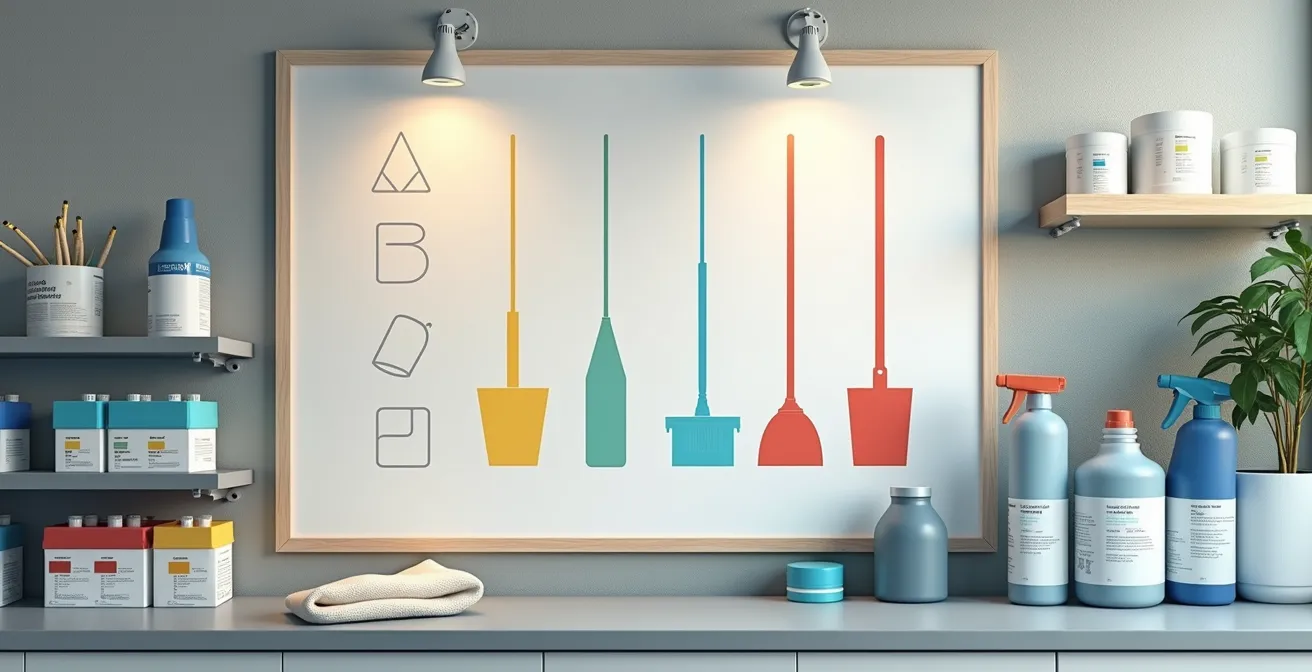
As the image demonstrates, a well-designed station creates an immediate sense of order. This visual clarity reduces the mental effort needed to find the right tool and follow the correct procedure. When comparing different types of aids, icon-based systems consistently outperform text-heavy instructions, especially in diverse teams. They require less training time and yield higher compliance rates. While the initial investment may be higher, the long-term gains in efficiency and safety provide a significant return.
This following table breaks down the effectiveness of different visual aid systems, highlighting why a hybrid approach often provides the best results in a regulated environment like Quebec.
| Feature | Text-Based Aids | Icon-Based Aids | Hybrid System |
|---|---|---|---|
| Language Barrier Impact | High – requires translation | Minimal – universally understood | Low – icons support text |
| Implementation Cost | $500-$1,000 | $800-$1,500 | $1,200-$2,000 |
| Compliance Rate | 65-70% | 80-85% | 85-90% |
| Training Time Required | 2-3 hours | 30-45 minutes | 1 hour |
| Quebec CNESST Alignment | Partial | Full | Full |
Reward Programs vs Disciplinary Action: What Drives Better Hygiene Compliance?
When faced with non-compliance, the managerial instinct can be to reach for the stick: disciplinary action. However, a punitive approach often fosters a culture of fear, hiding mistakes rather than correcting them. It frames hygiene as a chore to be done to avoid punishment, not as a shared value. In contrast, a well-designed reward system can be effective, but the most sustainable driver of compliance is creating an environment where employees feel respected, protected, and intrinsically motivated to maintain a clean space. Indeed, 86% of employees consider cleanliness a critical factor for their overall job satisfaction.
The key is to move away from a simple “if-then” reward structure (e.g., a gift card for perfect compliance), which can feel transactional. Instead, focus on recognition and creating a sense of collective ownership. This aligns perfectly with the Quebec workplace culture, which often values collaboration and consultation over rigid, top-down authority. A successful approach involves employees in the process, making them partners in maintaining safety.
One powerful strategy is to adopt a consultative approach, especially when changes to working conditions are needed. This principle is highlighted in the following case study, which reflects the typical labour relations environment in Quebec.
Case Study: The Quebec Consultative Approach to Compliance
In Quebec, where union presence is significant, unilateral changes to working conditions can be met with formal grievances. A more effective strategy, as noted by legal experts at Lavery, involves cooperation with employees and their representatives. For example, when new isolation protocols were required, employers who consulted with staff to offer solutions like paid leave—rather than simply mandating unpaid time off—achieved greater buy-in. This positions management as supportive and collaborative rather than punitive. This approach builds trust and demonstrates that the company values employee well-being, making staff more willing to reciprocate by adhering to hygiene protocols. It shifts the dynamic from “us vs. them” to a shared goal of a safe workplace.
By framing hygiene as a pillar of job satisfaction and adopting a supportive, consultative stance, you tap into a much more powerful motivator than fear. You build a resilient culture where people follow the rules because they want to, not because they have to.
The “Too Many Steps” Mistake That Causes Staff to Cut Corners
One of the most common and critical mistakes in protocol design is over-complication. When a hygiene procedure involves too many steps, it dramatically increases the cognitive load on employees. Each additional step is another item to remember, another moment of friction in a busy workflow. When faced with time pressure, staff will inevitably start cutting corners, and they almost always start by dropping the steps they perceive as least important. The problem isn’t that they are lazy; it’s that the system is too complex to be executed consistently under real-world conditions.
A streamlined, simplified process is far more resilient. The goal is to identify the Critical Control Points (CCPs)—the 20% of actions that prevent 80% of contamination risks. This often means focusing relentlessly on high-touch surfaces like door handles, light switches, and elevator buttons, and ensuring proper disinfectant contact time, a key standard set by organizations like Quebec’s CNESST. By stripping the protocol down to its most essential, high-impact elements, you make it easier to remember, faster to execute, and far more likely to be followed.
The secret is to make the critical steps non-negotiable and integrate them seamlessly into existing routines. This is a technique known as “task chaining,” where a new hygiene habit is linked to an established one (e.g., sanitizing your workstation immediately after clocking out). This reduces the mental effort required to initiate the new behaviour. The financial impact of such simplification is also significant; training data shows that teams that reduce cleaning time by just 30 minutes a day can save a company 1,300 payroll hours annually.
Your Action Plan for Auditing Cleaning Protocols
- Identify Contact Points: Map all high-touch surfaces and process steps where contamination can occur (e.g., door handles, shared equipment, payment terminals).
- Collect Current Practices: Observe and document the actual cleaning steps your team currently performs, not just what’s written in the manual.
- Assess for Coherence: Compare the observed practices against mandatory guidelines from Quebec bodies like CNESST, INSPQ, or MAPAQ. Is there a gap?
- Analyze for Mémorability: Identify which steps are consistently missed. Are they overly complex, poorly communicated, or seem redundant to staff?
- Create an Integration Plan: Redesign the protocol to focus only on the critical steps. Use visual aids and task chaining to integrate these essential actions into the daily workflow.
How Micro-Learning Sessions Can Refresh Hygiene Knowledge in 5 Minutes a Week?
Traditional training sessions—long, infrequent, and classroom-based—are notoriously ineffective for knowledge retention. The “Ebbinghaus forgetting curve” shows that we forget most of what we learn within days if the information isn’t reinforced. This is where micro-learning becomes a change manager’s most powerful tool. It consists of delivering training in short, focused bursts—typically 3 to 5 minutes—that can be easily integrated into the regular workday.
Instead of a one-hour annual refresher, imagine a five-minute video or a quick, interactive quiz delivered via a mobile app at the start of a shift. This approach is perfectly suited for refreshing hygiene protocols. You can cover a single topic, like the correct use of a new disinfectant, the proper technique for handwashing, or how to identify a specific contamination risk. Because the sessions are short and frequent, they repeatedly bring the information to the forefront of an employee’s mind, dramatically improving long-term retention.
The data on this method is compelling. For instance, SC Training research demonstrates that micro-learning modules of 5-10 minutes increase knowledge retention by 85% compared to just 12% for traditional, lecture-style instruction. This is because it aligns with how our brains actually learn: in small, digestible chunks, with frequent repetition over time. For a manager, this means a more knowledgeable team, higher compliance rates, and a more resilient safety culture, all achieved without pulling staff away from their duties for extended periods.
Case Study: The ROI of Segmented Training
Speed Cleaning’s Employee Training Manual provides a clear model for this approach. By breaking down complex cleaning procedures into short, digestible segments, companies can see tangible financial returns. For example, if 10 cleaning teams improve their efficiency by just 30 minutes per day through better-retained knowledge from micro-learning, the company saves 25 payroll hours per week. This can translate to approximately 1,300 payroll hours saved annually, a significant operational saving that directly results from a more effective training methodology.
Why Do Cleaners Waste 20% of Their Time backtracking in Large Offices?
Inefficiency in a cleaning operation is a hidden cost that directly impacts your budget and your team’s ability to adhere to protocols. A significant portion of this waste, often as much as 20% of a cleaner’s time, comes from unnecessary movement and backtracking. This happens when there is no logical, planned route for cleaning a large facility. A cleaner might travel from the 5th floor to the basement for a supply, only to return to the 5th floor to continue their work. Or they might clean a hallway, only to have to re-clean it after another task dirties it again. This isn’t poor performance; it’s a symptom of poor process design.
The solution is to think like a logistics expert and implement a systematic cleaning workflow. Two dominant methodologies are Zone Cleaning and Team Cleaning. In Zone Cleaning, one person is responsible for all tasks within a specific area. This works well in smaller, single-story buildings. However, in large, multi-level facilities like Montreal’s downtown towers, Team Cleaning is often far more efficient. In this model, each team member is a specialist (e.g., one person handles vacuums, another handles restrooms, a third does dusting and surfaces) and they move through the building in a coordinated, train-like fashion.
This specialization and planned routing can lead to significant time savings, often making the process 25-30% faster than traditional methods. It eliminates backtracking and ensures each task is performed with specialized tools by a trained expert. Choosing the right method depends on your facility’s layout, but implementing *any* systematic approach is a massive leap forward from letting cleaners wander without a plan.
The following table compares these methodologies, providing a framework for deciding which is best suited for different types of commercial buildings in Quebec.
| Method | Best For | Time Efficiency | Equipment Needs | Training Required |
|---|---|---|---|---|
| Zone Cleaning | Single-story industrial parks | 15-20% faster | Decentralized carts | 2-3 days |
| Team Cleaning | Multi-level Montreal towers | 25-30% faster | Specialized tools per person | 1 week |
| Hybrid Approach | Mixed-use buildings | 20-25% faster | Both systems | 5-7 days |
Why Do Cleaners Stop Seeing Dust Bunnies in Corners Over Time?
Have you ever noticed that a new cleaner on your team spots issues that veteran staff have been walking past for months? This isn’t because the long-term employees are becoming careless. They are experiencing a well-documented psychological phenomenon called inattentional blindness. The brain, in its quest for efficiency, learns to filter out predictable stimuli. After cleaning the same area day after day, a cleaner’s brain literally stops “seeing” the unchanging details, like the dust that slowly accumulates in a corner or the subtle grime on a baseboard. They are looking, but they are not seeing.
This is a critical concept for any manager overseeing hygiene. You cannot simply tell someone to “pay more attention.” Inattentional blindness is a feature of the human brain, not a bug in your employee’s performance. Therefore, you need a systemic solution to counteract it. The most effective strategy is to introduce novelty and change the perspective, forcing the brain to process the environment in a new way.
As the Cleaning Industry Management Standards (CIMS) highlight, this is a predictable function that systems must account for.
Inattentional Blindness is a predictable human brain function that systems must account for, not employee negligence. A fresh pair of eyes through zone rotation is far more likely to spot issues that the regular cleaner has become blind to.
– Cleaning Industry Management Standards, ISSA Training Guide
Implementing a system of monthly zone rotation is a simple but profoundly effective countermeasure. By having cleaners switch their assigned areas, you are constantly providing them with a “fresh pair of eyes.” Other techniques include conducting inspections by walking the cleaning path backwards or using tools like blacklight flashlights, which reveal organic matter that is invisible to the naked eye. These methods disrupt the brain’s autopilot and force a more conscious, detailed observation of the environment.
Key takeaways
- Staff resistance often stems from “protocol fatigue” and overly complex systems, not negligence.
- Visual aids, shadow boards, and simplified routines are more effective than memos and disciplinary action.
- A consultative, supportive approach, aligned with Quebec’s work culture, fosters greater buy-in than punitive measures.
How to Conduct a Sanitary Inspection in a Commercial Building in Under 30 Minutes?
A successful hygiene program requires verification. However, inspections should be efficient and strategic, not cumbersome. With the North American cleaning services market holding a dominant 45% of global revenue share, and Quebec businesses needing to meet strict CNESST standards, a fast and effective inspection process is a competitive advantage. The key is to focus on high-impact areas and use a structured methodology rather than a random walkthrough.
An effective 30-minute inspection is built on a “hot spot” approach. Instead of trying to see everything, you focus on a pre-determined list of critical areas that are the best indicators of the overall state of cleanliness. This includes the “First Five” points a customer or employee sees upon entering (e.g., entrance glass, reception desk) and high-consequence areas that pose the greatest risk if neglected (e.g., food preparation surfaces, restroom fixtures). During winter in Quebec, this focus must shift to include specific hazards like salt accumulation on entrance mats and wetness in locker rooms.
Using a standardized, bilingual checklist is essential. This ensures consistency between inspections and across different inspectors. It also provides clear, objective data that can be used for feedback and training, rather than subjective opinions. The goal of the inspection isn’t to “catch” employees making mistakes, but to verify that the system is working as designed. If an inspection reveals recurring issues in a certain area, it’s a signal that the process for that area needs to be redesigned, the training needs to be reinforced, or the tools need to be improved.
To truly embed these new hygiene protocols into your organization’s DNA, you must shift your mindset from that of an enforcer to that of a system architect. Your role is to design an environment where doing the right thing is also the easiest thing. By understanding the psychology of your team, simplifying processes, and using the workplace itself as a guide, you can build a culture of safety that is both effective and sustainable. To put these strategies into practice, the next logical step is to perform a systematic audit of your current protocols to identify the key points of friction and opportunities for improvement.
Frequently Asked Questions on Commercial Sanitary Inspections in Quebec
What are the ‘First and Last Five’ inspection points in a Quebec commercial building?
First Five: entrance door glass, reception desk, hand sanitizer stations, lobby floor, elevator buttons. Last Five: exit door handles, parking lot entrance, loading dock area, waste disposal zone, employee exit signage.
Which high-consequence areas require focus during Quebec winter inspections?
Entrance mats for salt accumulation, locker rooms for wetness (slip hazards), stairwells for ice melt tracking, HVAC vents for salt dust circulation, and emergency exits for snow clearance compliance.
How should inspection documentation align with Quebec regulations?
Use bilingual inspection forms cross-referenced with CNESST and MAPAQ regulations, photograph designated hot spots weekly, maintain digital logs accessible to both French and English-speaking staff, and ensure all documentation meets provincial audit requirements.