After a workplace accident involving blood, your biggest liability isn’t the mess—it’s the assumption that your regular staff can legally and safely clean it.
- In Quebec, blood is a regulated biohazard, not general waste. Its cleanup is governed by strict CNESST and WHMIS regulations that janitorial services are not equipped to meet.
- Assigning untrained employees to a trauma scene exposes them to bloodborne pathogens, creates immense legal liability for the company, and opens the door to psychological injury claims.
Recommendation: Immediately treat any trauma scene as a regulated medical event. Isolate the area and engage a certified biohazard remediation company to ensure compliance and safety.
The sound of the siren fades, but for a plant or construction site manager in Quebec, the real emergency is just beginning. There’s been an accident. There’s blood. And amidst the chaos, one urgent question surfaces: “Who cleans this up?” The immediate instinct is to call the maintenance crew, to find a mop and a bottle of bleach. It seems like a simple, albeit unpleasant, janitorial task that needs to be handled quickly to restore normalcy.
This is precisely where a manageable crisis can spiral into a catastrophic liability. That spill is not just a mess; it’s classified as “Biohazardous Infectious Material” under Canadian regulations. Treating it as a janitorial task, rather than the regulated medical waste management procedure it is, exposes your company to severe legal penalties from the CNESST, financial fallout from lawsuits, and deep psychological trauma for the very employees you ask to “help out”. Standard cleaning protocols are not just inadequate; they are a direct violation of your duty of care.
This guide moves beyond the mop and bucket. It is designed for Quebec managers who need to understand their precise legal obligations under the *Act respecting occupational health and safety* (AOHS). We will deconstruct the critical mistakes made in the first hour after an incident and outline the correct, compliant protocol to follow. This isn’t about cleaning; it’s about containment, decontamination, and liability protection for your employees and your business.
To navigate this complex but critical topic, this article breaks down your obligations into clear, manageable sections. The following summary outlines the key areas we will cover to ensure you can act decisively and correctly in the aftermath of a workplace accident.
Summary: Your Guide to Compliant Biohazard Management in Quebec
- Why Does Bleach Fail to Penetrate Porous Surfaces Contaminated by Body Fluids?
- How to Don and Doff PPE Correctly to Avoid Self-Contamination During Cleanup?
- Biomedical Waste vs General Trash: How to Segregate Cleanup Debris Legally?
- The Trauma Mistake: Why You Should Never Ask Regular Staff to Clean Blood spills
- How Establishing a Biohazard Response Contract in Advance Saves Crucial Hours?
- How to Maintain an Incident Log That Protects You in Case of Litigation?
- The Ammonia and Bleach Mistake: Understanding the Reactivity Risks in Your Closet
- Validating Decontamination: How to Prove Your Quebec Facility Is Safe to Reopen?
Why Does Bleach Fail to Penetrate Porous Surfaces Contaminated by Body Fluids?
In the aftermath of an accident, reaching for household bleach seems like a logical first step. It is universally known as a powerful disinfectant. However, when it comes to blood and bodily fluids, bleach is often the wrong tool for the job, providing a false sense of security while leaving behind invisible dangers. The primary reason for its failure is its inability to penetrate the microscopic structure of many common workplace materials and the organic matter it is supposed to clean.
Blood is not a simple liquid; it contains proteins and cells that, upon drying, create a protective matrix known as a biofilm. This biofilm acts as a shield, protecting pathogens like HIV, Hepatitis B, and Hepatitis C underneath. Bleach has high surface tension and evaporates quickly, meaning it often cleans the surface of the biofilm but fails to penetrate deep enough to kill the pathogens hiding within. This is especially true on porous surfaces like concrete, wood, carpet, or even tile grout, where fluids are absorbed deep into the material.
Furthermore, the effectiveness of bleach is rapidly neutralized by organic matter. When it comes into contact with blood, its disinfecting properties are almost immediately exhausted, rendering it useless. Professional bio-recovery technicians use enzymatic cleaners or EPA/Health Canada-approved, hospital-grade disinfectants specifically designed to break down biofilms and remain active in the presence of organic material. Choosing the right chemical is a regulatory requirement, as upcoming standards will reinforce. For instance, from December 15, 2025, all Quebec workplaces must comply with new WHMIS requirements, underscoring the legal importance of using correct, documented chemical procedures.
How to Don and Doff PPE Correctly to Avoid Self-Contamination During Cleanup?
Providing Personal Protective Equipment (PPE) is a legal requirement, but it’s only half the battle. The greatest risk of exposure to bloodborne pathogens often occurs not during the cleanup itself, but during the removal (doffing) of contaminated gear. A single mistake in the doffing sequence can transfer pathogens from a glove to your skin, turning your protective measures into a source of infection. This is why CNESST-compliant training goes far beyond simply handing an employee a pair of gloves and a mask.
The correct sequence for removing PPE is designed to ensure that the contaminated outer surfaces are never touched by bare skin. This meticulous, step-by-step process is a learned skill, not an intuitive one. For example, one gloved hand is used to peel off the other glove from the cuff, turning it inside out, without ever touching the skin of the wrist. The removed glove is held in the remaining gloved hand, and the second glove is then removed by sliding a clean finger under the cuff.
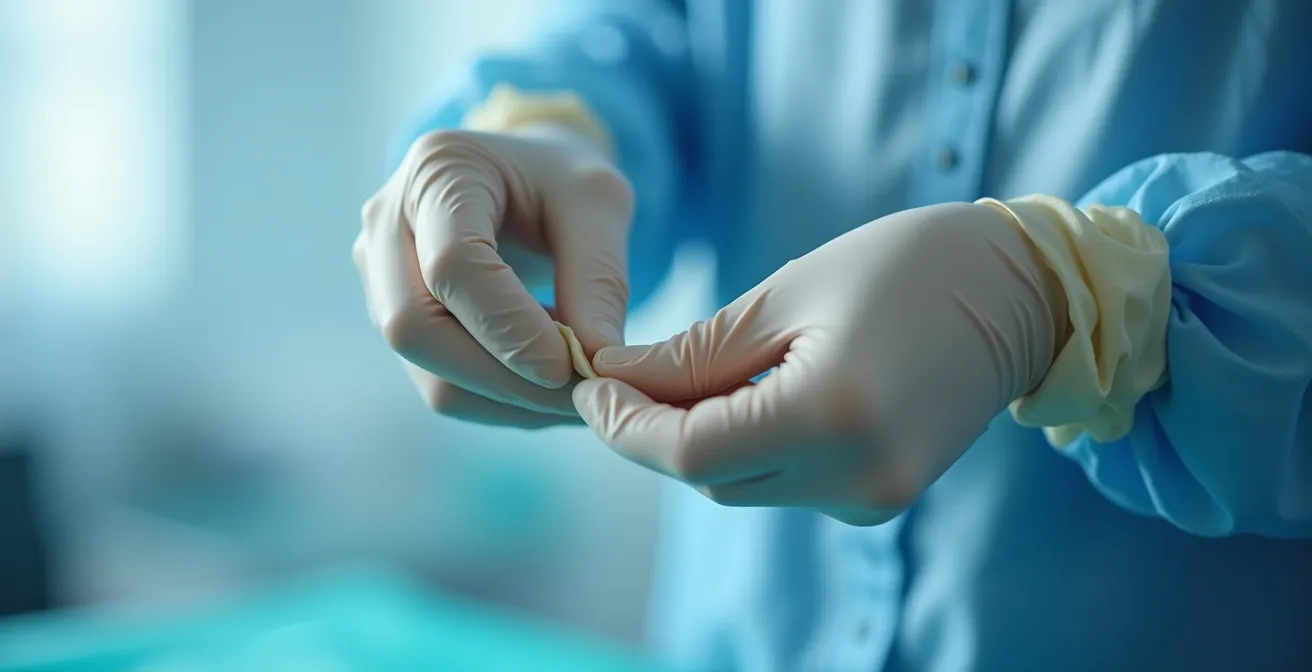
This clinical precision is non-negotiable. As the image above illustrates, the technique requires focus and adherence to a strict protocol. In Quebec, an employer’s responsibility is clearly defined, and an employee’s rights are protected by law. Forcing an untrained employee to handle biohazards is a direct violation of these statutes, including the fundamental right to refuse dangerous work (‘droit de refus’). The table below, based on Quebec’s *Act respecting occupational health and safety* (LSST) and the *Regulation respecting occupational health and safety* (RSST), clarifies this division of responsibility.
| Worker Rights under LSST | Employer Obligations under RSST |
|---|---|
| Right to a safe and injury-free workplace | Must provide appropriate PPE and training |
| Right to refuse dangerous work (‘droit de refus’) | Cannot force untrained employees to perform cleanup |
| Right to proper training before exposure | Must ensure CNESST-compliant training programs |
| Right to return to suitable employment after recovery | Must maintain incident documentation in French |
This legal framework underscores that biohazard cleanup is a specialized task for trained personnel, not a duty to be assigned to a general labourer. The risk of self-contamination is too high, and the legal consequences for the employer are too severe.
Biomedical Waste vs General Trash: How to Segregate Cleanup Debris Legally?
After a biohazard cleanup, the materials used—saturated cloths, contaminated PPE, and disposable tools—cannot simply be thrown into the facility’s dumpster. In Quebec, as across Canada, this material is classified as biomedical waste and is subject to stringent “cradle-to-grave” regulations. This means the original generator of the waste (your company) remains legally liable for it from the moment it is created until its final, certified destruction.
Improper disposal can lead to significant fines and legal action. The key to compliance is meticulous segregation at the source. All items contaminated with blood or potentially infectious materials must be separated from general trash and placed in designated, puncture-proof, and clearly labelled biohazard containers. These containers are typically red and marked with the universal biohazard symbol. This is not optional; it is a core requirement for handling human pathogens, as specified in Canada’s biosafety standards.
According to Quebec’s environmental regulations, biomedical waste is typically sorted into several categories that determine the required disposal method. For a workplace accident scene, the relevant categories generally include:
- Non-anatomical waste saturated with blood: This includes items like gauze, PPE, and cleaning cloths that are visibly soaked or dripping with blood.
- Sharps: Any item that can puncture a standard garbage bag, such as broken glass, metal fragments, or needles contaminated with biological material, must be placed in a designated sharps container.
- Anatomical waste: While less common in typical industrial accidents, this category includes any human tissues or body parts and requires special handling and disposal permits.
A certified remediation company is not only trained in these segregation protocols but also manages the entire chain of custody. They provide the correct containers, complete the necessary manifest documentation for transportation, and ensure the waste is delivered to a licensed disposal facility. This documented process is your only proof of legal compliance and your shield against future liability.
The Trauma Mistake: Why You Should Never Ask Regular Staff to Clean Blood spills
The most significant and costly mistake a manager can make after a traumatic incident is asking an untrained employee to clean it up. This decision goes beyond a simple breach of safety protocol; it exposes the company to a cascade of legal, ethical, and financial risks. The “trauma mistake” stems from viewing the scene as a physical mess, while ignoring the invisible biological and psychological contamination.
First, there is the psychological injury. Forcing an employee to confront a scene of trauma, especially if they knew the victim, can cause lasting psychological harm, leading to PTSD, anxiety, and depression. Such an assignment can be considered a breach of the employer’s duty of care under the Civil Code of Quebec, opening the door to psychological injury claims and grievances, particularly in unionized environments. It erodes trust and can permanently damage workplace morale.
Second, there is the immense legal and safety liability. Untrained staff lack knowledge of bloodborne pathogens, proper PPE use, and compliant cleaning methods. This puts them at direct risk of infection and the company at risk of severe CNESST violations. According to Quebec’s AOHS, any serious accident must be reported to the CNESST swiftly. As a study on workplace accidents notes, the employer is responsible for informing the CNESST as quickly as possible, within 24 hours. Using untrained staff for the cleanup complicates this report and signals a failure to follow established safety procedures.
The differences between a professional response and an in-house attempt are stark, carrying dramatically different levels of risk for the employer.
| Professional Cleanup | Untrained Employee Risks |
|---|---|
| OSHA Bloodborne Pathogens Standard compliance with proper training | Potential CNESST violations and workplace accident claims |
| Proper PPE and decontamination protocols | Risk of psychological injury claims |
| Insurance coverage and liability protection | Grievances in unionized workplaces |
| Certificate of Decontamination provided | Breach of duty of care under Civil Code of Quebec |
Ultimately, the short-term saving of not calling a professional is dwarfed by the long-term cost of potential lawsuits, regulatory fines, and a damaged workforce. It is a gamble no responsible Quebec employer should ever take.
How Establishing a Biohazard Response Contract in Advance Saves Crucial Hours?
In the high-stress, chaotic hours following a workplace accident, every decision is made under immense pressure. This is the worst possible time to be frantically searching online for a “biohazard cleanup company,” trying to vet credentials, and negotiating terms. Establishing a master service agreement or a biohazard response contract *before* an incident occurs is not an expense; it’s a strategic investment in operational continuity and risk mitigation. It is the proactive shield that protects your organization from making poor decisions in a crisis.
Having a pre-vetted, certified company on retainer provides several critical advantages. First, it guarantees an immediate, 24/7 response from a team that already understands your facility’s layout and operational needs. This drastically reduces downtime, allowing you to restore the affected area to safe operational status hours or even days sooner. Second, it ensures that financial terms, insurance requirements, and service level agreements are already in place, eliminating delays and confusion when time is of the essence. You make one phone call, and the entire compliant protocol is set in motion.
Most importantly, it removes the burden of due diligence from your shoulders during a crisis. Vetting a bio-recovery company requires careful verification of multiple credentials. Not all “cleaning companies” are certified for trauma scene remediation. Your chosen partner must have specific training, insurance, and a deep understanding of Quebec’s regulatory environment.
Your Action Plan: Vetting a Quebec Biohazard Remediation Partner
- Verify IICRC (Institute of Inspection, Cleaning and Restoration Certification) credentials and specific training in trauma and crime scene cleanup.
- Confirm they hold specialized liability insurance that explicitly covers bio-recovery and contamination services.
- Ensure they have documented, CNESST-compliant training programs and safety protocols for their technicians.
- Request proof of their licensed status for transporting and disposing of biomedical waste in Quebec.
- Confirm 24/7 emergency response capability with guaranteed response times and bilingual service for full compliance with Quebec’s language laws.
By taking these steps in advance, you transform a potential operational disaster into a managed, predictable, and compliant emergency response.
How to Maintain an Incident Log That Protects You in Case of Litigation?
In the aftermath of a workplace accident, your documentation is your most powerful legal shield. Memories fade and verbal accounts can differ, but a detailed, contemporaneous incident log provides an indisputable record of the event and the actions your company took in response. In the event of an investigation by the CNESST or subsequent litigation, this logbook becomes the primary evidence demonstrating your compliance and due diligence.
p>
So, what information must be included in a compliant incident report? The CNESST strongly recommends that every incident, no matter how minor, is recorded in the company’s official “Accident, Incident and First Aid Register.” This register should be a bound book with numbered pages to prevent tampering. For a serious incident involving biohazards, your log should go even further, detailing every step of the response. This includes the date and time of the incident, the names of all individuals involved, a factual description of what occurred, the immediate first aid measures taken, and the exact time the CNESST was notified (within the mandatory 24-hour window).
The documentation trail must continue through the cleanup process. You should record the name of the biohazard remediation company contacted, the time they arrived on-site, and a summary of the scope of work. Crucially, once the decontamination is complete, you must obtain and file the official Certificate of Decontamination provided by the contractor. This document, along with their ATP test results, is your definitive proof that the area was professionally and verifiably returned to a safe state. Under Quebec’s Charter of the French Language, it is also critical to ensure all this health and safety documentation is available in French to be fully compliant.
The Ammonia and Bleach Mistake: Understanding the Reactivity Risks in Your Closet
In a moment of panic, it can be tempting to grab whatever cleaning agents are available in the janitorial closet and mix them, assuming that “more is better.” This is a dangerous and potentially fatal error. The most common and hazardous of these impromptu cocktails is the mixture of bleach (sodium hypochlorite) and ammonia-based cleaners. When combined, these two common chemicals create a highly toxic substance: chloramine gas.
Inhaling chloramine gas can cause severe respiratory tract irritation, shortness of breath, chest pain, nausea, and fluid in the lungs. In a poorly ventilated area, exposure can be lethal. This chemical reaction highlights a critical point: your maintenance staff, while skilled at general cleaning, are not chemists. They are not trained in the specific reactivity risks of chemicals when applied to biological materials, a core component of WHMIS (Workplace Hazardous Materials Information System) training.
Professional biohazard technicians understand chemical compatibility. They would never mix reactive agents and instead use specific, formulated products for the task at hand. As OSHA guidelines and best practices emphasize, you must use an EPA-registered or Health Canada-approved disinfectant specifically designed to kill bloodborne pathogens. These products have been tested for efficacy and material compatibility, and their instructions include a critical detail often overlooked by untrained users: required contact time. A disinfectant doesn’t work instantly; it must remain wet on a surface for a specific duration (often 10 minutes or more) to effectively kill pathogens. Simply wiping a surface is not enough.
The chemical risks involved in biohazard cleanup are another compelling reason why this task should never be delegated to untrained personnel. It’s not just about the biological hazard; it’s about preventing a chemical one.
Key Takeaways
- Blood is Regulated: In Quebec, a blood spill is not a simple mess. It is a regulated biohazardous substance, and its cleanup is governed by strict CNESST and WHMIS laws, not janitorial best practices.
- Staff Risk is Company Liability: Assigning untrained employees to clean a trauma scene exposes them to infectious diseases and psychological injury, creating a significant legal and financial liability for the company under the Civil Code of Quebec.
- Process Over Product: Effective decontamination relies on a certified process—using the right chemicals, respecting contact times, and proper waste disposal—not just a strong cleaning product. A professional’s work is verifiable and legally defensible.
Validating Decontamination: How to Prove Your Quebec Facility Is Safe to Reopen?
After a professional biohazard remediation team has completed their work, how do you know—and, more importantly, how do you *prove*—that the area is truly safe for employees to return? A visually clean space is not the same as a microbiologically clean one. Pathogens are invisible, and your legal and ethical responsibility is to ensure they have been eradicated, not just hidden. This is where scientific validation becomes essential.
The industry standard for verifying cleanliness on a microscopic level is Adenosine Triphosphate (ATP) testing. ATP is an energy molecule found in all living cells, including bacteria, blood, and mold. While ATP testing doesn’t identify specific types of pathogens, it provides an immediate and accurate measurement of the total biological load on a surface. A certified technician will swab critical surfaces post-decontamination and use a device called a luminometer to measure the amount of ATP present. A low reading validates that the cleaning process was effective; a high reading indicates that residual organic matter remains and further decontamination is required.
This data-driven approach removes all subjectivity. It replaces “it looks clean” with “it is verifiably clean to a medical-grade standard.” The results from ATP monitoring provide a reportable, direct measurement of cleanliness. Upon achieving a passing result, the remediation company will issue a formal Certificate of Decontamination. This document is the final piece of your legal shield. It serves as your official proof to CNESST inspectors, insurance adjusters, and your own employees that you took every necessary step to restore a safe work environment.
Sharing this certificate with your team is a powerful way to rebuild trust and confidence after a traumatic event. It demonstrates transparency and a tangible commitment to their health and safety, allowing everyone to move forward with peace of mind.
The aftermath of a workplace accident is a defining moment for any manager. The choice is clear: you can react with the tools in the janitor’s closet and expose your company to untold risk, or you can respond with a compliant, professional protocol that protects your people and your business. The first step is to establish a relationship with a certified remediation partner *before* you need them. Take the initiative to put a proactive plan in place today.