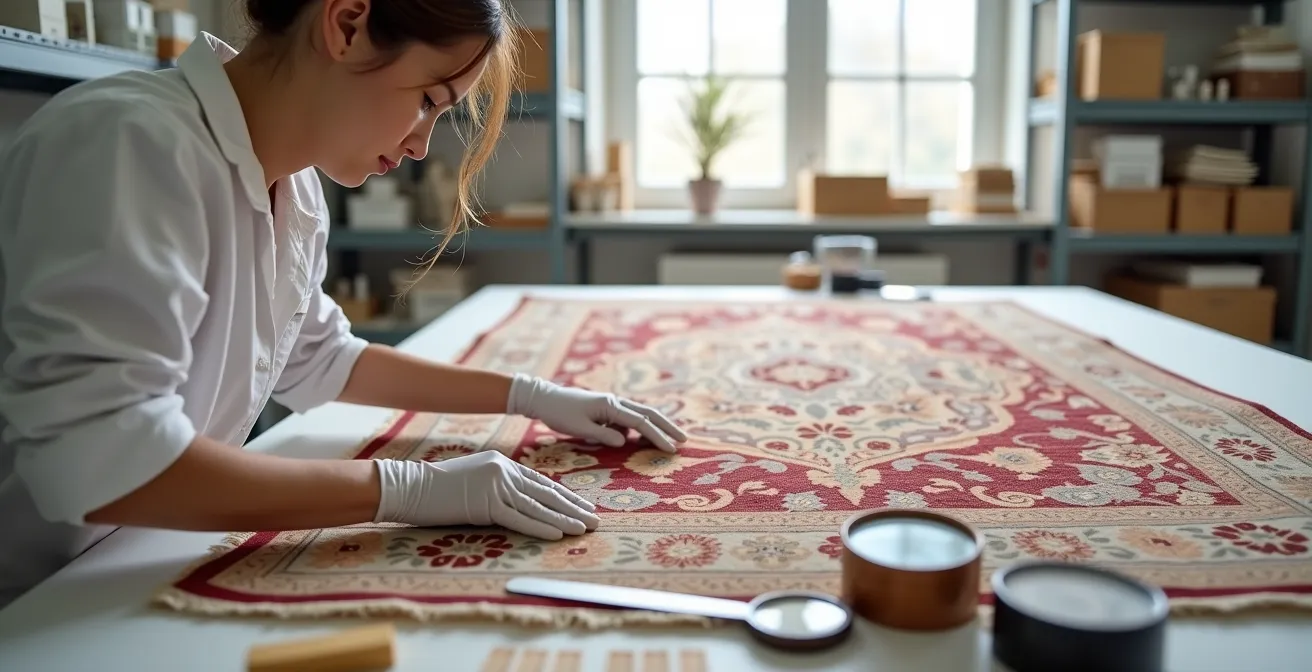
The greatest threat to heirloom textiles is not dirt, but environmental damage and improper cleaning methods that cause irreversible decay.
- Effective preservation prioritizes controlling humidity and light over aggressive washing.
- Professional techniques, like the wet fastness test and suction-only vacuuming, are non-negotiable to prevent fiber damage.
Recommendation: Shift your mindset from “cleaning” to “conservation.” Before attempting any intervention, first stabilize the textile’s environment to arrest decay.
An antique Aubusson rug or a set of silk drapes inherited from a grandparent is more than just a decorative object; it is a vessel of history, a tangible link to the past. For collectors and owners of heritage homes in Quebec, the responsibility of caring for these irreplaceable items is immense. The common impulse is to clean them, to restore their original vibrancy. However, this is where the most devastating mistakes are made. The conventional wisdom about cleaning often fails to account for the fragile chemistry of aged fibers.
Many guides will offer surface-level tips, but they rarely explain the underlying science of textile decay. They might mention spot testing or gentle vacuuming, but they omit the professional-grade specifics that separate preservation from destruction. The true secret to longevity for these heirlooms lies not in aggressive washing, but in a deep understanding of the materials and their interaction with the environment. It’s about arresting the slow, silent process of decay that is happening at a molecular level.
This guide adopts the perspective of a museum conservator. We will move beyond simple “how-to” instructions to explore the “why” behind each preservation technique. We will delve into the scientific principles of fiber degradation, environmental control, and risk-averse cleaning methods specifically contextualized for the unique climatic challenges of Quebec—from its dry, heated winters to its humid summers. By understanding the true nature of the threats, you can implement a strategy that ensures your textiles survive not just for years, but for generations to come.
text
This comprehensive guide is structured to walk you through the core principles of textile conservation, from understanding the chemistry of aging to applying specific, safe cleaning and maintenance techniques.
Summary: A Conservator’s Approach to Heirloom Textile Care
- Why Do Silk and Wool Fibers Become Brittle and Acidic with Age?
- How to Perform a Wet Fastness Test Before Cleaning Any Vintage Fabric?
- Suction-Only Vacuuming vs Beater Bar: Which Destroys Antique Rug Knots?
- The Plastic Bag Mistake That Rots Antique Textiles Through Trapped Humidity
- How to Clean and Rotate Textiles to Prevent Uneven UV Fading?
- The Water Temperature Mistake That Can Shrink Wool Carpets Permanently
- The Vacuuming Mistake That Crushes Velvet Upholstery Fibers
- How to Wash Bedding and Curtains to Kill 99% of Allergens Effectively?
Why Do Silk and Wool Fibers Become Brittle and Acidic with Age?
The primary reason heirloom textiles degrade is not from use, but from a slow chemical breakdown called acidic hydrolysis. Natural fibers like wool and silk are proteins, and over time, they absorb atmospheric pollutants, particularly sulfur dioxide—a common residue in older Quebec homes with a history of coal or oil heating. When combined with moisture in the air, these pollutants form sulfuric acid, which directly attacks and severs the molecular chains of the fibers, making them brittle and weak.
This process is accelerated by an unstable environment. Wool and silk are hygroscopic, meaning they naturally absorb and release moisture from the air to stay in equilibrium. When indoor air is too dry (a common issue during Quebec winters with central heating), fibers lose their essential moisture, becoming desiccated and fragile. Conversely, when the air is too humid (typical of summers in Montreal), it provides the water needed for acid hydrolysis to run rampant, promoting mildew and foxing (brown spots). The key to long-term preservation is therefore environmental control. Maintaining a stable relative humidity is the single most effective conservation measure, according to the Canadian Conservation Institute guidelines, which recommend a steady range of 45-55%.
Your Preventive Preservation Plan: Auditing Your Textile Environment
- Install a hygrometer in rooms where textiles are stored or displayed to monitor relative humidity levels continuously.
- During Quebec’s dry winter heating season, use a room humidifier to maintain 45-55% RH and prevent fiber desiccation.
- In humid summer months, run a dehumidifier to prevent moisture levels from exceeding 55% and creating acidic conditions.
- Keep textiles away from direct heat sources like radiators and from exterior walls that experience dramatic temperature fluctuations.
- Test indoor air quality for sulfur dioxide residues, especially in older Montreal and Quebec City homes with histories of coal heating.
By stabilizing the environment, you are not just cleaning; you are actively arresting the chemical reactions that destroy your heirlooms from within. This foundational step is more critical than any cleaning method.
How to Perform a Wet Fastness Test Before Cleaning Any Vintage Fabric?
Before a single drop of water touches the main body of a vintage textile, assessing the stability of its dyes is a non-negotiable step. This is known as a wet fastness test. A fugitive dye that bleeds can ruin an entire piece, causing irreversible staining and loss of pattern definition. The common advice to “test in an inconspicuous area” is correct but often lacks the necessary rigor for valuable items. A professional approach provides a much more accurate assessment.
The advanced conservation technique involves more than a simple dab. To perform it correctly, use distilled or demineralized water, as the minerals and chlorine in tap water can alter the results. Moisten a clean, white cotton swab with this water. Instead of rubbing, which can damage fibers, press the damp swab firmly against a single color area for a timed 30-second interval. Afterward, roll (do not wipe) the swab onto a piece of white blotting paper. This method is sensitive enough to reveal even the slightest, almost invisible dye bleed. Repeat this process for every single color on the textile, as different dyes will have different levels of stability.
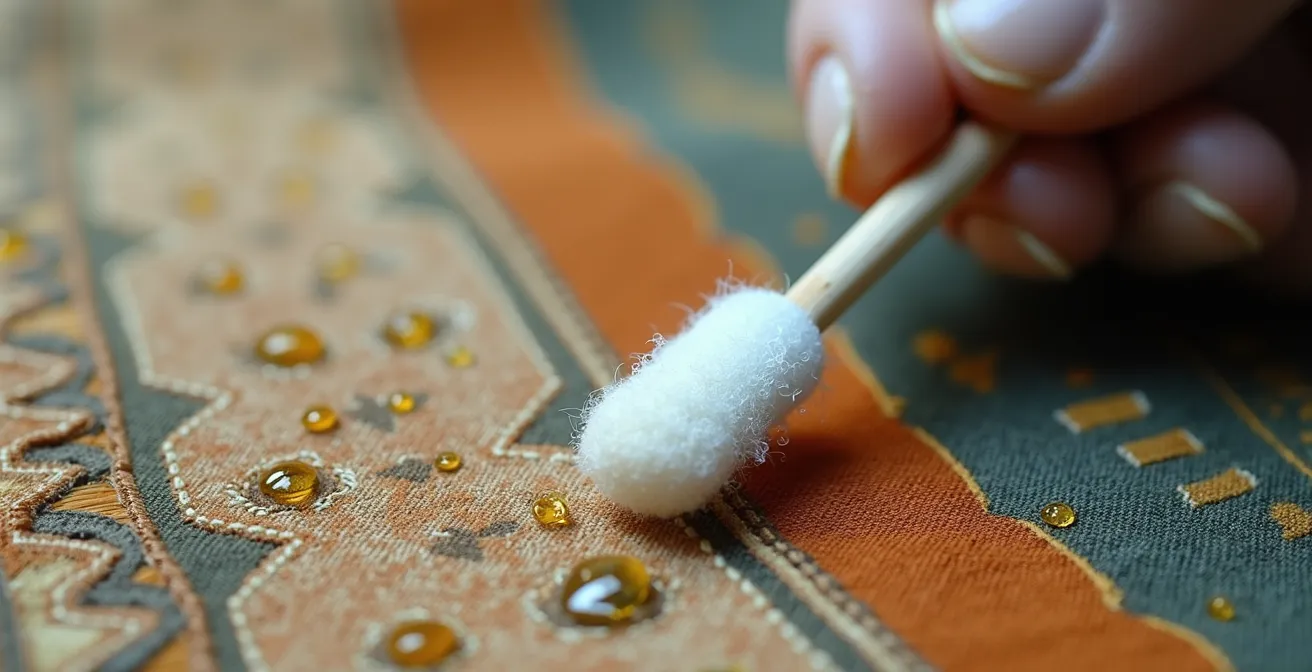
The choice of water is more critical than many realize, especially in different municipalities. A Canadian textile preservation expert offers a crucial warning for those in Quebec:
Distilled water is best, especially for the final rinse, but if you live in a soft water zone, you can use tap water.
– Canadian textile preservation expert, Vintage Fashion Guild Forums
This highlights how the varying mineral content across regions can impact both testing and cleaning. If any color transfers to the blotting paper, wet cleaning should not be attempted. The risk is simply too high.
Suction-Only Vacuuming vs Beater Bar: Which Destroys Antique Rug Knots?
The most common maintenance task for any rug is vacuuming, but for a hand-knotted antique rug, it is also the most hazardous if done incorrectly. The aggressive, rotary action of a modern vacuum’s beater bar is the mortal enemy of an old rug. This rotating brush is designed to agitate and pull debris from synthetic, machine-made carpets. On a hand-knotted rug, it does not distinguish between dirt and fiber; it yanks at the individual knots that form the pile, causing them to fray, fuzz, and eventually pull out entirely. It can also catch and unravel the hand-wrapped selvedge edges, destroying the structural integrity of the rug.
As leading experts in the field state, the danger cannot be overstated:
Electric vacuum cleaners should never be used on antique rugs. Never use the beater brush on any handwoven rugs, as its rotary action is far too rough and can pull out knots and fray out the wrapped selvedge edges.
– Claremont Rug Company, Professional Antique Rug Care Guidelines
The only safe way to vacuum an antique rug is with suction-only. The Canadian Conservation Institute recommends a specific, gentle technique. First, place a piece of clean fiberglass or nylon window screen over the area to be cleaned. This acts as a protective barrier. Use only the soft-bristled upholstery brush attachment, and set the vacuum’s suction to the lowest possible level. Gently pass the brush over the screen, always moving in the direction of the pile—never against it. This method lifts surface dust and grit without putting any mechanical stress on the fragile knots. During spring in Quebec, when abrasive salt and sand particles are tracked indoors, weekly gentle vacuuming with this method is crucial to prevent these particles from grinding down the fibers.
The Plastic Bag Mistake That Rots Antique Textiles Through Trapped Humidity
When it comes to storing heirloom textiles, one of the most well-intentioned but destructive mistakes is using plastic bags or sealed plastic bins. The belief is that plastic protects from dust, pests, and water. In reality, it creates a deadly trap. Plastic is non-breathable, and as ambient temperature fluctuates, it creates a micro-environment inside the container. Any moisture trapped within—either from the textile itself or the air—condenses, and as Smithsonian conservators warn, this can create a 100% humidity microclimate, which is the perfect breeding ground for mold and mildew.
This high humidity accelerates the chemical decay we discussed earlier, effectively “rotting” the fibers. The correct storage method relies on materials that are both protective and breathable. The gold standard in museum conservation is to use acid-free archival materials. This means storing textiles in an acid-free box and cushioning any folds with crumpled acid-free tissue paper. The paper prevents sharp creases, which can break fibers over time, and both the box and paper buffer the textile from environmental pollutants while allowing it to breathe.
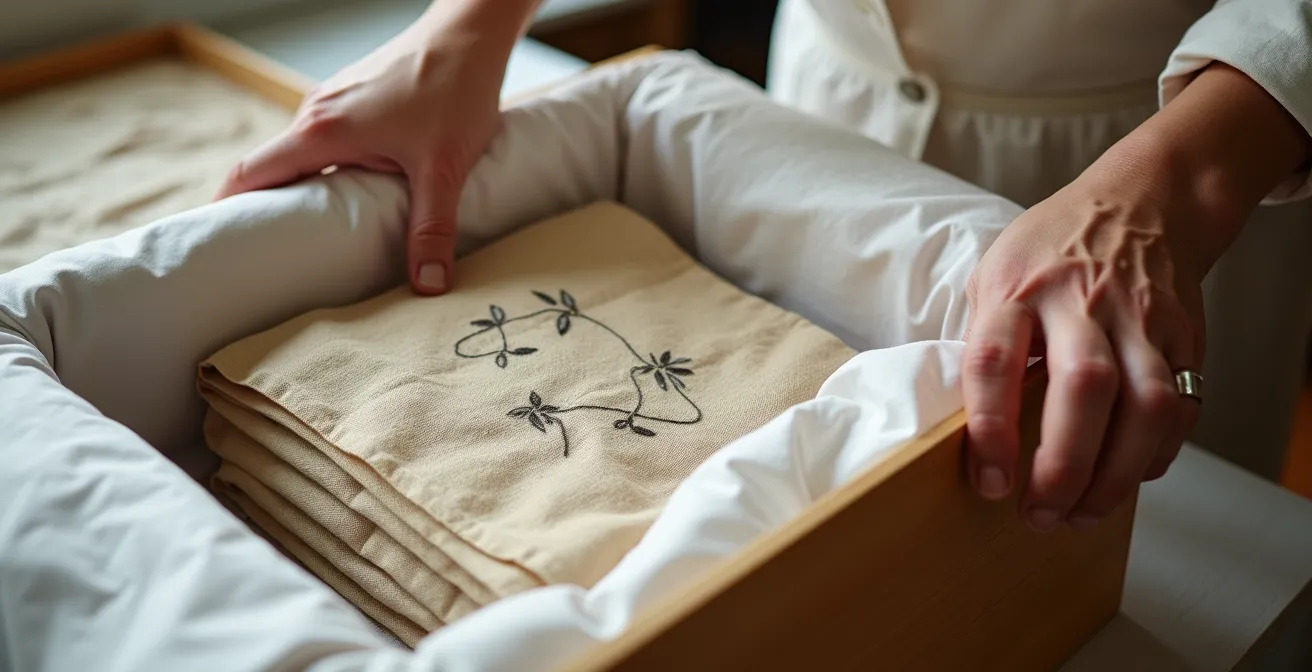
The location of storage is just as important as the container. An attic or basement in a Quebec home is a poor choice, as these areas experience the most extreme temperature and humidity swings throughout the year. A much better location is an interior closet in a climate-controlled part of the house, away from exterior walls, pipes, and heat sources. This ensures the textile remains in a stable environment, protected from the very conditions that fuel its deterioration.
How to Clean and Rotate Textiles to Prevent Uneven UV Fading?
Beyond humidity, the second great environmental enemy of textiles is ultraviolet (UV) light. UV radiation, present in all daylight, is a high-energy force that breaks down the chemical bonds in both fibers and dyes. This damage is cumulative and irreversible, resulting in faded colors and weakened, brittle fabric. The effect is often seen as a “sun-bleached” patch on a rug or curtain that was consistently exposed to a window. In Quebec, with its dramatic seasonal shifts in sun angle and intensity, managing light exposure is a critical conservation task.
The most effective preventative measure is to block UV light at its source. While heavy drapes can help, professional UV-filtering window films can achieve a 99% UV transmission reduction without significantly darkening the room. This is a highly recommended investment for any room displaying valuable textiles. However, even with filtering, some light will get through. The next line of defense is a strategic rotation schedule. By periodically changing the orientation of a textile, you can ensure that any light exposure is distributed evenly, preventing localized fading.
A simple yet effective strategy for Quebec homeowners is to tie rotations to the solstices:
- Summer Solstice (around June 21st): The sun is at its highest and most intense. Rotate rugs 180 degrees to counteract the strong summer light.
- Winter Solstice (around December 21st): The sun is low in the sky, penetrating deeper into rooms. Rotate rugs again to compensate for this different angle of exposure.
- Wall-Hung Textiles: For items like tapestries, consider switching their positions between north-facing (less direct light) and south-facing walls on an annual basis.
This disciplined approach ensures that no single part of the textile bears the brunt of the sun’s damaging rays over the long term.
The Water Temperature Mistake That Can Shrink Wool Carpets Permanently
When wet cleaning is deemed safe after a successful fastness test, water temperature becomes the next critical variable, especially for wool. The common misconception is that hot water cleans better. While true for modern laundry, applying hot water to an antique wool rug can cause catastrophic, irreversible shrinkage. This process, known as felting, occurs at a microscopic level. Wool fibers are covered in tiny, overlapping scales, similar to shingles on a roof.
As a professional rug cleaning expert explains, the mechanism is about shock, not just heat:
It’s not the heat, it’s the rapid change in temperature combined with moisture and agitation that causes the microscopic scales on wool fibers to interlock permanently.
– Professional Rug Cleaning Expert, Room for Tuesday – Vintage Rug Care Guide
When subjected to a sudden temperature change (thermal shock) and mechanical action, these scales open up and lock into one another, preventing the fibers from returning to their original length. The result is a dense, matted, and permanently shrunken textile. To avoid this, any wet cleaning of wool must be done with cool or lukewarm water, and the temperature must be kept consistent from the washing stage through to the final rinse. Any sudden shift from warm to cold, or vice-versa, can initiate the felting process.
The following table provides a general guide for safe water temperatures when dealing with delicate antique textiles, based on an analysis of best practices for vintage fabric care.
| Textile Type | Safe Temperature Range | Risk if Too Hot | Risk if Too Cold |
|---|---|---|---|
| Wool Rugs | 15-20°C (60-68°F) | Felting/Permanent Shrinkage | Ineffective Cleaning |
| Silk Textiles | Cold Only (Below 15°C) | Fiber Damage | None |
| Cotton/Linen | Up to 30°C (86°F) | Color Bleeding | Starch Won’t Dissolve |
| Blended Fabrics | 15-20°C (60-68°F) | Varies by Blend | Poor Soil Removal |
Always defer to the most conservative temperature range if you are unsure of the fiber content. The risk of permanent damage far outweighs the benefit of slightly more effective soil removal.
The Vacuuming Mistake That Crushes Velvet Upholstery Fibers
Velvet, with its dense, plush pile, presents a unique cleaning challenge. The beauty of velvet lies in the uniform direction of its cut fibers, which catch and reflect light. The most common mistake in maintaining antique velvet upholstery is using improper vacuuming techniques that crush, abrade, or permanently alter the direction of this pile, creating unsightly marks and shadows.
Direct suction from a standard vacuum hose can be too strong, flattening the pile. Worse yet, rubbing or scrubbing with a hard plastic attachment will cause irreversible damage. Professional conservators employ a ‘lift and place’ method. Using a vacuum on its gentlest setting with a soft brush attachment, they work through the pile methodically. The key is to never drag the brush across the surface. Instead, you gently place the brush on a small area, allow the suction to lift the dust, and then lift the brush completely before placing it on the next adjacent area. This avoids any scrubbing motion that would crush the delicate fibers.
For particularly fragile or ancient velvet, many conservators forgo vacuuming altogether in favor of even gentler, zero-risk alternatives. These methods focus on lifting dust without applying pressure or suction:
- Use a specialized, very soft-bristled velvet brush, always brushing gently in the direction of the pile.
- For smaller items like cushions, take them outdoors on a dry, non-humid day and gently shake them to dislodge dust.
- To refresh a pile that has become slightly flattened, use a handheld steamer from a distance of 6-8 inches. The steam will relax the fibers without direct contact, but you must avoid getting the fabric wet.
As with any technique, it is imperative to test on a hidden or inconspicuous area first, such as the underside of a cushion or a seam allowance.
Key Takeaways
- The most critical act of preservation is controlling the environment; aim for 45-55% relative humidity and minimize UV light exposure.
- Always perform a rigorous wet fastness test with distilled water before any wet cleaning is considered.
- Never use a vacuum’s beater bar on antique rugs or velvet; use suction-only with a soft brush and gentle technique.
How to Wash Bedding and Curtains to Kill 99% of Allergens Effectively?
For antique bedding, curtains, and other textiles that can’t be wet-cleaned, allergens like dust mites pose a significant problem. Traditional washing in hot water, the standard method for killing mites, is often too damaging for fragile, older fabrics. Fortunately, there is a highly effective, non-invasive conservation technique that is perfectly suited for Quebec’s climate: cryogenic cleaning, or freezing.
Dust mites cannot survive in extreme cold. Research shows that freezing textiles at -18°C (0°F) for a minimum of 48 hours is sufficient to kill 100% of adult mites and their eggs. This method is completely safe for most natural fibers and dyes, as it involves no water, no chemicals, and no mechanical agitation. For Quebec residents, this technique can often be accomplished using the natural winter environment.
To safely perform this allergen control method, follow these steps during a consistent winter cold spell:
- Place the dry textile into a clean, breathable cotton bag or wrap it in a cotton sheet. Do not use plastic, as it can trap condensation.
- Gently remove excess air from the bag without compressing the fabric.
- Place the package in an unheated but protected space, such as a garage, a shed, or a covered balcony, ensuring it stays dry and away from direct sunlight.
- Leave the textile in place for at least 48 hours while the outdoor temperature remains consistently below -18°C.
- After the freezing period, bring the textile indoors and allow it to return to room temperature gradually *before* handling it, as frozen fibers can be brittle.
- Once at room temperature, take the item outdoors and gently brush or shake it to remove the dead mites and their allergenic residue.
This process provides the sanitizing benefits of a hot wash without any of the associated risks, making it an ideal solution for delicate heirlooms.
By embracing these conservation-minded principles, you transform from a simple owner into a true custodian. The gentle techniques and environmental controls outlined here are your primary tools to ensure that the beauty, integrity, and history woven into your heirlooms are preserved for the next generation to cherish. Your role is not just to clean, but to protect.