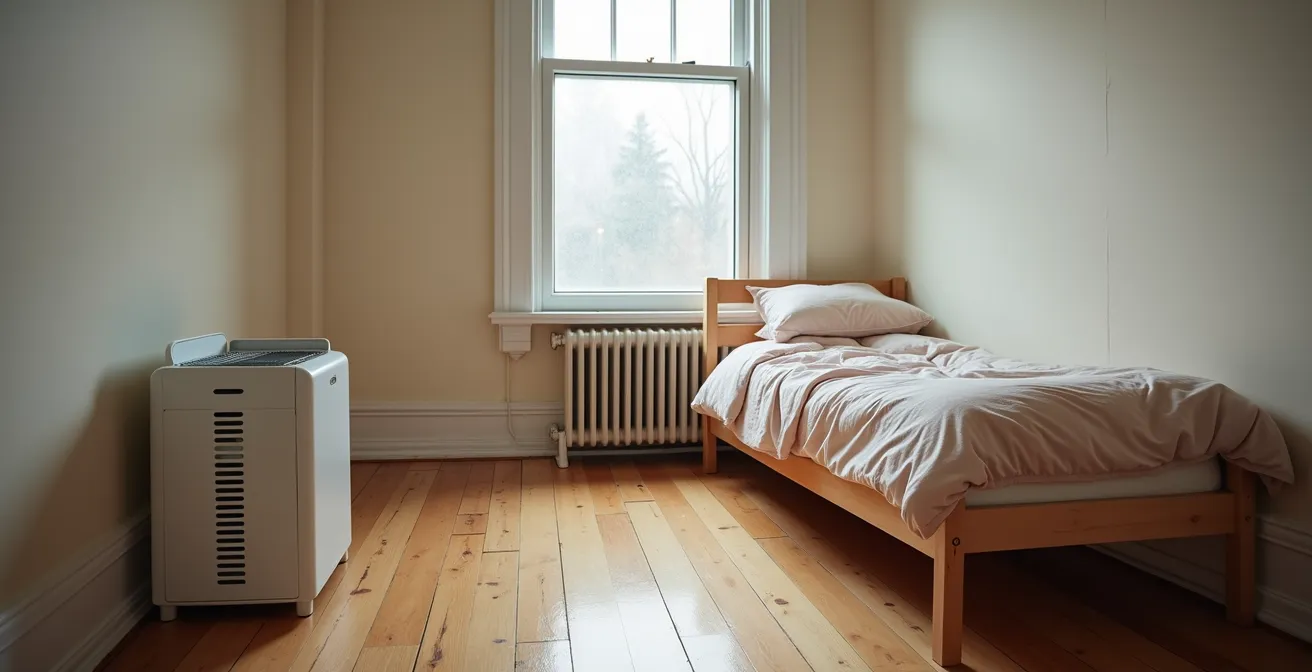
To protect a child with asthma in an older Montreal home, you must treat the building as a complete system, not just clean its surfaces.
- The key is controlling hidden factors like humidity and air pressure, which are often the root cause of persistent allergens in Quebec’s unique housing stock.
- Simply vacuuming or using generic air purifiers is ineffective against the specific challenges posed by drafty plexes and legacy building materials.
Recommendation: Focus first on sealing the building envelope and managing indoor humidity levels before investing in expensive appliances.
For parents in Montreal, the charm of a vintage plex or triplex often comes with a hidden challenge: managing the persistent coughs and wheezing of a child with asthma. You follow the standard advice—you vacuum relentlessly, dust every surface, and choose unscented products. Yet, the triggers persist, seemingly embedded within the very walls of your home. This constant battle can feel frustrating and isolating, leaving you to wonder what you’re missing.
The common approach to allergies focuses on surface-level cleaning. While important, this strategy often fails in older Quebec homes because it ignores the building’s underlying dynamics. The true sources of allergens like dust mites, mold, and even fine drywall dust are governed by factors you can’t see: indoor humidity, air infiltration from outside, and the building’s own air pressure. These elements create a perfect storm, allowing allergens to thrive and recirculate, no matter how clean your floors are.
But what if the solution wasn’t just to clean more, but to understand your home as an interconnected system? The real key to creating a safe haven for your child lies in shifting focus from simple cleaning to strategic building science. It’s about controlling the environment that allows allergens to prosper in the first place. This means tackling humidity, sealing air leaks, and making informed choices about renovations and air purification technology.
This guide, combining clinical insights with building expertise, will walk you through the most effective strategies tailored for Montreal’s specific housing challenges. We will explore why dust mites persist, how to handle renovations safely, what product labels to trust, and how to manage your home’s air to finally get control over your child’s indoor allergy triggers.
To navigate these critical topics, this article is structured to address your most pressing questions. Below, you will find a detailed table of contents guiding you through each step of creating a healthier indoor environment for your family.
Summary: A Systematic Approach to Allergy-Proofing Your Montreal Home
- Why Do Dust Mites Thrive in Bedrooms Despite Regular Vacuuming?
- How to Transition from Carpets to Hard Floors While Minimizing Dust Clouds?
- Certified Asthma & Allergy Friendly vs Unscented: What Labels Should You Trust?
- The Window Opening Mistake That Invites More Pollen During Allergy Season
- How to Wash Bedding and Curtains to Kill 99% of Allergens Effectively?
- How Does Dust Accumulation on Coils Force Your HVAC System to Work Harder?
- HEPA Filters vs UV Sanitizers: Which Technology Best Protects Your Bedroom Air?
- Why Does Drywall Dust Reappear 24 Hours After a Standard Vacuuming?
Why Do Dust Mites Thrive in Bedrooms Despite Regular Vacuuming?
You vacuum the bedroom, wash the sheets, and yet your child’s nighttime allergies persist. The reason isn’t a lack of cleanliness; it’s an invisible factor that makes your efforts futile: humidity. Dust mites (Dermatophagoides pteronyssinus) don’t drink water; they absorb moisture directly from the air. In a typical Montreal home, where summer humidity can be high and winter heating can cause condensation, bedrooms often become ideal breeding grounds. A relative humidity above 50% is all they need to thrive.
Regular vacuuming only removes a fraction of the dust mite population, as they live deep within mattresses, pillows, and upholstered furniture. The core of the problem is the environment itself. To know if your home has high humidity, look for signs like condensation on windows, a musty smell, or peeling paint. A simple and inexpensive tool called a hygrometer can give you a precise reading. For parents of asthmatic children, this device is as essential as a thermometer.
The most impactful strategy is therefore not more cleaning, but aggressive humidity control. A study on homes in temperate climates like Quebec’s showed that maintaining humidity below 51% was transformative. It found that after 17 months, homes with proper humidity control had allergen levels more than 10 times lower than humid homes. This demonstrates that defeating dust mites is a battle over the atmosphere in your room, not just the dust on the floor.
Focus on running a dehumidifier during humid months and ensuring your bathroom and kitchen are well-ventilated to exhaust moisture at its source. This shift in focus from surface cleaning to environmental control is the first principle of creating an asthma-safe bedroom.
How to Transition from Carpets to Hard Floors While Minimizing Dust Clouds?
For families managing asthma, removing wall-to-wall carpeting is one of the most effective “source control” strategies available. Carpets are massive reservoirs for dust mites, pet dander, and mold spores that are impossible to fully clean. Transitioning to hard flooring like hardwood or laminate is a clear win for indoor air quality. However, in older Montreal homes, this renovation project comes with a significant, often overlooked risk: asbestos.
Many homes built or renovated in Quebec between the 1930s and 1990 contain asbestos, especially in vinyl floor tiles, linoleum backing, and the adhesive used to glue them down. Disturbing these materials without proper precautions can release microscopic asbestos fibers into the air, creating a severe long-term health hazard far worse than the allergens you’re trying to remove. This is a non-negotiable safety concern. Before tearing up any old flooring, getting it tested by a certified lab is mandatory. This is a necessary step for which the cost of removing asbestos-contaminated flooring can range from $1,500 to $2,750 in a 2,000 sq ft home, depending on the extent of the contamination.
This illustration shows a professionally sealed work area, a critical step to contain dust and potential asbestos fibers during renovation, protecting the rest of your home.
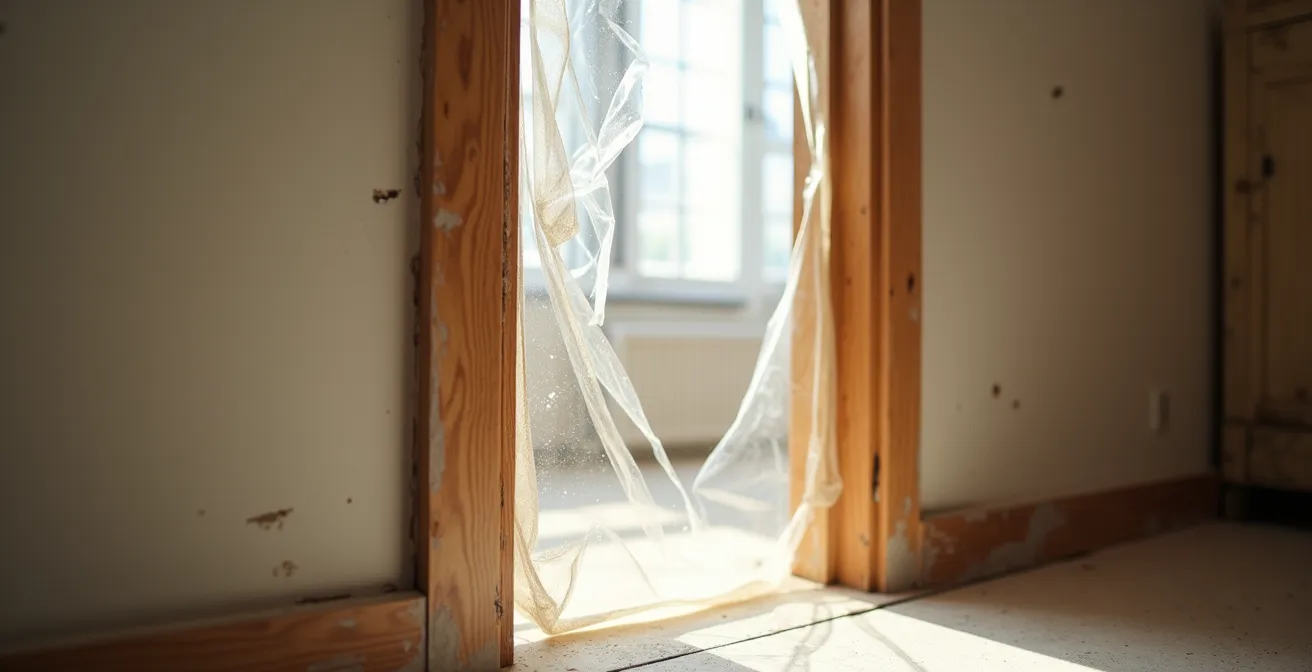
As you can see, containment is not optional. A professional abatement contractor will create a sealed enclosure with negative air pressure to ensure that no dust escapes the work zone. Attempting this as a DIY project is extremely dangerous. The following checklist outlines the official safety protocol you must ensure your contractor follows.
Action Plan: Asbestos Safety Protocol for Floor Removal
- Material Testing: For any Quebec residential building constructed or renovated between 1930 and 1990, insist on having flooring materials tested for asbestos before any demolition begins.
- Sample Analysis: Ensure the contractor takes samples from all affected materials and has them analyzed by an accredited, independent laboratory, not their own.
- Work Area Containment: Verify that the work area is completely sealed off with heavy-duty plastic sheeting and that workers are using appropriate personal protective equipment (PPE), including respirators.
- Family Safety: Do not enter the contractor’s work area under any circumstances. Shut down your home’s mechanical ventilation system (like an HRV or furnace fan) to prevent it from drawing contaminated air into other rooms.
- Post-Removal Clearance: After the removal is complete, the area must be thoroughly cleaned with HEPA vacuums. An independent air quality test should be performed to confirm the space is free of asbestos fibers before the containment is taken down.
Certified Asthma & Allergy Friendly vs Unscented: What Labels Should You Trust?
Navigating the aisles of Canadian Tire or your local pharmacy, you’re faced with a barrage of labels: “unscented,” “hypoallergenic,” “eco-friendly,” “fragrance-free.” For a parent of an asthmatic child, choosing the right cleaning product, vacuum, or bedding can feel like a high-stakes decision. Unfortunately, many of these terms are marketing ploys with no regulated scientific meaning. An “unscented” product, for example, can still contain masking fragrances that act as respiratory irritants.
The most reliable indicator for products in Canada is the Asthma & Allergy Friendly® certification. As Asthma Canada explains, this is not a marketing term but a mark of rigorous, independent testing. According to them, “The Asthma & Allergy Friendly Certification Program is an independent certification program created to scientifically test and identify consumer products.” This means a certified vacuum has proven its ability to capture allergens and prevent them from leaking back into the air, and certified bedding has demonstrated it can withstand hot water washing to kill dust mites.
This table breaks down the reliability of common labels found in Quebec stores, helping you distinguish between scientifically-backed claims and vague marketing.
| Certification Type | Testing Standard | Available in Quebec Stores | Reliability for Asthma |
|---|---|---|---|
| Asthma & Allergy Friendly® | Scientific testing for allergen reduction | Canadian Tire, online retailers | High – independently verified |
| Health Canada Approved | Safety and efficacy standards | Pharmacies, major retailers | High – government regulated |
| Unscented/Fragrance-Free | No standardized testing | All major stores | Medium – may still contain irritants |
| Eco/Bio Labels | Environmental focus | Avril, Rachelle Béry | Low – natural ingredients can trigger allergies |
While “Eco” or “Bio” labels from stores like Avril or Rachelle Béry suggest natural purity, it’s crucial to remember that natural ingredients (like essential oils or plant-based compounds) can be potent allergy triggers. For asthma management, scientific proof of allergen removal will always trump claims of “naturalness.” Trusting a certified standard over a marketing buzzword is a fundamental part of creating a truly safe indoor environment.
The Window Opening Mistake That Invites More Pollen During Allergy Season
On a beautiful spring day in Montreal, the instinct to throw open the windows and “air out the house” is strong. However, for a child with pollen allergies, this can be the single worst thing you can do. Opening windows is like opening a floodgate for microscopic allergens. While it feels fresh, you are actively inviting millions of pollen grains into your home, where they will settle on every surface and become a persistent source of irritation long after the windows are closed.
Understanding Montreal’s specific pollen calendar is key. Tree pollen peaks in late April and May, followed by grass pollen in the summer. But the most notorious trigger for many is ragweed. In our region, ragweed peaks from mid-August to October, making late summer and early fall a critical time for vigilance. Pollen counts are typically highest in the morning, between 5 a.m. and 10 a.m., so keeping windows sealed shut during this period is especially important.
So how do you get fresh air without the allergens? The answer lies in mechanical ventilation. Your strategy should be to keep outdoor air out and clean the air that’s already inside. This means relying on your air conditioning (if you have it) or, more importantly for Quebec homes, your air exchanger (HRV/ERV). These systems are designed to bring in fresh air while filtering it. Using a window fan is counterproductive, as it actively pulls unfiltered, pollen-laden air into your home.
Instead of relying on open windows, adopt these pollen-blocking strategies:
- Use air conditioning: This is highly effective as it cools and dehumidifies without introducing outside pollen.
- Run your air exchanger (HRV/ERV): Ensure its filters are clean or upgraded to a higher MERV rating during pollen season.
- Keep windows closed: This is especially critical during morning hours and on high-pollen-count days (check local weather reports).
- Use a portable air cleaner: A unit with a true HEPA filter in the child’s bedroom can capture any pollen that does make its way inside.
By managing your home’s ventilation mechanically, you take control of the air your child breathes, rather than leaving it to the whims of the season.
How to Wash Bedding and Curtains to Kill 99% of Allergens Effectively?
The bedroom is ground zero for dust mite exposure, with mattresses, pillows, and bedding acting as the primary reservoirs. While you can’t wash a mattress, you can wage a highly effective war on allergens by properly laundering everything else. The key to killing dust mites isn’t the detergent you use, but the water temperature. To be effective, you must wash fabrics in very hot water.
Asthma Canada confirms that laundering bed linens in water at 55 degrees Celsius (131°F) effectively kills dust mites. Most home water heaters are set lower for safety, and many washing machines’ “hot” settings don’t actually reach this temperature. You may need to adjust your water heater or use a machine’s “Sanitize” cycle if it has one. This aggressive approach must be balanced against Quebec’s high electricity costs from Hydro-Québec, but for a severely asthmatic child, the health benefits of a weekly hot-water wash for all bedding are undeniable.
But what about non-washable items like stuffed animals, decorative pillows, or delicate curtains? This is where a classic Quebec winter provides a unique, cost-free solution: freezing. Dust mites cannot survive in very low temperatures or low humidity. By sealing these items in a plastic bag and placing them on your balcony or in a snowbank for 24 hours during the coldest part of winter, you can kill the mites just as effectively as with hot water.
To maintain an allergen-free bed, combine these laundering techniques with physical barriers. Use mite-allergen impermeable encasings for pillows, mattresses, and box springs. These zippered covers trap any existing mites inside and prevent new ones from colonizing, making your weekly washing routine even more effective. This multi-pronged approach—hot washing, seasonal freezing, and encasing—creates a truly hostile environment for dust mites.
How Does Dust Accumulation on Coils Force Your HVAC System to Work Harder?
Your home’s Heating, Ventilation, and Air Conditioning (HVAC) system—be it a furnace, a heat pump (thermopompe), or an air conditioner—is the respiratory system of your house. It circulates all the air your family breathes. When it’s compromised, your air quality suffers. A critical point of failure is the accumulation of dust on the evaporator and condenser coils. These coils are where heat exchange happens, and they operate in a moist environment, making them a perfect magnet for dust, dander, and mold spores.
As a layer of dust builds up, it acts as an insulator, forcing your system to run longer and harder to heat or cool your home. This not only drives up your Hydro-Québec bill but also creates a breeding ground for allergens. The combination of organic dust (food for mold) and moisture on the coils is ideal for mold growth. Furthermore, the constant moisture is a haven for dust mites; studies show that the development of dust mites is greatly accelerated when 75% humidity allows rapid development, a condition often found around dirty, damp coils.
This split-view image dramatically illustrates the difference between clean and dirty heat pump coils. The obstruction on the right directly translates to reduced efficiency and a contaminated air supply for your home.

When your HVAC fan kicks on, it can blow these accumulated mold spores and mite fragments directly into your child’s bedroom. This is why regular HVAC maintenance is not a luxury but a critical health measure. At least once a year, you should have a professional clean the coils, check the drainage pans, and ensure the entire system is functioning cleanly and efficiently. A clean HVAC system is a foundational element of a low-allergen home environment, working to improve air quality rather than contaminate it.
Key Takeaways
- The most effective allergen control in older Montreal homes comes from managing the building’s humidity and air pressure, not just surface cleaning.
- Renovations like carpet removal require mandatory asbestos testing and professional containment to avoid releasing hazardous fibers.
- Trust scientifically-backed certifications like “Asthma & Allergy Friendly®” over vague marketing terms like “unscented” or “hypoallergenic.”
HEPA Filters vs UV Sanitizers: Which Technology Best Protects Your Bedroom Air?
Once you’ve controlled the major allergen sources, the final line of defense is to actively clean the air in your child’s bedroom with a portable air purifier. The market is flooded with options, but the two dominant technologies are HEPA filtration and UV-C sanitization. Understanding their different functions is critical to choosing the right tool for your specific problem, especially in the context of Montreal’s climate which can promote mold.
High-Efficiency Particulate Air (HEPA) filters are the gold standard for physical particle removal. A true HEPA filter is certified to capture 99.97% of airborne particles down to 0.3 microns in size. This includes dust mite allergens, pet dander, pollen, and most mold spores. As the Allergy & Asthma Network warns, “HEPA filters are most commonly used in freestanding air cleaners and vacuum cleaners. If you see ‘HEPA-like’ on the label, buyers beware.” This is a mechanical filter; it’s a physical barrier that traps particles. Its primary strength is removing the “stuff” from the air.
The Asthma & Allergy Friendly Certification Program is an independent certification program created to scientifically test and identify consumer products
– Asthma Canada, Asthma Canada – Managing Allergies
UV-C sanitizers, on the other hand, do not trap anything. They use ultraviolet light to destroy the DNA of microorganisms like bacteria, viruses, and mold spores, rendering them unable to reproduce. Their strength is sterilization. However, they are ineffective against non-living allergens like pollen or pet dander. The following table compares these technologies for common issues in Quebec homes.
| Technology | Effectiveness Against | Best For | Maintenance | Cost Range |
|---|---|---|---|---|
| HEPA Filter | 99.97% of particles 0.3 microns+ | Dust, pollen, pet dander | Replace every 6-12 months | $50-200/year |
| UV-C Sanitizer | Destroys mold DNA, kills viruses | Mold spores, bacteria, viruses | Replace bulb every 5 years | $40-80/bulb |
| Hybrid HEPA+UV | Both particle capture and sterilization | Complete protection for damp Montreal basements | Both filter and bulb replacement | $90-280/year |
For an asthmatic child in a potentially damp Montreal basement or older home where mold is a concern, a hybrid unit that combines a HEPA filter with a UV-C lamp offers the most comprehensive protection. The HEPA filter traps the mold spore, and the UV light ensures it is killed and cannot proliferate within the filter itself.
Why Does Drywall Dust Reappear 24 Hours After a Standard Vacuuming?
It’s a maddening phenomenon for anyone living in an older, draftier house: you meticulously clean every surface, only to find a fine layer of dust has reappeared the next day. This “ghost dust” isn’t a sign of poor cleaning; it’s a symptom of a physics problem in your home called negative air pressure. This is especially common in the basements and lower levels of Montreal plexes.
Negative pressure occurs when more air is exhausted from your home (by bathroom fans, kitchen hoods, or even a clothes dryer) than is brought in. This creates a slight vacuum, causing the house to suck in “make-up” air from the path of least resistance. In a leaky older home, that path is through countless tiny cracks and gaps: around window frames, behind baseboards, through electrical outlets, and from dusty wall cavities or crawlspaces. This incoming air carries with it the ultra-fine dust that has settled inside your walls for decades.
This is why Health Canada, in its guidance on dust mites, emphasizes ventilation and building integrity. It highlights the importance of managing indoor moisture and notes that for air quality, children’s bedrooms should ideally be on a higher floor, not in basements, where negative pressure issues are most pronounced. To stop ghost dust, you must stop the uncontrolled air infiltration. This means sealing your home’s “building envelope.”
The solution is a systematic sealing process, often called ‘calfeutrage’ in Quebec. It involves using caulk, acoustic sealant, and weatherstripping to close all the unintentional air pathways. This is a detailed, but highly effective, DIY project that can dramatically improve your home’s air quality and energy efficiency.
- Seal the High/Low Gaps: Use caulk to seal all cracks or holes between ceilings and crawlspaces or attics. Seal the door to any crawlspace tightly.
- Attack the Trim: Apply a flexible acoustic sealant along the top and bottom of your baseboards and around window and door frames. This is a major source of air leaks from wall cavities.
- Plug the Penetrations: Use foam gaskets or weatherstripping around every electrical outlet and switch plate on exterior walls. Seal gaps around any plumbing pipes that go through walls.
By sealing these leaks, you force your home to draw air from controlled sources, like your HRV or fresh air intakes, rather than from dusty, hidden cavities. This is the final and most advanced step in taking control of your home’s ecosystem.
Ultimately, creating a low-allergen home is an ongoing process of vigilance and strategic intervention. By shifting your focus from reactive cleaning to proactively managing your home’s humidity, ventilation, and structural integrity, you can build a truly safe and healthy environment where your child can breathe easier.