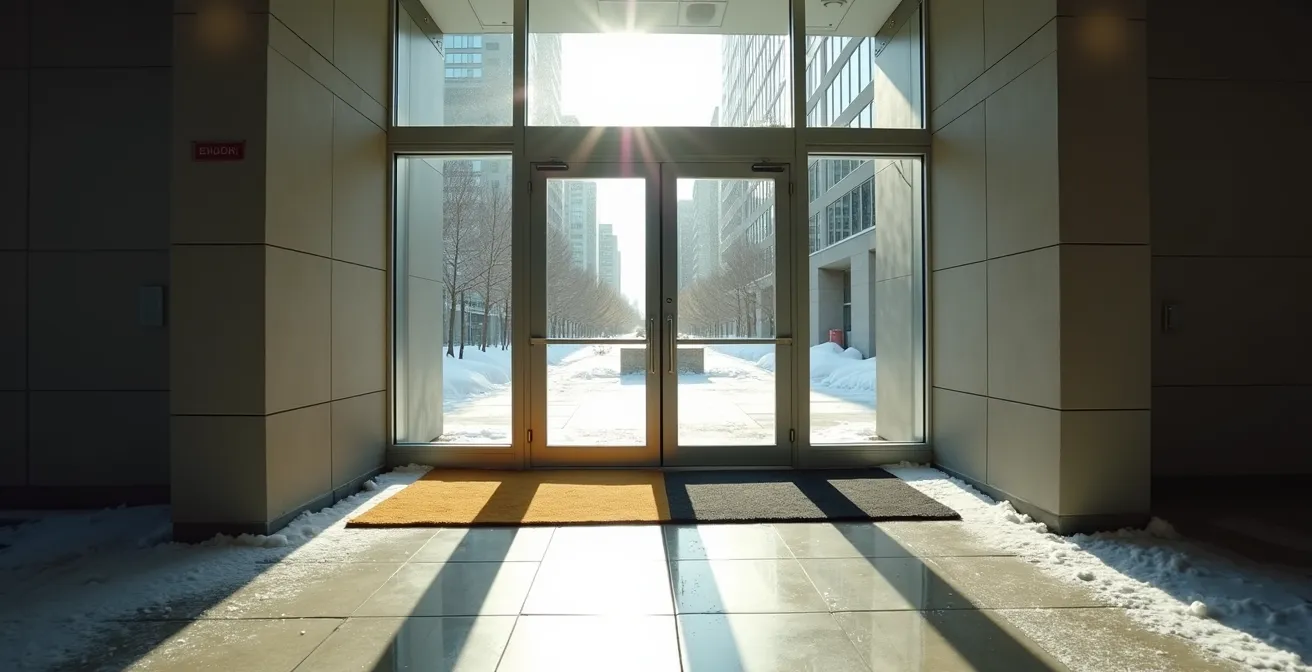
The most cost-effective matting solution for Quebec winters is not about the purchase price versus the rental fee; it’s about which system prevents the highest long-term costs from floor damage and increased labour.
- Standard rental mats often reach their saturation point within hours during heavy snowfall, transferring corrosive salts directly to your floors.
- Owning mats provides control over cleaning frequency but requires a significant, often underestimated, investment in labour and specialized equipment.
Recommendation: The optimal choice hinges on a detailed calculation of your building’s foot traffic, your staff’s capacity for daily maintenance, and the total financial risk of floor degradation.
As a Quebec facility manager, you face the annual dilemma as the first snowflakes fall: how to manage the slush, water, and corrosive salts tracked into your building. The immediate battle line is drawn at the entrance, and your primary weapon is the floor mat. The debate quickly simplifies to a familiar question: is it more cost-effective to rent mats that are swapped out weekly, or to purchase them outright? This focus on a simple rent-versus-buy calculation is a critical financial error.
Most analyses stop at the surface, comparing rental contract fees to the one-time capital expenditure of purchasing. This approach, however, completely ignores the primary function of the matting system: to protect your much larger investment—your building’s floors. The true financial question isn’t about the cost of the mat, but the total cost of a system’s potential failure under the unique duress of a Quebec winter, characterized by heavy snow and the pervasive use of calcium chloride.
This analysis will shift the perspective from a simple cost comparison to a comprehensive liability and risk assessment. We will dissect the performance decay of both rental and owned mats during a snowstorm, calculate the hidden costs of maintenance and floor damage, and provide a framework to determine the genuinely most cost-effective solution for your specific facility. It’s time to move beyond the sticker price and calculate the true cost of protecting your assets.
To navigate this complex financial decision, this article breaks down the key performance and cost factors. The following sections will guide you through a complete analysis, from the science of mat failure to the long-term economic impact of your choice.
Summary : A Financial Analyst’s Guide to Entrance Matting in Quebec
- Why Do Standard Mats Stop Working After Only 2 Hours of Heavy Snowfall?
- How to Calculate the “Rule of 15 Feet” for Your Building’s Entrance?
- Nylon vs Polypropylene: Which Fiber Scrapes Dried Mud Better?
- The Curling Edge Hazard: When Should You Replace Your Entrance Mat?
- How to Deep Clean Rubber-Backed Mats Without Destroying Them?
- How Placing 15 Feet of Matting Can Capture 80% of Debris Before It Enters?
- High-Velocity Floor Fans vs Extra Matting: Which Dries Entryways Faster?
- How Often Should You Steam Clean Office Carpets Based on Foot Traffic Data?
Why Do Standard Mats Stop Working After Only 2 Hours of Heavy Snowfall?
The effectiveness of an entrance mat is not infinite. During a heavy Quebec snowstorm, a standard mat reaches its system failure point surprisingly quickly. The primary reason is saturation. A typical mat can only absorb a finite amount of water and trap a limited quantity of debris. Once its fibres are saturated with melted snow and its surface is caked with salt and grit, it ceases to perform its function. Instead of cleaning footwear, it becomes a transfer pad, applying a layer of salty, abrasive slush to every subsequent shoe that crosses it.
The problem is exacerbated by the type of de-icing agents used. Calcium chloride, prevalent in Quebec for its effectiveness at low temperatures, is highly corrosive. When a mat is saturated, this chemical is no longer contained. It seeps into the mat backing and, more critically, is tracked directly onto your interior flooring. This corrosive salt infiltration attacks floor finishes, degrades grout, and can cause permanent staining and damage to expensive materials like marble, hardwood, and high-grade tile.

The destructive power of these salts should not be underestimated. It’s a slow-motion chemical attack on your building’s assets. To understand the scale of the damage, one only needs to look at larger public infrastructure.
Case Study: Montreal’s Champlain Bridge Salt Damage
A stark example of this corrosive action is the original Champlain Bridge in Montreal. Designed for a much longer lifespan, its 57-year service life was significantly shortened by the relentless attack of road salts. As documented in an analysis of infrastructure challenges, the constant exposure led to severe corrosion of its steel and concrete structures, necessitating a multi-billion dollar replacement. While a floor is not a bridge, the chemical principle is identical: continuous exposure to de-icing salts leads to premature and costly failure.
For a facility manager, this means a rental mat that is only swapped weekly can be functionally useless for five or six days of that week during a prolonged storm cycle. This period of failure is when the most significant, and most expensive, damage to your flooring occurs.
How to Calculate the “Rule of 15 Feet” for Your Building’s Entrance?
The “Rule of 15 Feet” is a foundational principle in facility management for effective soil and moisture control. The concept is simple: it takes approximately 15 feet of continuous matting to remove the vast majority of dirt and water from the soles of shoes. This isn’t just an arbitrary number; it’s based on the average number of steps a person takes to wipe their feet sufficiently. Calculating this for your entrance involves more than just laying down a single long runner. It requires implementing a strategic 3-zone system to progressively clean footwear.
This system breaks the 15-foot journey into three distinct functional zones. The first zone, the exterior, uses an aggressive scraper mat. The second, just inside the door, uses a scraper/wiper hybrid. The third, further inside, uses a finishing wiper mat. This multi-stage approach ensures that different types of debris are captured at each step, from heavy snow and ice to fine salt dust and residual moisture. Implementing this system is the first line of defense in protecting your flooring investment, and it forms the basis for any meaningful cost-benefit analysis.
Action Plan: Implementing a Quebec-Ready 3-Zone Mat System
- Zone 1 (Exterior, 0-5 feet): Install an aggressive outdoor scraper mat designed to break up and trap packed snow, ice, and coarse grit before it enters the building.
- Zone 2 (Vestibule, 5-10 feet): Place a durable scraper/wiper combination mat. Its role is to remove slush, absorb significant amounts of water, and capture smaller rock salt particles.
- Zone 3 (Lobby, 10-15 feet): Position a high-absorption finisher or wiper mat. This final stage is crucial for capturing any remaining fine dust, salt residue, and moisture to prevent it from reaching your main floors.
- Backing and Safety: Ensure every mat within the system features a high-quality rubber backing. This prevents the mats from slipping on wet surfaces, a critical liability consideration.
- Maintenance Protocol: Use a wet/dry vacuum daily during winter months to remove the accumulated salt and moisture from all three zones, including from underneath the mats to prevent floor damage.
Once you’ve established the physical requirement of a 15-foot system, the financial analysis can begin. The initial comparison between renting and owning the required mats seems straightforward, but the numbers only tell part of the story.
| Factor | Rental Mats | Owned Mats |
|---|---|---|
| Annual Cost (e.g., three 3’x5′ mats) | ~$1,560 | ~$450 (one-time purchase) |
| 3-Year Total Cost | $4,680 | $450 – $900 (assuming one replacement) |
| Size Flexibility | Limited to stock sizes | Custom dimensions available |
| Winter Performance Control | Dependent on bi-weekly replacement schedule | Full control with daily maintenance |
| Liability Coverage | Dependent on service contract terms | Full owner responsibility |
Looking at this table, owning appears to be the clear winner on direct cost. However, this simple analysis dangerously omits the performance and material science aspects that dictate a system’s true effectiveness and long-term cost.
Nylon vs Polypropylene: Which Fiber Scrapes Dried Mud Better?
The choice of fibre is a critical variable in a mat’s performance, directly impacting its scraping ability, water absorption, and durability. As a financial analyst, viewing this as a material specification issue is key to understanding long-term value. The two most common synthetic fibres used in commercial mats are Nylon and Polypropylene, each with distinct cost-performance profiles relevant to a Quebec winter.
Nylon is often considered the premium choice. Its fibres have a “memory” that allows them to spring back after being crushed, maintaining their scraping texture longer under heavy foot traffic. Nylon also excels at absorbing and hiding water. However, it is more expensive and can be slower to dry. Polypropylene, on the other hand, is a less expensive, solution-dyed fibre known for its stain and fade resistance. It is not as resilient as nylon and can crush down over time, reducing its scraping effectiveness. Its key advantage is that it is hydrophobic; it does not absorb water but rather traps it between its fibres, allowing it to dry much faster.
For scraping dried mud and trapping fine salt particles, a high-density, coarse polypropylene fibre is often superior. Its stiff texture provides an aggressive scraping action. The challenge in Quebec isn’t just mud; it’s the slushy, chemical-laden mixture that refreezes. This is where the specific properties of the de-icer become relevant. Research from Canadian winter safety experts shows that calcium chloride continues melting ice at -25°C (-13°F). This means the mats are dealing with liquid brine at temperatures where water would normally be solid ice, placing extreme demands on the mat’s ability to both scrape and manage moisture.
Given this context, polypropylene’s quick-drying nature is a significant advantage for an owned-mat maintenance program, as it can be cleaned and returned to service faster. As experts in commercial matting note, the durability of this material is a key factor. In their winter guide, Imperial Dade highlights the practical benefits:
Polypropylene fabric dries quickly and if properly taken care of should not rot or fade.
– Imperial Dade, Commercial Entry Mats Winter Guide
Ultimately, the decision between nylon and polypropylene is a trade-off. Nylon offers superior crush resistance and aesthetics, while polypropylene provides excellent scraping, stain resistance, and faster drying times at a lower cost. For a facility manager focused on the total cost of ownership, a high-quality, coarse polypropylene mat may offer a better return on investment, especially if a rigorous in-house cleaning protocol is in place.
The Curling Edge Hazard: When Should You Replace Your Entrance Mat?
A mat’s lifecycle is not indefinite, and its degradation is a direct financial concern. Beyond reduced cleaning efficacy, a worn-out mat becomes a significant safety and liability risk. The most prominent and dangerous sign of failure is the curling edge hazard. When the rubber or vinyl edges of a mat begin to curl, lift, or crack, they create a trip-and-fall hazard that can lead to costly insurance claims and legal liabilities.
In Quebec, this degradation is accelerated by extreme temperature fluctuations. The rubber and vinyl compounds used in mat backing become brittle in the severe cold, making them susceptible to cracking when flexed. The constant exposure to calcium chloride also attacks these materials, causing them to lose their flexibility and begin to warp. Once an edge starts to curl, the problem escalates quickly as it gets caught on carts, footwear, and cleaning equipment. This is a non-negotiable red flag; a mat exhibiting curled or cracked edges must be replaced immediately, regardless of whether it is owned or rented.
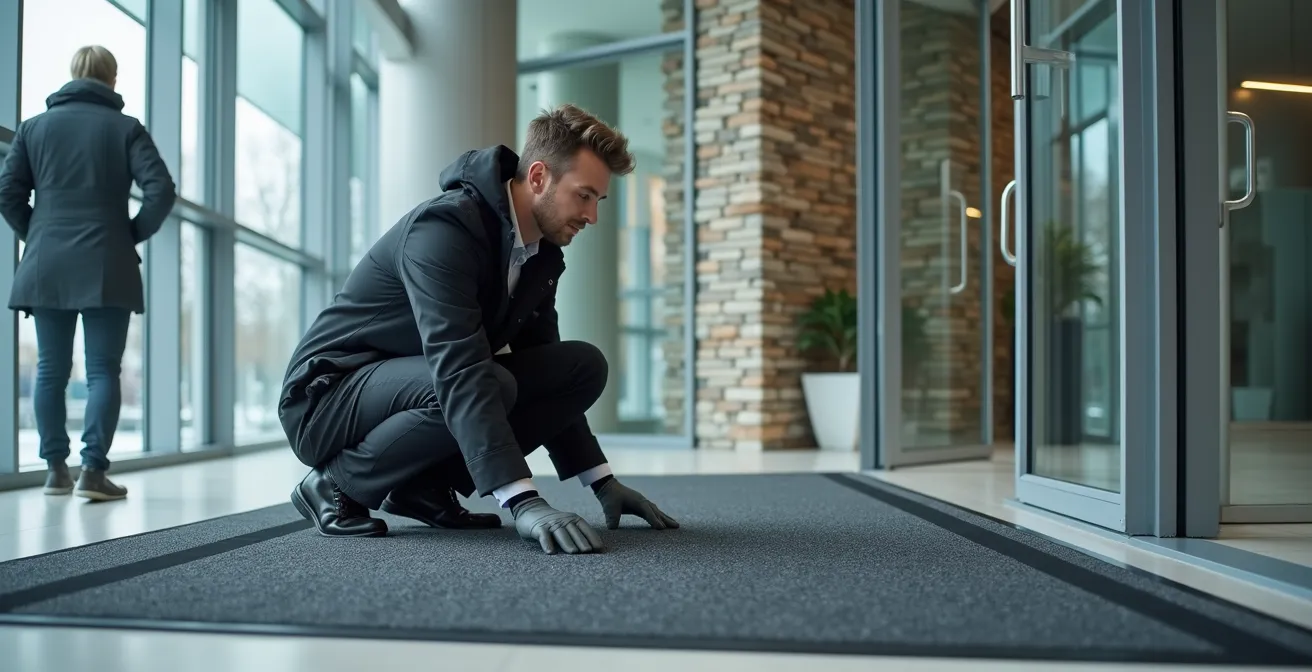
Other critical indicators of replacement include a visible loss of pile height in the main traffic path (a sign the fibres are crushed and no longer scraping effectively), ripples or waves in the center of the mat that will not flatten, and “salt bloom”—a white, powdery residue that appears on the mat’s backing, indicating that corrosive salts have fully penetrated the mat and are now attacking the floor beneath.
For facility managers with rental contracts, there’s a common misconception that the service provider is solely responsible for identifying and replacing hazardous mats. While contracts often specify a replacement schedule (e.g., bi-weekly in winter), the terms for immediate replacement due to a safety hazard can vary. It is the facility manager’s duty to inspect mats regularly and formally request an immediate swap if a hazard is identified. Relying solely on a pre-set schedule is a failure in due diligence. For those who own their mats, the onus of inspection and replacement falls entirely on them, adding another layer to the true maintenance burden.
How to Deep Clean Rubber-Backed Mats Without Destroying Them?
For facility managers who choose to own their mats, the lower initial capital outlay comes with a significant, and often underestimated, operational cost: the labour and equipment for deep cleaning. Simply vacuuming is insufficient during a Quebec winter. A rigorous process is required to remove the embedded, corrosive calcium chloride without destroying the mat itself. Improper cleaning can damage the rubber backing, leading to cracking and curling, thereby shortening the asset’s lifespan.
The key to effective cleaning is a two-step process focused on salt neutralization and extraction. First, a specialized salt-neutralizing rinse solution must be applied. These are specifically formulated chemical agents that dissolve the stubborn calcium chloride crystals that have bonded with the mat fibres. Using standard carpet shampoo is ineffective and can even react with the salts to create a sticky residue that attracts more dirt. This is a crucial distinction: you are not just cleaning dirt; you are performing a chemical remediation.
After the neutralizer has had time to work, the second step is extraction. A commercial-grade carpet extractor or a powerful wet/dry vacuum must be used to pull the dissolved salts and moisture completely out of the mat. Air-drying alone is not enough, as it will leave salt residue behind to continue its corrosive attack. The mat must be allowed to dry completely before being put back into service to prevent mildew and bacterial growth. This necessity for a drying period means a robust owned-mat program requires a backup set of mats to maintain continuous entrance protection. This effectively doubles the initial capital investment.
In contrast, a key value proposition of rental services is the off-site, industrial-scale cleaning process they employ. As mat rental provider Tritex Services outlines, their service involves picking up soiled mats and replacing them with fresh ones. They state their standard rental mats are 90 mils in thickness and are antimicrobial-treated for optimal cleanliness. This highlights a specification difference; rental mats are often thicker and purpose-built to withstand frequent, aggressive washing, a process that would likely destroy a lower-grade purchased mat.
How Placing 15 Feet of Matting Can Capture 80% of Debris Before It Enters?
The “Rule of 15 Feet” is not just a guideline; it’s a quantifiable investment in operational efficiency and asset protection. The financial impact of a properly implemented 15-foot, 3-zone matting system is significant, primarily through cost avoidance. Commercial facility management research consistently shows that a well-designed entrance matting system is the single most effective measure in preventing facility-wide soiling. Data from industry leaders like Imperial Dade indicates that 85-90% of tracked-in soil can be stopped at the entrance with proper matting.
From a financial analyst’s perspective, this 85-90% figure translates directly into major savings. Every pound of dirt captured in the matting is a pound of dirt that your cleaning staff does not have to remove from hallways, offices, and elevators. It is also abrasive material that is not grinding away at your floor finishes, extending the life of your flooring and reducing the frequency of expensive restorative maintenance like stripping and waxing vinyl floors or refinishing hardwood.
During a Quebec winter, this principle is even more potent. The “soil” is a highly destructive mix of dirt, water, and corrosive salts. Preventing this mixture from migrating past the lobby is paramount. The cost of not capturing it at the door is not just increased daily cleaning labour; it’s the long-term, capital-intensive cost of floor replacement and repair from salt damage. When you analyze the numbers, the initial cost of a comprehensive matting system, whether rented or owned, is dwarfed by the savings it generates.
This comparative analysis, based on industry data, illustrates the powerful return on investment. The cost of the matting system itself becomes a secondary consideration when weighed against the massive operational and capital savings it enables.
A detailed cost savings analysis reveals the true value of this preventative measure. The following table quantifies the financial benefits of an effective system compared to inadequate matting.
| Expense Category | Without Proper Matting | With 15-Foot System |
|---|---|---|
| Floor Stripping/Waxing Frequency | 4 times per year | 2 times per year |
| Lobby Flooring Replacement Cycle | Every 5 years | Every 8-10 years |
| Daily Cleaning Labour (Lobby) | 2 hours | 1 hour |
| Annual Salt Damage Repairs | ~$5,000 | ~$1,000 |
These figures demonstrate that investing in an effective 15-foot system is not an expense, but a high-yield investment in cost reduction. The question is not *if* you should implement it, but which procurement method—rental or ownership—delivers this result most cost-effectively for your specific operational context.
High-Velocity Floor Fans vs Extra Matting: Which Dries Entryways Faster?
In the battle against wet, slippery entrances, facility managers often deploy high-velocity floor fans as a rapid-response solution. While these fans are effective at accelerating surface evaporation, from a cost-analysis perspective, they represent an entirely different category of expense compared to matting. Relying on fans is a reactive, energy-intensive tactic, whereas expanding your matting is a passive, preventative investment.
A floor fan’s primary function is to move air, which requires a constant consumption of electricity. While a single fan’s draw may seem negligible, running multiple fans for several hours a day throughout the winter months adds up. This becomes a particularly salient point in Quebec’s current economic climate. Data from the Tribunal administratif du logement indicates a 5.9% average increase in operating costs for facilities, with energy being a significant contributor. Relying on fans means adding a variable, and likely increasing, operational expense to your budget.
Extra matting, by contrast, has no direct energy cost. Its function is to absorb and contain moisture. While a larger matting system represents a higher initial capital cost (if purchased) or a higher monthly fee (if rented), this cost is fixed and predictable. The more effective comparison is not about drying speed, but about cost of containment vs. cost of remediation. Matting contains the problem at the source. Fans are a tool to remediate the problem once the water has already spread across the floor, creating a slip hazard.
Furthermore, fans do not address the issue of salt. They may evaporate the water, but they leave behind a concentrated, abrasive salt residue on your floors, which still needs to be cleaned. A high-quality wiper mat, as the final stage in a 15-foot system, will trap both the water and the salt particles within its fibres. Therefore, from a total cost perspective, investing in additional, high-quality finisher matting is almost always the more financially sound strategy than relying on energy-consuming fans. The fan should be seen as an emergency tool, not a primary component of your winter floor-care strategy.
Key Takeaways
- The true cost of a matting system must include the long-term financial risk of floor damage from corrosive salts, not just the initial purchase or rental fee.
- Rental mats can offer convenience, but their performance plummets as they become saturated between scheduled replacements, creating a window of high risk for your floors.
- Owning mats provides control over cleanliness but requires a calculated investment in backup inventory, specialized cleaning equipment, and dedicated labour hours that must be factored into the total cost.
How Often Should You Steam Clean Office Carpets Based on Foot Traffic Data?
While entrance mats are the first line of defense, some salt and moisture will inevitably be tracked further into the building, settling in office carpets and runners. The frequency of deep cleaning these carpets is a direct consequence of your entrance matting’s effectiveness. A high-performing 15-foot system will dramatically reduce the amount of salt contamination, thus lowering the required frequency and intensity of carpet cleaning. This is a critical, yet often overlooked, downstream financial impact.
The decision on cleaning frequency should be data-driven, based on foot traffic and the severity of the winter. High-traffic areas will require more frequent deep cleaning to prevent long-term damage. The core issue, again, is the corrosive nature of calcium chloride. Just as it degrades concrete, it can cause significant damage to carpet fibres and backing. An analysis of ice melting products highlights this effect: Calcium chloride increases the freeze-thaw cycle, leading to cracking, scaling, and surface deterioration. This same principle of chemical degradation applies when salty slush is left to dwell in carpets, breaking down fibres and leading to premature wear.
Therefore, a facility manager must view deep carpet cleaning not as a routine aesthetic task, but as essential preventative maintenance. Failing to remove embedded salts post-winter will shorten the lifespan of your carpet, accelerating a major capital replacement expense. The cost analysis must connect the dots: a higher investment in a superior entrance matting system directly translates to lower costs in labour, chemicals, and equipment for downstream carpet maintenance, and extends the life of the carpet asset.
The final choice between renting and owning mats should be made only after this complete financial picture is assembled. It requires an honest audit of your facility’s traffic, an accurate calculation of your in-house maintenance capabilities and costs, and a clear-eyed assessment of the risks. An underperforming matting system is not a bargain; it is a deferred and magnified cost.
To make the most profitable decision for your facility, your next step is to conduct a detailed audit of your entrance. Quantify your daily foot traffic during a winter storm, calculate the true hourly cost of your cleaning staff’s labour, and get a firm quote on the capital cost of floor repairs. Only with this data in hand can you accurately compare the total cost of ownership against a comprehensive rental service proposal.
Frequently Asked Questions on Rental Mats vs Owned Mats: Which Solution Is Most Cost-Effective for Quebec Winters?
What are the main signs a mat needs immediate replacement?
The primary signs are curling edges that create trip hazards, a visible “salt bloom” (white powder) in the backing, significant loss of pile height from being crushed flat, and any ripples or waves in the mat’s center that do not flatten out.
How does Quebec winter accelerate mat deterioration?
The extreme cold unique to Quebec winters causes vinyl and rubber edges to become brittle and crack much faster than in milder climates. Furthermore, the heavy use of calcium chloride salts penetrates the mat’s backing materials, causing premature degradation and breakdown from within.
What’s the rental company’s typical replacement obligation?
Most rental contracts specify a regular exchange schedule, such as bi-weekly during winter months. However, the obligation for immediate replacement due to a safety hazard (like a curling edge) can vary by provider. It is crucial to verify these specific terms in your service contract and not assume automatic replacement for safety issues.