Over a 5-year horizon in Quebec, a strategic restoration program consistently delivers a lower Total Cost of Ownership (TCO) and higher ROI than a reactive replacement strategy.
- Proactive restoration prevents minor issues like micro-scratches from escalating into irreversible damage, avoiding capital-intensive slab replacements.
- Choosing materials like polished concrete over epoxy offers superior durability against Quebec’s thermal shocks, drastically reducing long-term maintenance and recoating costs.
Recommendation: Shift from viewing floor maintenance as an operational expense (OPEX) to a strategic investment (CAPEX preservation) that protects asset value and enhances tenant satisfaction.
For any Quebec asset manager, the line item for floor replacement in the CAPEX budget is a recurring source of tension. The debate seems simple: do we absorb the high upfront cost of replacing a worn-out floor, or do we try to extend its life with restoration? This binary choice, however, often overlooks the most critical factor in our climate: the relentless financial erosion caused by winter. The constant assault of de-icing salts, abrasive grit, and extreme thermal shocks turns minor surface issues into irreversible capital damage faster than in any other environment.
The conventional wisdom focuses on immediate savings, often leading to short-term fixes that ultimately accelerate the need for a full, costly replacement. But what if the conversation changed? What if we stopped treating restoration as a simple repair and started viewing it as a strategic financial tool? The key isn’t just to make floors look good; it’s to build a protective shield around your asset’s value, transforming reactive maintenance expenses into predictable, value-preserving investments.
This article moves beyond the surface-level cost comparison. We will dissect the 5-year Total Cost of Ownership (TCO) of both approaches, specifically for high-traffic commercial properties in Quebec. We will analyze how proactive sealing, the right material choices for our climate, and scheduled maintenance interventions don’t just save money—they generate a measurable return on investment by preventing catastrophic failure and preserving the premium aesthetic that justifies higher rental and occupancy rates.
Summary: A Strategic Guide to Floor Asset Management in Quebec
- Why Micro-Scratches on Stone Floors Lead to Permanent Staining Risks?
- How to Apply High-Performance Sealants to Porous Surfaces in High-Traffic Areas?
- Polished Concrete vs Epoxy Coating: Which Solution Lasts Longer in Warehouses?
- The Acidic Cleaner Error That Can Ruin Travertine Flooring in Seconds
- How to Maintain the “Wet Look” on Terrazzo Floors Between Professional Restorations?
- 3 Coats vs 5 Coats: What Is the Optimal Finish Thickness for Supermarkets?
- How to Perform a Mid-Winter “Scrub and Recoat” to Save Your Floor’s Life?
- How Preserving Aesthetic Elements Like Brass and Marble Enhances Hotel Guest Satisfaction?
Why Micro-Scratches on Stone Floors Lead to Permanent Staining Risks?
The first sign of asset value erosion on a stone floor isn’t a crack or a deep gouge; it’s an almost invisible network of micro-scratches. In a Quebec winter, every foot that enters your building brings in salt and sand, acting like fine-grit sandpaper on your marble, granite, or travertine floors. These scratches compromise the stone’s factory finish, opening up its natural pores. Once breached, the surface becomes a sponge for dirt, grime, and most destructively, the dissolved de-icing salts that are tracked inside. This process, known as etching, is a chemical burn that dulls the finish.
What begins as a cosmetic issue quickly becomes a structural one. The porous, scratched surface now traps moisture and contaminants deep within the stone. When this moisture—often laden with corrosive chlorides—freezes and thaws, it creates immense internal pressure, leading to spalling and pitting. At this stage, simple cleaning is ineffective. The stain is no longer on the surface; it’s part of the stone’s matrix. Ignoring these early warning signs locks you into a cycle of escalating costs, where what could have been a simple honing and polishing job turns into a complex, expensive, and sometimes impossible restoration project.
The financial progression from prevention to replacement is alarmingly steep for Quebec building managers. As the following cost escalation model shows, a minor preventative action can avert a five-figure capital expense. This data from Angi.com, adapted for local context, highlights how delaying professional intervention exponentially increases remediation costs. Ignoring micro-scratches is not saving money; it’s pre-authorizing a much larger future withdrawal from your CAPEX budget.
| Prevention Stage | Cost (CAD) | Action Required | Consequence if Ignored |
|---|---|---|---|
| Preventative Matting & Cleaning | $50-75 | Install winter mats, daily cleaning | Micro-scratches form |
| Micro-scratch Honing | $500-750 | Professional honing service | Deep staining begins |
| Stain Removal Poultice | $2,000-2,500 | Chemical treatment | Permanent damage |
| Slab Replacement | $5,000+ | Full stone replacement | N/A |
How to Apply High-Performance Sealants to Porous Surfaces in High-Traffic Areas?
If micro-scratches are the entry point for damage, then a high-performance sealant is the impenetrable shield. For porous surfaces like limestone, slate, or unpolished concrete, applying a sealant isn’t just maintenance; it’s a critical preventative investment. The right sealant penetrates the stone’s pores and creates a sacrificial, non-porous barrier. This layer takes the abuse from foot traffic, salt, and spills, protecting the valuable asset underneath. In high-traffic areas, this barrier is the single most important factor in preventing the deep, permanent staining that necessitates costly restoration or replacement.
The application process, however, is a science. In Quebec’s climate, factors like indoor humidity and temperature fluctuations are critical. Applying a sealant in a humid environment can trap moisture, leading to a cloudy finish and premature failure. Furthermore, using a standard sealant not designed for our winters is a wasted investment. A proper salt-resistant topcoat is formulated to withstand the chemical attack of calcium chloride and maintain its integrity during extreme temperature swings, preventing it from becoming brittle and cracking.
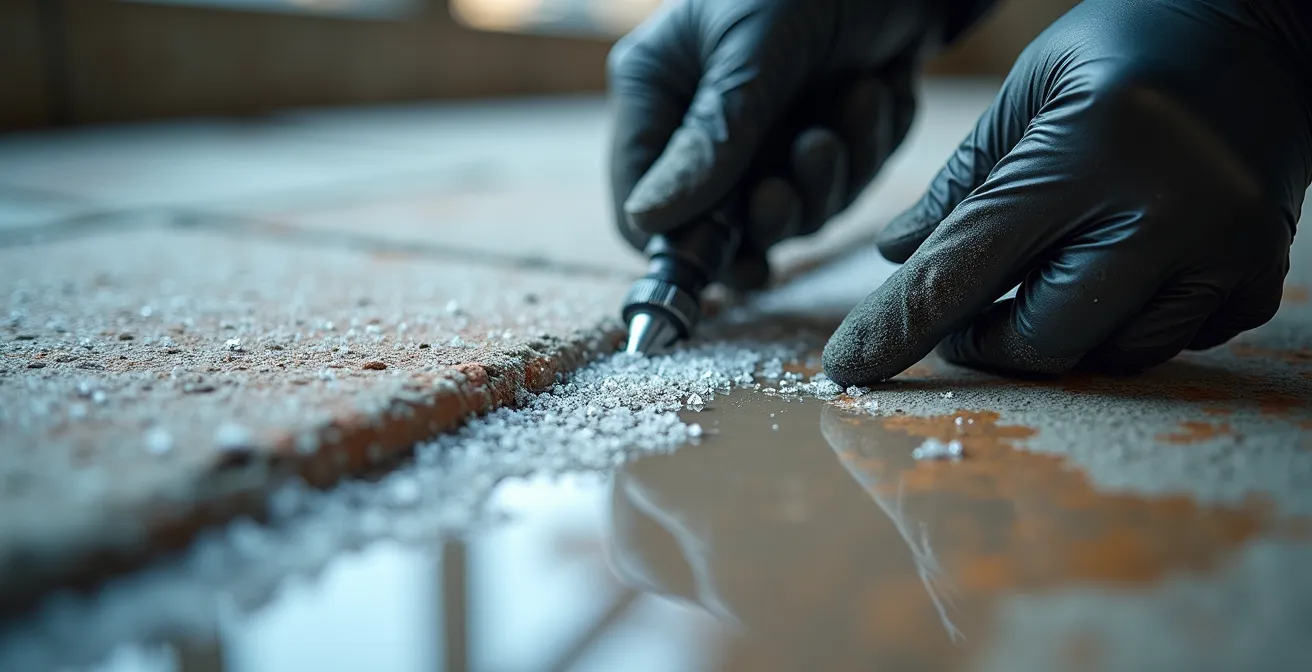
As this image demonstrates, the sealant forms a clear, protective membrane over the stone’s vulnerable pores. This barrier prevents salt and grime from penetrating the surface, effectively stopping the erosion process before it begins. To ensure this protection is effective, following a strict, climate-specific protocol is non-negotiable. It guarantees optimal curing and maximum durability, turning your floor into a resilient, low-maintenance asset.
Action Plan: Quebec Winter Sealant Application Protocol
- Test indoor humidity levels: Must be below 50% for optimal curing.
- Remove all calcium chloride salt residue: Use a pH-neutral cleaner to avoid chemical reactions.
- Apply a thin base coat: Use a low-VOC penetrating sealer compliant with CNESST regulations for worker safety.
- Allow for adequate drying time: A minimum of 2-4 hours with proper ventilation is crucial.
- Apply a salt-resistant topcoat: Choose a product specifically designed for -30°C temperature variations.
Polished Concrete vs Epoxy Coating: Which Solution Lasts Longer in Warehouses?
In the demanding environment of a Quebec warehouse, the choice of flooring goes directly to the bottom line. The two main contenders, polished concrete and epoxy coating, appear similar but have vastly different performance profiles and 5-year TCOs. Epoxy provides a colourful, seamless surface, but its vulnerability to Quebec’s climate makes it a recurring operational expense. Epoxy is a topical coating; it sits on top of the concrete. Under the severe thermal shock of a loading bay door opening in January, the concrete slab and the epoxy coating contract at different rates. This differential movement causes the epoxy to become brittle, leading to cracking, chipping, and delamination.
Polished concrete, by contrast, is not a coating but a process. It involves mechanically grinding, honing, and polishing the existing concrete slab with industrial diamonds. A chemical densifier is applied, which penetrates the concrete and creates a reaction, hardening the surface and eliminating porosity. The result is a floor that is part of the building’s structure itself. It cannot chip, peel, or delaminate. It has excellent resistance to thermal shock and a lifespan that, with minimal maintenance, can exceed 10 years even under heavy forklift traffic.
While the initial installation cost can be comparable, the 5-year TCO reveals the superior financial model of polished concrete. The need to strip and re-apply epoxy every 3-5 years, coupled with the associated downtime, makes it a significantly more expensive long-term proposition, as commercial flooring cost estimators show.
| Cost Factor | Polished Concrete | Epoxy Coating |
|---|---|---|
| Initial Installation (per sq ft) | $3-$8 | $4-$7 |
| CCQ Labor Rates | $85/hour | $75/hour |
| Thermal Shock Resistance (-30°C) | Excellent | Poor (becomes brittle) |
| Lifespan Under Forklift Traffic | 10+ years | 3-5 years |
| Light Reflectivity | 30% increase | 20% increase |
| 5-Year Maintenance Cost | $0.50/sq ft | $2.50/sq ft + recoating |
| Total 5-Year Cost (10,000 sq ft) | $35,000-$85,000 | $65,000-$95,000 |
Case Study: Montreal Distribution Center Floor Performance Analysis
A 50,000 sq ft Quebec logistics facility switched from epoxy to polished concrete in 2023. After one winter season with constant exposure to -30°C through loading bays and heavy salt tracking, the polished concrete showed no thermal damage while maintaining slip resistance. The facility reported a 40% reduction in annual floor maintenance costs and the elimination of the 3-day downtime previously required for epoxy recoating.
The Acidic Cleaner Error That Can Ruin Travertine Flooring in Seconds
One of the fastest ways to turn a valuable stone floor into a massive liability is through a simple, preventable mistake: using the wrong cleaner. Calcium-based stones like travertine, marble, and limestone are highly sensitive to acids. When an acidic cleaner—or more commonly in Quebec, an aggressive salt remover containing muriatic or phosphoric acid—comes into contact with these floors, it triggers an immediate chemical reaction. The acid dissolves the calcium carbonate in the stone, literally eating away the surface. This process, called etching, instantly removes the stone’s polish, leaving a dull, rough, and often chalky-white mark that looks like a chemical burn.
This damage is not a stain; it is physical damage to the stone itself and cannot be removed by cleaning. The only way to repair it is through a costly and disruptive process of professional restoration, which involves grinding down the entire affected area with diamond abrasives to create a new, smooth surface, followed by honing and repolishing. According to HomeAdvisor’s stone restoration cost data, this intensive repair work can range from $1 to $20 per square foot, depending on the severity of the damage.
The financial impact of a single cleaning error can be catastrophic. Proper training for janitorial staff is not an expense; it’s an insurance policy against a five-figure restoration bill. Implementing a strict protocol that includes using pH test strips and stocking only approved, pH-neutral cleaners is a low-cost, high-impact strategy to protect your asset.
Case Study: Westmount Condo Travertine Restoration
In January 2024, a luxury Westmount condominium experienced severe travertine damage when maintenance staff used an acidic winter salt remover on the lobby floor. The cleaner caused immediate etching across 800 square feet. Professional restoration required diamond grinding, honing, and repolishing at a cost of $8,000, compared to the $200 that proper pH-neutral cleaning products would have cost for the entire winter season.
Preventing this costly error requires a simple but rigorous process. Staff must be trained to:
- Test all cleaners with pH strips before use, ensuring the pH is between 6.5 and 7.5.
- Never use winter salt removers containing muriatic or phosphoric acid on calcium-based stone.
- Stock only approved pH-neutral cleaners from designated Quebec suppliers.
- Post visual pH scale charts in janitorial closets as a constant reminder.
- Implement mandatory quarterly training on stone-safe cleaning practices.
How to Maintain the “Wet Look” on Terrazzo Floors Between Professional Restorations?
The deep, reflective “wet look” of a polished terrazzo floor is a hallmark of a premium property. This high-gloss finish isn’t just aesthetic; it’s a sign of a well-maintained, non-porous surface that is easy to clean and resistant to staining. However, in high-traffic areas, the constant abrasion from foot traffic, especially during Quebec winters, gradually dulls this finish. The key to preserving asset value and avoiding a full, costly re-grind is a strategic program of interim maintenance focused on one primary technique: high-speed burnishing.
Burnishing is not cleaning. It’s a process that uses a high-speed floor machine (1500-2000 RPM) and a specialized pad to heat and re-harden the floor’s topcoat finish. This friction melts the top layer of the finish just enough to smooth out the microscopic scratches and scuffs, restoring its original gloss and hardness. It effectively “heals” the protective layer, closing off the pores that could otherwise trap dirt and lead to a dull appearance.
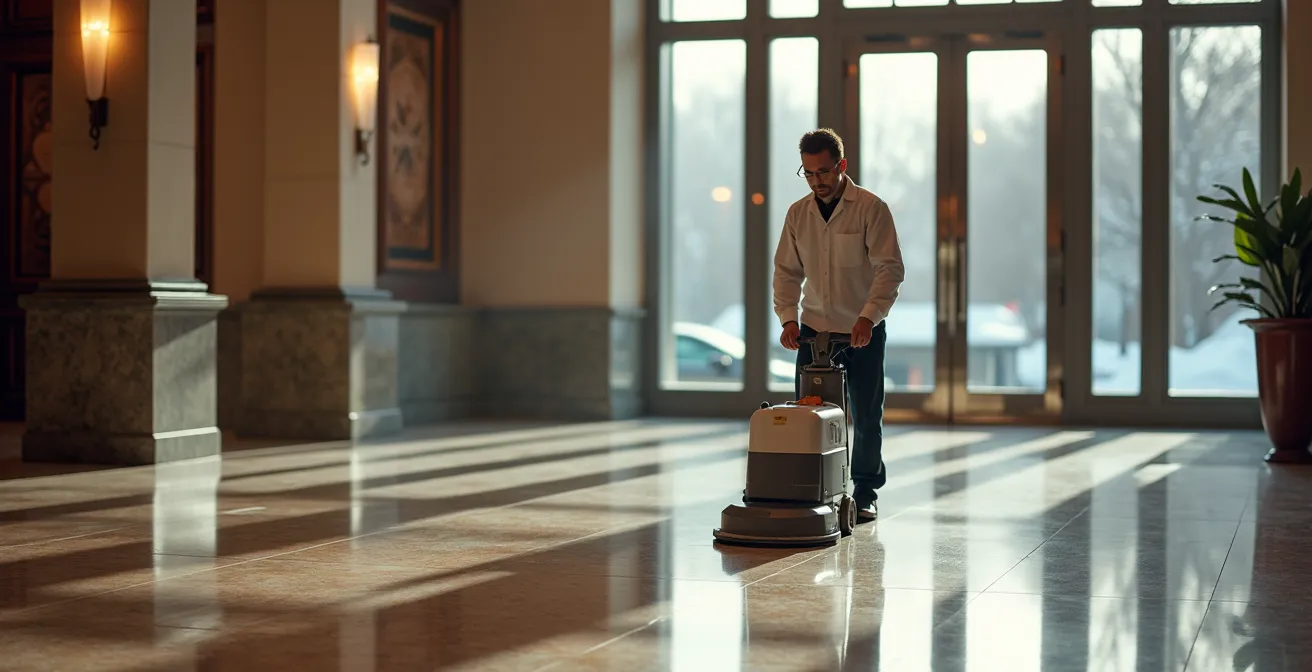
A scheduled burnishing program is a perfect example of proactive maintenance. Instead of waiting for the floor to look dull and dirty—at which point a more aggressive and costly “scrub and recoat” might be needed—regular burnishing maintains the “wet look” indefinitely. The frequency of this task should be adapted to the seasons, with more intensive work required during the winter months to combat the relentless attack of salt and slush.
This seasonal approach, as outlined in property maintenance guides, allows for targeted, cost-effective interventions that extend the life of the floor’s deep gloss finish for years, pushing the need for a full restoration far into the future. A well-executed maintenance plan is far more economical than periodic, large-scale restoration projects.
| Season | Maintenance Frequency | Key Tasks | Cost per 1000 sq ft |
|---|---|---|---|
| Winter (Dec-Mar) | Weekly burnishing | Salt film removal, high-speed burnishing | $200-300/month |
| Spring (Apr-May) | Bi-weekly | Deep clean, recoat preparation | $150-200/month |
| Summer (Jun-Aug) | Monthly | Light burnishing, spot treatment | $100-150/month |
| Fall (Sep-Nov) | Bi-weekly | Pre-winter seal check, burnishing | $150-200/month |
3 Coats vs 5 Coats: What Is the Optimal Finish Thickness for Supermarkets?
For a high-traffic supermarket in Quebec, the floor finish is the first line of defense against shopping carts, spills, and the constant barrage of winter salt and slush. A common cost-saving measure is to apply a minimal number of finish coats—typically three. While this reduces initial labor and material costs, it’s a classic example of a false economy. A thinner, 3-coat finish wears down rapidly, requiring frequent, disruptive, and costly strip-and-recoat cycles, often as much as four times per year.
Applying five coats of a high-quality finish, while more expensive upfront, creates a significantly thicker and more durable protective layer. This “deep gloss” finish has a higher solids content, making it much more resistant to abrasion and chemical attack from de-icing salts. The thicker wear layer means the floor can withstand more traffic and more aggressive daily cleaning before the finish is compromised. Consequently, the need for a full strip and recoat is drastically reduced—often from quarterly to semi-annually or even annually, depending on traffic.
The 5-year TCO calculation is compelling. The higher initial investment for a 5-coat application is quickly offset by the massive reduction in annual maintenance costs and, crucially, the reduction in aisle closure time and business disruption. This is a clear case where spending more initially leads to significant long-term savings and a better-looking, safer floor for customers.
| Factor | 3 Coats | 5 Coats |
|---|---|---|
| Initial Material Cost | $450/1000 sq ft | $750/1000 sq ft |
| CCQ Labor Cost | $600 (8 hours) | $900 (12 hours) |
| Curing Time/Aisle Closure | 18 hours | 30 hours |
| Scrub & Recoat Frequency | Every 3 months | Every 6 months |
| 5-Year Total Cost | $13,450 | $7,650 |
Case Study: Downtown Montreal Provigo Floor Coating Analysis
A high-traffic Provigo in downtown Montreal switched from a 3-coat to a 5-coat finish application in 2024. Despite a 67% higher initial cost, the store achieved a return on investment within 8 months through reduced maintenance labor (four fewer annual stripping cycles) and eliminated customer complaints about slippery floors during winter. The thicker finish withstood constant salt and slush tracking, maintaining its gloss and slip resistance throughout the harsh Quebec winter.
How to Perform a Mid-Winter “Scrub and Recoat” to Save Your Floor’s Life?
By late January, even the best-maintained floors in Quebec are showing signs of battle fatigue. The protective finish has been worn down by weeks of salt, sand, and heavy holiday traffic. Waiting until spring to perform a deep clean is a critical mistake. During these mid-winter months, embedded de-icing salts are actively deteriorating the finish and beginning to damage the flooring material underneath. A proactive mid-winter “scrub and recoat” is an emergency intervention that can prevent irreversible damage and save a floor from premature replacement.
This process involves using a low-speed scrubber to remove the top layers of soiled finish without stripping the floor down to the base. This removes the embedded salt and grime. After a thorough cleaning and neutralization, one or two coats of a specialized, quick-drying winter-grade finish are applied. This tactical recoat replenishes the protective layer, restoring the floor’s appearance and, more importantly, its ability to resist salt damage for the remainder of the winter. As facility maintenance data confirms, a mid-winter recoating provides a 147% ROI by preventing premature replacement.
Performing a recoat in sub-zero conditions presents challenges, but they can be overcome with proper planning. Using dehumidifiers to control indoor humidity and forced-air heaters to accelerate curing are key techniques. This targeted intervention is a powerful tool in an asset manager’s arsenal—a relatively low-cost surgical strike that protects a very high-value asset.
Case Study: Gatineau Shopping Centre Emergency Floor Preservation
In February 2024, Les Promenades Gatineau shopping centre invested $5,000 in an emergency mid-winter scrub and recoat for their 15,000 sq ft main corridor VCT flooring. The proactive maintenance removed 6 weeks of embedded de-icing salt. This single intervention prevented an estimated $150,000 premature floor replacement that would have been necessary within 18 months due to irreversible salt damage, while maintaining safe, attractive flooring through the rest of winter.
Action Plan: The Quebec Mid-Winter Recoat Playbook
- Schedule for late January/early February after peak holiday traffic and salt accumulation.
- Pre-heat the building to a minimum of 22°C for 24 hours prior to application to aid curing.
- Use dehumidifiers to achieve a target humidity of 35-45% in sealed winter buildings.
- Apply a salt-neutralizing cleaner before scrubbing to remove embedded chlorides from the finish.
- Use a specialized winter-grade, quick-dry finish to minimize downtime.
Key Takeaways
- The 5-Year Total Cost of Ownership (TCO) is the most critical metric; initial cost is often misleading.
- Proactive restoration, especially in Quebec’s climate, is a high-ROI investment, not a simple expense.
- Material choice is paramount: polished concrete outperforms epoxy in cold climates, and thicker finishes drastically reduce long-term maintenance costs.
How Preserving Aesthetic Elements Like Brass and Marble Enhances Hotel Guest Satisfaction?
In the hospitality sector, the condition of your property’s aesthetic elements is not just a matter of maintenance; it’s a direct driver of revenue. A gleaming marble lobby, polished brass fixtures, and pristine terrazzo floors create a powerful first impression that communicates luxury, quality, and attention to detail. This perception of quality directly impacts guest satisfaction, which in turn influences online review scores, justifying a higher Average Daily Rate (ADR) and boosting Revenue Per Available Room (RevPAR). Allowing these signature heritage elements to become dull, scratched, or stained is tantamount to voluntarily reducing your property’s earning potential.
Restoring these elements is an investment in the guest experience. The cost of professionally restoring a marble lobby or polishing an elevator’s brass trim is often a fraction of the revenue gained from a marginal increase in ADR over the course of a year. Guests may not consciously notice that the marble is perfectly honed, but they will perceive an overall atmosphere of quality and care. This subconscious positive impression is what leads to 5-star reviews mentioning the “beautiful lobby” or the “impeccable condition” of the hotel.
As Joseph Poletti, a seasoned property manager, points out, the connection between aesthetics and finance is direct and measurable. His experience is validated by financial models showing a clear return on investment for heritage restoration projects.
A brilliantly restored marble lobby can impact online review scores, justify higher Average Daily Rates, and improve RevPAR significantly.
– Joseph Poletti, Property Manager, Revival Stone Testimonial, St. Gabriel Village
Investing in your property’s aesthetic is investing in its brand and bottom line. The data below shows a clear correlation between targeted restoration investments and tangible revenue growth for Quebec hotels.
| Investment Area | Cost | Guest Review Impact | ADR Increase | Annual Revenue Gain |
|---|---|---|---|---|
| Brass Elevator Restoration | $15,000 | +20% positive mentions | +$10 | $36,500 |
| Marble Lobby Restoration | $25,000 | +35% 5-star reviews | +$15 | $54,750 |
| Complete Heritage Package | $40,000 | +45% overall satisfaction | +$25 | $91,250 |
Ultimately, the choice is not between restoring and replacing. It is between a reactive, expensive cycle of degradation and replacement, or a proactive, strategic program of preservation that protects your CAPEX, lowers your TCO, and enhances the value of your asset. For Quebec property managers, the latter is the only financially sound path forward. To understand the potential ROI for your specific property, the next logical step is to conduct a detailed 5-year TCO analysis.