Effective disinfection is a procedural science where application errors, not product choice, pose the biggest financial and health risks.
- Common mistakes like improper concentration and ignoring contact time render even the best disinfectants useless, wasting product and money.
- Verifying product claims against Health Canada’s Drug Product Database (DPD) is a non-negotiable step to ensure efficacy and compliance.
Recommendation: Shift focus from simply buying “strong” products to implementing and verifying correct disinfection protocols to reduce costs and improve safety.
As a purchasing manager in Quebec, you are constantly balancing budget constraints with the non-negotiable need for a safe and healthy environment. The pressure to procure cleaning supplies efficiently often leads to a focus on unit price, but this overlooks a critical distinction: the one between sanitizing and disinfecting. Many believe these terms are interchangeable, or that “disinfecting” is simply a stronger version of “sanitizing.” This common misunderstanding is the source of significant wasted expenditure and, more alarmingly, false security.
The standard advice to “clean before you disinfect” is fundamental, but it only scratches the surface. The real challenge, and the hidden cost, lies in the execution. In the world of microbiology, a disinfectant’s power is nullified by incorrect procedure. This isn’t just about choosing a product with the right Drug Identification Number (DIN); it’s about understanding the science of its application. The true key to saving money and preventing sickness is not in the bottle you buy, but in mastering the protocols of its use.
This guide moves beyond simplistic definitions. We will explore the procedural science that dictates whether your investment in disinfectants is actually working. We will deconstruct the most common and costly mistakes—from ignoring contact time to improper dilution—and provide a framework for a robust, evidence-based antimicrobial stewardship program. You will learn how to verify product claims using official Canadian resources and how to match the right chemistry to the specific pathogens threatening your facility, ensuring every dollar spent on disinfection delivers a real return on safety and compliance.
This article will provide a clear, step-by-step framework for making informed decisions. By understanding the science behind the labels, you can build a disinfection strategy that is both effective and economically sound. Explore the sections below to master these critical concepts.
Contents: Sanitizing vs. Disinfecting: A Strategic Guide
- Why Does Wiping a Surface Too Soon Render Disinfectants Useless?
- How to Remove Biofilms That Shield Bacteria from Chemical Attacks?
- Broad-Spectrum vs Targeted Disinfectants: Which to Choose for Flu Season?
- The Concentration Mistake That Creates Superbugs Instead of Killing Them
- How to Rotate Disinfectant Chemistries to Prevent Bacterial Resistance?
- How to Use ATP Testing Swabs to Validate Disinfection Scientifically?
- How to Use the Drug Product Database (DPD) to Verify Product Claims?
- Choosing the Right DIN Disinfectant: How to Match the Product to the Pathogen?
Why Does Wiping a Surface Too Soon Render Disinfectants Useless?
The single most common failure in disinfection protocols is misunderstanding the concept of contact time, also known as dwell time. This is the period a disinfectant must remain wet on a surface to achieve its claimed kill rate. Wiping a surface dry immediately after application is equivalent to not using the disinfectant at all. The chemical needs time to penetrate the cell walls of microorganisms and neutralize them. Without this time, you are merely moving pathogens around, providing a false sense of security while wasting expensive product.
From a microbiological standpoint, this process is not instantaneous. Each disinfectant chemistry works differently, but all require a specific duration to break down viruses, bacteria, and fungi. For example, quaternary ammonium compounds need to disrupt the cell membrane, while oxidizing agents like hydrogen peroxide must cause destructive oxidative stress. These are chemical reactions that unfold over seconds or minutes, not milliseconds. Research consistently shows that to achieve a significant reduction in microbial load, the full contact time is non-negotiable. PDI Healthcare research confirms that 99.9% of microorganisms require the full manufacturer-specified contact time to be eliminated. This is a critical compliance point for organizations like Quebec’s CNESST, which expects protocols to follow manufacturer guidelines precisely.
To ensure efficacy, the surface must remain visibly wet for the entire duration listed on the product label—whether it’s 30 seconds or 10 minutes. This often requires applying the product generously and, in some cases, reapplying it if it begins to dry prematurely due to airflow or temperature. The visual below demonstrates the necessary state for effective disinfection.
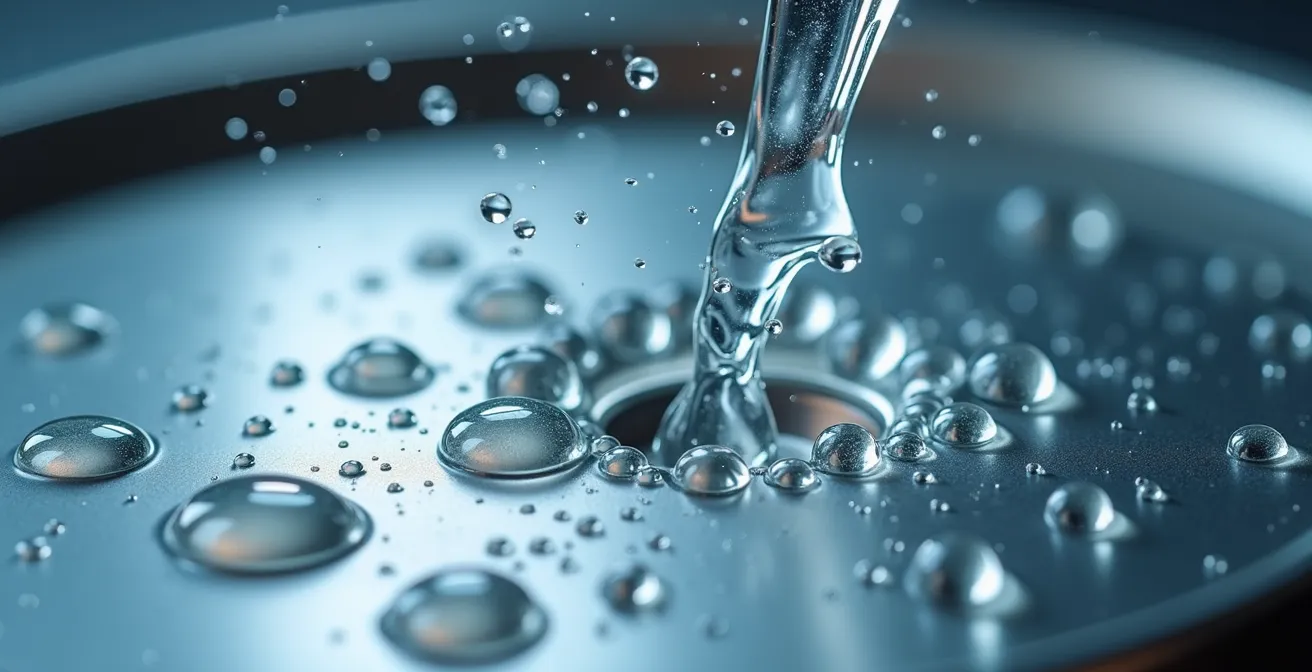
As you can see, achieving a uniform, unbroken film of liquid is key. The goal is to create an environment that is lethal to pathogens for the required duration. Allowing the surface to air dry naturally is the best practice, ensuring the chemical works for its full intended lifespan. Training staff on this one principle can dramatically increase the effectiveness of your entire sanitation program.
How to Remove Biofilms That Shield Bacteria from Chemical Attacks?
Even with perfect contact time, disinfectants can fail if they can’t reach their target. One of the most significant challenges in any facility is the presence of biofilms. A biofilm is not just a collection of bacteria; it is a complex, self-produced matrix of slime (extracellular polymeric substances) that encases a community of microorganisms, acting as a physical shield. This sticky, protective layer makes the embedded bacteria up to 1,000 times more resistant to disinfectants than their free-floating counterparts. Biofilms are a primary source of persistent contamination in environments ranging from hospital drains to food processing equipment.
Simply spraying a disinfectant on a biofilm is often ineffective. The chemical cannot penetrate the dense polysaccharide shield to reach the bacteria within. Eradicating a biofilm requires a multi-step approach that prioritizes physical disruption before chemical action. According to Canadian public health guidelines, the most effective protocol involves three critical stages. First, mechanical action, such as vigorous scrubbing with a brush, is used to physically break apart the biofilm’s structure. This initial step is crucial for exposing the underlying bacteria.
Once the biofilm is physically disrupted, the second step is to apply a specialized cleaner, often an enzymatic or degreasing agent, designed to dissolve the polysaccharide matrix itself. This chemically breaks down the “glue” holding the colony together. Only after these two preparatory steps—scrubbing and dissolving—can the final step, the application of an appropriate disinfectant with proper contact time, be effective. This combined protocol has been a cornerstone of infection control in high-risk settings like Quebec CHSLDs, where it has proven successful in mitigating persistent contamination risks from sources like floor drains.
Broad-Spectrum vs Targeted Disinfectants: Which to Choose for Flu Season?
As a purchasing manager, one of your key decisions is whether to stock a broad-spectrum or a targeted disinfectant. A broad-spectrum disinfectant is effective against a wide range of pathogens, including bacteria, viruses (both enveloped and non-enveloped), and fungi. A targeted disinfectant has proven efficacy against specific microorganisms, such as Influenza A or Norovirus. The choice is a strategic risk management decision that depends entirely on your facility’s environment and the pathogens you are most likely to encounter, particularly during flu season in Quebec.
The Public Health Agency of Canada offers a clear framework for this choice. As a consultant microbiologist, I advise my clients to assess their specific risk profile. For a low-traffic corporate office where the primary concern is the seasonal flu, a cost-effective targeted disinfectant with a specific claim against Influenza A virus may be sufficient. However, for high-risk, high-traffic environments like a daycare, a medical clinic, or a CHSLD, a broad-spectrum product is a much wiser investment. These facilities face a diverse and unpredictable array of pathogens, and a broad-spectrum disinfectant provides a critical layer of defense against both expected and unexpected threats.
The misuse of powerful disinfectants is also a concern. It is important to remember that these are powerful chemicals. In fact, INSPQ data shows a 20.4% increase in disinfectant-related calls to poison control centres during the initial phase of the COVID-19 pandemic, highlighting the need for proper training and use. Using a broad-spectrum product where it’s not needed can lead to unnecessary chemical exposure and cost. Conversely, using a targeted product in a high-risk setting can leave you vulnerable to other dangerous pathogens not covered by its claims.
For a low-traffic office, a targeted disinfectant might be cost-effective. For a daycare or clinic, a broad-spectrum product is a better investment in risk management.
– Public Health Agency of Canada, COVID-19 Cleaning and Disinfecting Guidelines
The decision ultimately comes down to a cost-benefit analysis where the “cost” is not just the price per bottle, but the potential cost of an outbreak. For most businesses in Quebec preparing for flu season, a quality broad-spectrum disinfectant is the most prudent and defensible choice.
The Concentration Mistake That Creates Superbugs Instead of Killing Them
While contact time is a passive error, incorrect concentration is an active one with far more dangerous consequences. Many facilities purchase disinfectants in concentrated form to save on shipping and storage costs—a sound financial strategy. However, if these concentrates are not diluted exactly according to the manufacturer’s instructions, they can either be ineffective or, worse, contribute to the development of antimicrobial resistance. When a disinfectant is over-diluted, it creates what is known as a “sublethal dose.” This concentration is too weak to kill all the pathogens, but strong enough to stress them, allowing the most resilient organisms to survive and multiply, passing on their resistance traits.
In essence, improper dilution acts as a training ground for creating “superbugs.” This is not a theoretical risk. Human error in manual mixing is rampant. A case study from Facility Plus, which services facilities across Canada, found that manual dilution errors were creating sublethal doses in up to 30% of applications. This common mistake completely undermines the purpose of disinfection, wastes money on ineffective solutions, and poses a long-term public health risk.
For a Quebec purchasing manager, ensuring correct dilution is a matter of both safety and compliance with CNESST regulations, which mandate adherence to product specifications. The most reliable solution is to remove human error from the equation by investing in automated dilution control systems. These systems connect directly to a water line and automatically mix the precise ratio of concentrate and water with the push of a button. Where automation isn’t feasible, using pre-measured packets or cartridges is the next best option. Regular verification with chemical test strips should also be part of the protocol to ensure concentrations are consistently accurate.
Action Plan: Auditing Your Dilution Protocol
- Points of Contact: Identify all locations where disinfectants are mixed and stored (e.g., janitorial closets, dispensing stations).
- Collecte: Inventory your current dilution methods. Are they manual (glug-glug method), using pre-measured packets, or fully automated systems?
- Cohérence: Compare your current procedures against the manufacturer’s specifications for each product and Quebec’s CNESST workplace safety requirements.
- Clarity & Error-Proofing: Evaluate your training materials. Are instructions clear, visual, and available in both French and English to serve all staff?
- Plan d’intégration: Create a prioritized plan to transition high-use areas to automated dilution systems or, at minimum, implement a documented verification process using test strips.
By implementing these controls, you ensure that every litre of disinfectant is potent enough to do its job, protecting both your staff and your budget from the hidden costs of resistance.
How to Rotate Disinfectant Chemistries to Prevent Bacterial Resistance?
Just as in medicine, where doctors vary antibiotics, facilities should practice antimicrobial stewardship by rotating disinfectant chemistries. Continuously using the same type of disinfectant, such as a quaternary ammonium compound (quat), can allow microorganisms in your environment to develop resistance to that specific chemical’s mode of action. Over time, this can render your primary disinfectant less effective. Rotating between different chemical classes helps prevent this by challenging pathogens with different kill mechanisms, keeping them off-balance.
This strategy is particularly critical in settings with a high bioload and vulnerable populations, such as hospitals or long-term care facilities. In fact, major hospitals in Montreal have integrated disinfectant rotation into their antimicrobial stewardship programs to combat the rise of resistant organisms. The principle is simple: don’t let the enemy get used to your attack. By switching, for example, from a quat-based product to an Accelerated Hydrogen Peroxide (AHP) product, you change the method of assault from disrupting the cell membrane to destroying it through oxidation.
As a purchasing manager, implementing a rotation schedule is a proactive, strategic move. It doesn’t have to be complicated. A simple quarterly rotation is often sufficient. The key is to switch between products with different active ingredients and modes of action. For example, using a quat in Q1, an AHP product in Q2, a different quat formulation in Q3, and a specialty product like hypochlorous acid in Q4 for specific threats like norovirus. This approach is a hallmark of a sophisticated, modern disinfection program.
The following table provides a sample rotation schedule suitable for many Quebec facilities, incorporating different chemical classes and their ideal use cases throughout the year.
| Quarter | Chemistry Type | DIN Example | Contact Time | Best For |
|---|---|---|---|---|
| Q1 (Jan-Mar) | Quaternary Ammonium | DIN-approved Quat | 30-60 sec | General bacteria |
| Q2 (Apr-Jun) | Accelerated Hydrogen Peroxide | AHP products | 30 sec-1 min | Broad spectrum |
| Q3 (Jul-Sep) | Different Quat formulation | Alternative Quat | 1-2 min | Envelope viruses |
| Q4 (Oct-Dec) | Hypochlorous Acid | HOCl products | 30 sec | Norovirus, C. diff |
How to Use ATP Testing Swabs to Validate Disinfection Scientifically?
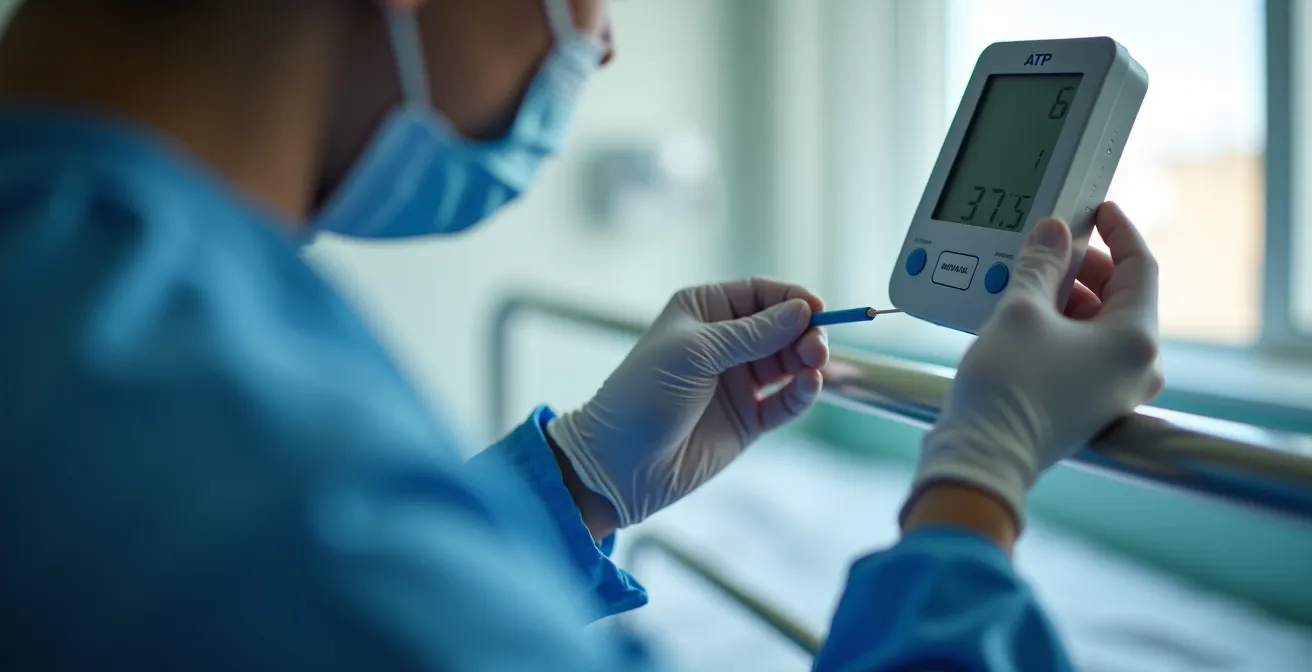
How do you prove your cleaning and disinfection protocols are actually working? A surface can look clean but still harbor a high microbial load. This is where scientific validation comes in. ATP (Adenosine Triphosphate) testing is a fast, simple, and powerful tool that allows you to measure the overall cleanliness of a surface in seconds. ATP is an energy molecule found in all living cells, including bacteria, food debris, and human skin cells. An ATP meter doesn’t count bacteria, but it measures the total organic load, which is a direct indicator of how clean a surface is.
The process is straightforward: you swab a surface, insert the swab into a handheld luminometer, and get a reading in Relative Light Units (RLU). A low RLU score indicates a clean surface, while a high score signals that the surface needs to be re-cleaned and disinfected. For a purchasing manager in Quebec, ATP testing provides objective, quantifiable data to validate cleaning effectiveness, justify budgets, and demonstrate due diligence to auditors from organizations like MAPAQ or Accreditation Canada. It’s the “trust but verify” component of your program.
Implementing an ATP program involves sourcing a meter and swabs from a Canadian scientific supplier, establishing baseline RLU benchmarks for different surfaces (e.g., <10 RLU for critical food-contact surfaces, <30 for general high-touch points), and creating a testing schedule. It is also crucial to remember the first step: cleaning. Effective cleaning physically removes the majority of the biolim. In fact, UC Davis Medical Center research demonstrates that cleaning with microfiber mops can achieve a 99% bacterial reduction, compared to only 30% with traditional cotton mops. ATP testing can validate this crucial first step before disinfection even begins.
Using the data from ATP tests allows you to identify problem areas, refine cleaning protocols, and provide targeted training to staff. It transforms cleaning from a subjective task into a managed, data-driven process, providing you with the hard evidence needed to confirm your investment in products and labor is paying off.
How to Use the Drug Product Database (DPD) to Verify Product Claims?
In Canada, any product that claims to disinfect a surface is regulated by Health Canada and must have a Drug Identification Number (DIN). This 8-digit number on the product label is your key to verifying a manufacturer’s claims. It is a common and costly mistake for purchasing managers to rely solely on marketing terms like “hospital-grade” or “heavy-duty.” These terms are not regulated and have no standard definition. The only way to know what a product is truly approved to kill is by checking its DIN in Health Canada’s official Drug Product Database (DPD).
The DPD is a free, publicly accessible online tool. By entering a product’s DIN, you can see exactly which pathogens Health Canada has certified it to be effective against. This is not just good practice; it is your primary tool for due diligence. A case study illustrates this perfectly: a Quebec facility manager was purchasing products marketed as “hospital-grade” for their premises. Upon checking the DINs in the DPD, they discovered that while the products were legitimate disinfectants, they lacked specific efficacy claims against key pathogens of concern for their facility, such as SARS-CoV-2. This discovery prompted a complete overhaul of their purchasing protocol.
By shifting their strategy to cross-reference every potential product’s DIN against the DPD and only purchasing those with explicit, approved claims for their target pathogens, they dramatically improved their infection control posture. This simple verification step ensures you are not paying a premium for marketing hype but are instead purchasing a tool with government-vetted efficacy. It empowers you, the purchasing manager, to cut through the noise and make evidence-based decisions that protect both your people and your budget. It’s also important to differentiate a DIN from other numbers. An NPN (Natural Product Number) is for products like hand sanitizers, and a PCP Act number is for pesticides; only a DIN signifies a Health Canada-approved disinfectant.
Case Study: The Power of DIN Verification
A Quebec facility manager discovered that several products they were using, marketed as ‘hospital-grade,’ lacked specific pathogen claims in Health Canada’s Drug Product Database (DPD). By cross-referencing the 8-digit DIN numbers from the labels, they identified that only products with explicit, government-vetted claims against their target pathogens (e.g., ‘Influenza A virus’) met their actual infection control requirements. This led to a complete revision of their purchasing protocols, eliminating ineffective products and improving safety outcomes.
Making DPD verification a mandatory step in your procurement process is the single most effective way to guarantee you are getting the protection you are paying for.
Key Takeaways
- Procedure over Product: The effectiveness of disinfection hinges on correct procedure (contact time, concentration) far more than on perceived product “strength.”
- Verification is Non-Negotiable: Use objective tools like ATP testing to validate cleaning and Health Canada’s DPD to verify disinfectant claims before purchasing.
- Think Like a Strategist: Employ advanced strategies like chemical rotation and pathogen-specific selection to prevent resistance and optimize protection.
Choosing the Right DIN Disinfectant: How to Match the Product to the Pathogen?
The final piece of the puzzle is synthesizing all this information to make the optimal purchasing decision. Once you have verified a product’s claims via its DIN, the ultimate strategic choice is to match that product to the specific pathogens and environments within your facility. A one-size-fits-all approach is rarely the most effective or cost-efficient. The pathogens of concern in a restaurant kitchen (e.g., Salmonella, E. coli) are different from those in a CHSLD (e.g., C. difficile, Candida auris) or a school during flu season (e.g., Influenza, Norovirus).
A pathogen-environment matrix is an invaluable tool for this purpose. By mapping common pathogens against different facility types, you can make highly targeted purchasing decisions. For example, many common quat-based disinfectants are not effective against difficult-to-kill non-enveloped viruses like Norovirus or spore-forming bacteria like C. difficile. For these threats, a product based on chlorine, Accelerated Hydrogen Peroxide, or another specialized chemistry is required. Using this targeted approach ensures you have the right weapon for the fight, preventing outbreaks and avoiding the costs associated with them.
This level of specificity also has a direct impact on your bottom line in ways that go beyond the bottle price. Factoring in labour time is crucial. A disinfectant with a 30-second contact time can save significant labour costs compared to one with a 10-minute contact time, especially across a large facility. Indeed, industry analysis shows up to a 30% reduction in total costs when labour efficiency is factored into the disinfectant selection process. By choosing a product that is not only effective against your target pathogen but also efficient to use, you optimize for both safety and budget.
The following matrix, adapted for common Quebec environments, provides a starting point for matching disinfectants to specific needs.
| Pathogen | CHSLD | Restaurant | School | Office |
|---|---|---|---|---|
| Norovirus | Chlorine/AHP | Chlorine 1000ppm | AHP | Quat+ |
| Influenza | AHP/Quat | Quat | AHP | Quat |
| C. difficile | Chlorine 5000ppm | N/A | Chlorine | N/A |
| MRSA | AHP | Quat+ | AHP | Quat |
| Candida auris | Chlorine/AHP | N/A | N/A | N/A |
Armed with this scientific approach, you can now transform your disinfection protocols from a simple cost centre into a strategic asset for organizational health and safety. Begin by auditing your current contact time and concentration procedures to identify the most immediate opportunities for improvement.
Frequently Asked Questions on Sanitizing vs. Disinfecting
What is the difference between a DIN and an NPN?
A DIN (Drug Identification Number) is a number issued by Health Canada for disinfectants that have proven claims against specific microorganisms. An NPN (Natural Product Number) is used for natural health products, including many hand sanitizers, which are regulated differently and do not typically carry surface disinfection claims.
How do I verify a product’s claims using the DPD?
To verify a claim, locate the 8-digit DIN on the product’s label. Enter this number into Health Canada’s online Drug Product Database (DPD). The database will display the product’s official information, including the “Approved For” section which lists the specific pathogens the product has been government-vetted to be effective against.
What does a PCP Act registration number mean?
A Pest Control Products (PCP) Act registration number is assigned to products regulated as pesticides in Canada. This category can include some types of antimicrobial products, but they fall under a different regulatory framework than DIN-registered surface disinfectants. For healthcare and general facility surface disinfection, a DIN is the standard identifier to look for.