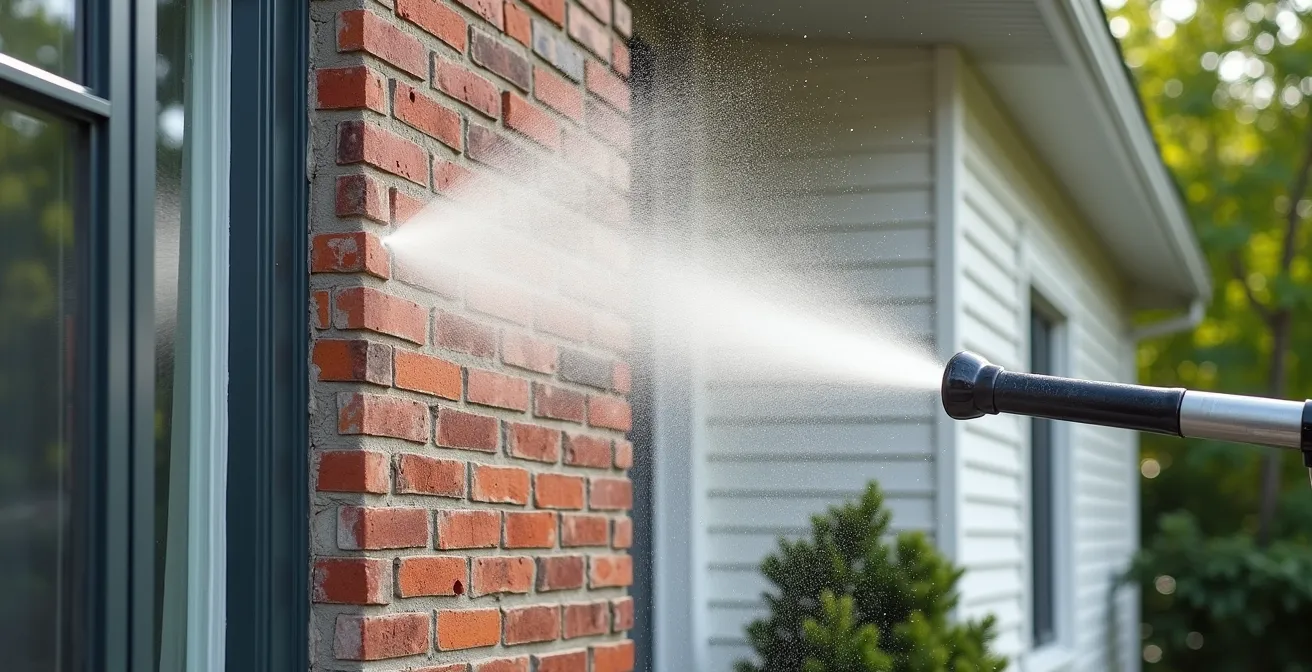
The belief that higher pressure equals a better clean is the single most costly mistake a Quebec homeowner can make for their siding.
- High-pressure washing injects water behind siding, leading to catastrophic mold growth and damage during our freeze-thaw cycles.
- Soft-washing uses specialized, biodegradable algaecides to eliminate organic growth at the root, offering protection that lasts up to three times longer.
Recommendation: Always choose a cleaning method based on a scientific assessment of the contaminant and surface, not on brute force. This guide explains how.
As a Quebec homeowner, you take pride in your property’s appearance. So when you see those unsightly green and black streaks of algae and mold appear on your stucco or siding, your first instinct might be to blast them away with the highest pressure possible. It seems logical: more power, more clean. However, this common approach is precisely what can lead to thousands of dollars in hidden damages, especially in our unique climate.
The problem isn’t just about what you see on the surface. Aggressive pressure washing doesn’t just strip away the grime; it forces water into every tiny crack and seam of your building’s exterior. This trapped moisture becomes a ticking time bomb, creating the perfect breeding ground for mold behind your walls and causing structural damage when it freezes and expands during our harsh winters. Protecting your home isn’t about using brute force; it’s about using the right science.
This is where soft-washing comes in. It’s a completely different philosophy. Instead of relying on destructive pressure, it uses specialized, biodegradable cleaning solutions applied at low pressure—no more than a garden hose—to kill organic growth at its root. This guide will walk you through the science behind why soft-washing is not just a gentler alternative, but a fundamentally more effective and longer-lasting solution for protecting your most valuable asset against the specific challenges of the Quebec environment.
In the following sections, we will delve into the specific mechanics of how high pressure causes damage, how professional solutions are mixed for our climate, and what safety and compliance standards you must demand from any contractor working on your property.
Summary: A Scientific Guide to Protecting Your Home’s Exterior
- Why Does High PSI Water Injection Cause Mold Growth Behind Siding?
- How to Mix Biodegradable Algaecides specifically for Quebec’s Climate?
- Does Soft-Washing Keep Mold Away Longer Than Standard Power Washing?
- The Plant Burn Mistake: How to Protect Landscaping During Chemical Cleaning
- How to Clean 3-Story Façades Safely from the Ground Using Telescopic Poles?
- Why Does Urban Pollution Degrade Brick Mortar Faster in Downtown Areas?
- How to Pressure Wash Salt Away Without Driving It Deeper into the Pores?
- High-Rise Window Cleaning: How to Ensure Compliance with Quebec Safety Code for Suspended Work?
Why Does High PSI Water Injection Cause Mold Growth Behind Siding?
The core danger of high-pressure washing isn’t the force you see, but the water you don’t. When a jet of water hits your siding at 1,300 PSI or more, it doesn’t just clean the surface; it acts like a hydraulic needle. This pressure is powerful enough to lift the edges of vinyl siding, penetrate weep holes, and exploit microscopic gaps in your home’s exterior envelope. Once inside, this water becomes trapped against the sheathing and insulation, creating a pocket of persistent dampness.
In Quebec, this problem is dangerously amplified by our climate. During the winter, that trapped water freezes. According to building science principles, water expands by approximately 9% when it freezes. This expansion exerts immense force on your home’s structure, damaging vapor barriers, warping sheathing, and creating even larger gaps for future water intrusion. It’s a destructive cycle that begins with a single, overly aggressive cleaning.
When spring arrives, the ice melts, and the trapped moisture, now combined with organic dust and darkness, creates the ideal breeding ground for toxic black mold (Stachybotrys). The process is a slow-motion disaster:
- Injection: High-pressure water (1,300-2,800 PSI) forces its way under siding through gaps and crevices.
- Damage: Trapped water freezes in winter, expanding and compromising vapor barriers and wood sheathing.
- Growth: The spring melt creates persistent damp conditions perfect for aggressive mold growth behind the siding, where it can go unnoticed for years.
Soft-washing, by contrast, uses pressure equivalent to a gentle rain. It cleans the surface without ever breaching the building’s protective envelope, completely eliminating the risk of water injection and subsequent freeze-thaw cycle damage.
How to Mix Biodegradable Algaecides specifically for Quebec’s Climate?
Effective soft-washing isn’t just about low pressure; it’s a science of chemistry tailored to the environment. Unlike pressure washing, which is a blunt mechanical force, soft-washing relies on the chemical efficacy of its solutions to do the work. The primary active ingredient in most professional algaecides is Sodium Hypochlorite (SH), a biodegradable compound that neutralizes algae, mold, and mildew. However, its effectiveness is highly dependent on one critical factor: ambient temperature.
A true professional in Quebec understands that a one-size-fits-all mixture will fail. A solution that works perfectly on a 25°C day in July will be significantly less effective on a 12°C day in October. Adjusting the concentration of the cleaning solution is crucial for achieving a complete root-level kill of the contaminants without using excessive chemicals. This is not guesswork; it’s a calculated process.
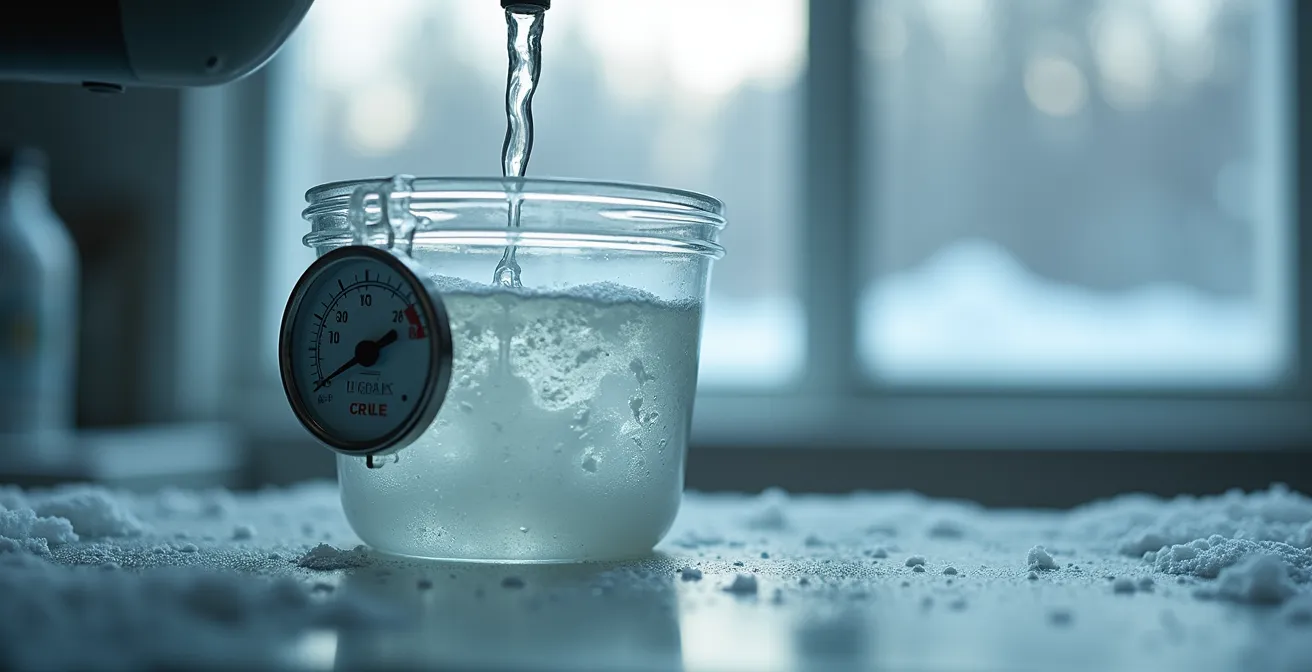
As you can see, the professional’s toolkit involves more than just a spray wand; it requires a deep understanding of how to adapt to changing conditions. For Quebec’s varied seasons, this means carefully adjusting the mix ratio to ensure peak performance, whether in the heat of summer or the crisp air of spring and fall. The goal is always maximum effectiveness with minimal environmental impact.
This table from industry experts illustrates how a professional contractor adjusts their approach based on the temperature on the day of service. This precision is what separates a true exterior cleaning specialist from a generalist with a power washer. It demonstrates a commitment to achieving results through science, not force, as shown in this temperature-based effectiveness chart.
| Temperature Range | SH Effectiveness | Recommended Concentration | Quebec Season |
|---|---|---|---|
| Above 20°C | 100% | 1-3% | Summer |
| 10-20°C | 75% | 3-4% | Spring/Fall |
| Below 10°C | 50% | 4-6% + booster | Early Spring/Late Fall |
Does Soft-Washing Keep Mold Away Longer Than Standard Power Washing?
Absolutely, and the reason lies in the core difference between the two methods: soft-washing sanitizes, while pressure washing merely “trims.” When you use high-pressure water to blast away mold and algae, you are only removing the visible surface layer of the growth. You are leaving the microscopic roots and spores embedded in the pores of your siding or stucco. In a matter of months, these roots will regenerate, and the green and black stains will return, often thicker than before.
Soft-washing, on the other hand, is a treatment. The biodegradable algaecides penetrate the surface and neutralize these organisms at a biological level, achieving a complete root-level kill. This is why the results last significantly longer. Instead of a temporary cosmetic fix, you’re getting a deep clean that sanitizes your home’s exterior.
Soft washing not only cleans but also kills the spores of organic growths, offering longer-lasting results compared to pressure washing.
– MTM Hydro Parts Technical Team, The Ultimate Guide to Using a Soft Wash System
The difference in longevity is dramatic. While a pressure-washed surface in Quebec might look clean for a season, it often requires re-cleaning within 8 to 12 months. In contrast, data shows that professional soft-wash treatments can prevent mold regrowth for 24-36 months, offering two to four times the value and protection for your investment.
Case Study: Laurentians Property Mold Prevention
In humid regions with heavy tree cover like the Laurentians, homeowners constantly battle recurring algae on their siding. Research shows soft washing is more effective at killing and removing mold at the roots, offering longer-lasting results compared to pressure washing which often eliminates only the visible portion. For properties in this region, this root-level treatment significantly extends the time between cleanings, saving homeowners money and preserving the integrity of their siding over the long term.
The Plant Burn Mistake: How to Protect Landscaping During Chemical Cleaning
One of the biggest fears homeowners have about chemical cleaning is the potential for damage to their cherished landscaping. It’s a valid concern. Improperly applied or managed cleaning solutions can indeed harm or even kill plants, grass, and flowerbeds. This is where the difference between an amateur and a seasoned professional becomes glaringly obvious. A true expert operates with a strict protocol designed to protect your entire property, not just the surfaces being cleaned.
A common mistake is to simply throw a plastic tarp over plants. This can be even more damaging, as the plastic can trap heat and “cook” the foliage on a sunny day. A professional protocol is far more meticulous and is based on principles of dilution and neutralization. The goal is to ensure that any runoff is so diluted by the time it reaches the soil that it is completely harmless.
The professional 3-step plant protection protocol includes:
- Step 1: Pre-Saturation: Before any cleaning solution is applied, all surrounding soil, foliage, and root systems are completely saturated with fresh water. This ensures that the plants have already absorbed all the water they need, and any incidental contact with diluted runoff will not be absorbed.
- Step 2: Specialized Covers: Where necessary, breathable, specialized plant covers are used. These protect from direct spray without trapping damaging heat.
- Step 3: Post-Rinse and Neutralization: Immediately after rinsing the cleaned facade, the surrounding landscape is given another generous rinse to wash away any residual solution. In some cases, a neutralizing agent is applied to the soil as an extra precaution.
This level of care is a hallmark of a professional, responsible contractor. It’s a non-negotiable part of the job. Furthermore, a reputable company in Quebec will always protect you. They should carry comprehensive insurance, because accidents can happen. As a client, you should always verify that your contractor has sufficient coverage. In our industry, it’s standard that professional Quebec contractors should carry liability insurance of at least $2 million to protect you and your property from any eventuality.
How to Clean 3-Story Façades Safely from the Ground Using Telescopic Poles?
Cleaning multi-story buildings presents a significant safety challenge. The traditional image of workers on high ladders or expensive scaffolding is not only risky but often unnecessary for soft-washing applications. Modern technology allows trained professionals to safely and effectively clean buildings up to three or even four stories high, all while keeping their feet firmly on the ground. This is achieved through the use of specialized carbon fiber telescopic poles.
These poles are incredibly lightweight yet rigid, allowing an operator to precisely control the application of the cleaning solution on upper floors without the instability of ladders. This method is not only safer for the worker but also eliminates the risk of ladders damaging your siding, gutters, or landscaping. However, using these tools effectively and safely requires specific equipment and strict adherence to safety protocols, especially in a province with numerous overhead power lines.
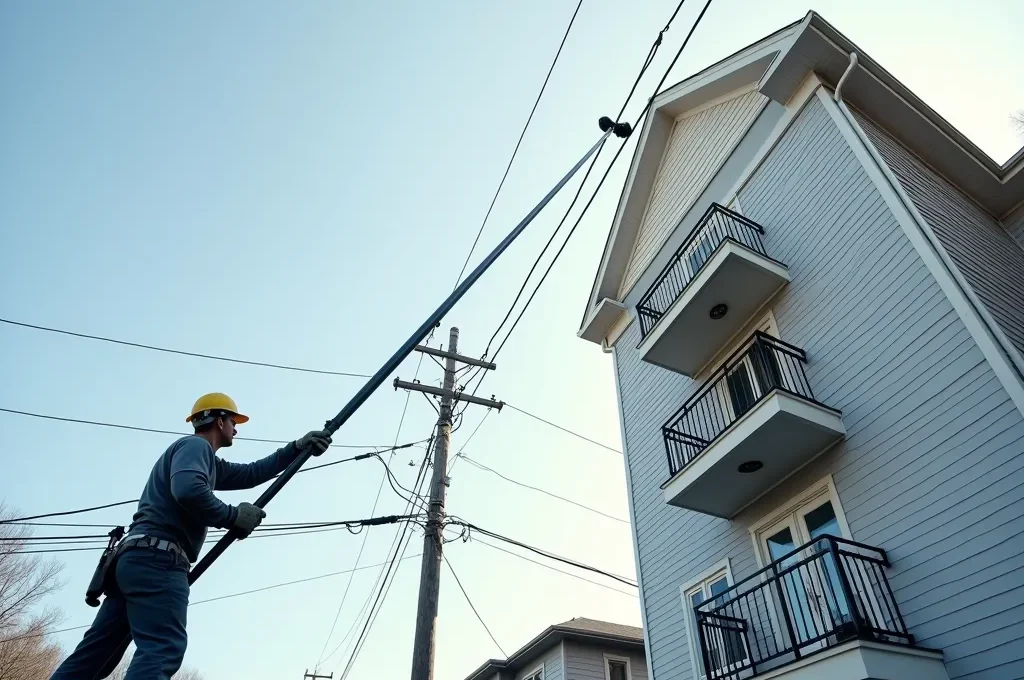
A professional setup for ground-based high-reach cleaning is more than just a long pole. It involves a system designed for safety and effectiveness:
- Carbon Fiber Poles: These are preferred over aluminum as they are lighter, more rigid, and non-conductive, offering better control and an added layer of safety.
- Specialized Nozzles: These are engineered to project a soft-wash solution up to 40 feet in a coherent stream, which then turns into a gentle spray upon impact. This achieves height without creating high pressure.
- Pressure Regulation: The system maintains a low pressure (150-300 PSI) even at maximum extension to ensure a true soft-wash.
- Situational Awareness: The number one rule is to always check for overhead power lines before extending any equipment. As a strict rule, Hydro-Québec mandates maintaining at least a 3-meter minimum safe distance from all power lines.
Why Does Urban Pollution Degrade Brick Mortar Faster in Downtown Areas?
If you own a brick property in a dense urban area like downtown Montreal, you’re not just fighting against biological growth; you’re battling chemistry. The brick and mortar on your building are under constant assault from urban pollution. Emissions from traffic and industrial activity release sulfur oxides and nitrogen oxides into the atmosphere. These compounds mix with precipitation to form acid rain, a weak but relentlessly destructive acidic solution.
The primary target of this acid rain is the mortar holding your bricks together. Mortar is rich in calcium carbonate, which is alkaline. When acid rain lands on the mortar, a chemical reaction occurs, converting the durable calcium carbonate into soft, water-soluble gypsum. This new compound has no structural integrity. During the next rain, or during a cleaning, this softened gypsum simply washes away, causing the mortar joints to recede and crumble over time.
This process is accelerated by Quebec’s freeze-thaw cycles. Water penetrates the now-porous, gypsum-laden mortar, freezes, expands, and breaks the mortar apart from the inside. This is why you often see accelerated deterioration on heritage buildings in high-traffic urban centers.
Case Study: Acid Rain’s Impact on Montreal’s Heritage Buildings
An analysis of Montreal’s historic brick buildings shows a clear pattern of accelerated mortar deterioration in high-traffic downtown areas. The constant exposure to acid rain from urban pollution chemically alters the mortar, making it soft and prone to erosion. Gentle, regular cleaning with a pH-neutral or slightly alkaline solution is the recommended preservation strategy. This process removes the acidic pollutants from the surface, neutralizing the chemical reaction and halting the destructive cycle before significant damage occurs. Using high-pressure washing on these weakened surfaces would be catastrophic, blasting away the already compromised mortar.
This illustrates that cleaning in an urban environment is also a form of preservation. A gentle, scientific approach removes the harmful acidic layer, neutralizing the threat and extending the life of your building’s masonry.
How to Pressure Wash Salt Away Without Driving It Deeper into the Pores?
After a long Quebec winter, your walkways, driveways, and the base of your building are likely caked in a white film of road salt residue. The instinct to grab a pressure washer and blast it away is strong, but it’s precisely the wrong thing to do. High pressure doesn’t effectively remove salt; it pulverizes the salt crystals and drives them deeper into the porous surfaces of concrete and masonry.
When salt is driven into the pores, it creates a phenomenon called subflorescence. Moisture from the ground or air is drawn to the trapped salt, and as the water evaporates, the salt recrystallizes and expands just below the surface. This expansion creates immense internal pressure, causing the surface to flake, spall, and crumble. You may have solved the visible problem, only to create a much more serious, structural one.
The professional technique for salt removal is counter-intuitive. It uses very low pressure but high water volume, following a “Dissolve and Flood” methodology:
- Pre-Wetting: The surface is thoroughly wetted with a large volume of water at very low pressure (under 500 PSI). This begins the process of dissolving the surface salt.
- Neutralizer Application: A specialized salt-neutralizing additive is applied. This solution breaks the chemical bond between the salt ions and the surface, lifting it out of the pores.
- Flood Rinsing: The entire area is then rinsed from the top down with a high volume of water. This “flood” carries the dissolved salts completely away from the surface, rather than driving them deeper.
This careful, multi-step process is the only way to truly remove accumulated salt without causing long-term, subsurface damage. It’s another example where scientific technique triumphs over brute force.
Key Takeaways
- High-pressure washing injects water behind siding, which freezes, expands, and leads to mold and structural damage in Quebec’s climate.
- Soft-washing uses biodegradable solutions to kill mold and algae at the root, providing results that last 2-4 times longer than pressure washing.
- A true Quebec professional adapts their chemical mix to the temperature, protects your landscaping meticulously, and carries a minimum of $2 million in liability insurance.
High-Rise Window Cleaning: How to Ensure Compliance with Quebec Safety Code for Suspended Work?
When the scope of work moves from a three-story building to a high-rise, the level of required expertise and regulatory compliance increases exponentially. In Quebec, working at heights, especially on suspended scaffolds or bosun’s chairs, is governed by a strict set of regulations enforced by the CNESST (Commission des normes, de l’équité, de la santé et de la sécurité du travail). For a property owner or manager, hiring a contractor who does not meet these standards is a massive liability risk.
It is not enough for a company to simply have the equipment. Their team must possess specific, up-to-date certifications proving they have been trained on safety procedures, fall arrest systems, and rescue plans. This is not optional; it is the law. As the CNESST itself mandates, a worker’s competency is the first line of defense against accidents.
Professionals must hold specific certifications recognized by the CNESST for working at heights, including training on suspended scaffolds and fall arrest systems.
– CNESST Quebec, Regulation respecting occupational health and safety (RSST)
For anyone hiring a contractor for high-rise work in Quebec, due diligence is not just recommended; it’s essential for legal and financial protection. You must actively verify their compliance. This goes far beyond a simple quote; it’s about confirming their qualifications to perform the work safely and legally on your property.
Action Plan: Verifying Your High-Rise Cleaning Contractor in Quebec
- Verify Certifications: Ask for proof that every worker on site holds current, CNESST-approved certifications for suspended work and working at heights.
- Confirm Insurance: Request a certificate of insurance confirming they hold a minimum of $2 million in liability coverage, specific to high-rise operations.
- Request Rescue Plan: By law, the contractor must have a written, site-specific rescue plan. Ask to see it.
- Check Anchor Inspections: Rooftop anchor points must be inspected and certified annually by an engineer. Ask for the most recent inspection certificate for your building’s anchors.
- Ensure Code Compliance: Confirm that their equipment and procedures comply with all relevant sections of the Quebec Construction Code and Safety Code.
Ultimately, making the right choice between soft-washing and pressure washing comes down to prioritizing the long-term health of your property over a short-term fix. By understanding the science and partnering with a qualified, insured, and certified professional who respects Quebec’s specific environmental and regulatory challenges, you are not just cleaning your home—you are making a wise investment in its protection and value. For an expert assessment tailored to your property’s specific needs, the next logical step is to consult with a specialized exterior cleaning contractor.