
The key to zero-downtime floor stripping in Quebec retail is not just working overnight, but executing a planned operation of environmental control and chemical precision.
- Timing must account for winter conditions, which accelerate floor degradation and complicate ventilation.
- The number of wax coats and the neutralization process are critical decision points that directly impact finish durability and prevent costly failures.
Recommendation: Shift from a reactive cleaning mindset to proactive asset management by implementing a scheduled buffing and recoating program to extend the life of your floor finish and reduce the frequency of full strips.
For a Quebec retail manager, the gloss on the floor is more than just aesthetics; it’s a reflection of the store’s quality and attention to detail. Yet, the process required to maintain that shine—floor stripping and waxing—presents a significant operational challenge: how to execute a major overhaul without closing doors or disrupting business. The constant flow of customers, combined with the harsh realities of Quebec winters bringing in salt and slush, means floor finishes degrade rapidly, leading to a dull, yellowed, and unprofessional appearance.
The standard advice is often to “do it overnight.” While correct, this simple instruction masks a complex logistical reality. It overlooks the critical factors of proper ventilation in freezing temperatures, the precise chemistry needed to counteract de-icing salt residues, and the strategic decisions on finish thickness that can mean the difference between a durable shine and a costly failure within months. It’s a task where cutting corners leads to peeling wax, slippery surfaces, and ultimately, more frequent and disruptive interventions.
But what if the solution wasn’t just about scheduling, but about strategy? This guide moves beyond the basics to adopt the perspective of a commercial works planner. We will focus on the principles of environmental control and chemical precision essential for operational continuity in the Quebec retail landscape. This is not just about cleaning; it’s about protecting a valuable asset—your floor—while ensuring your business never misses a beat.
This article will provide a detailed roadmap, breaking down the critical technical decisions you need to make. We will explore why floors yellow, how to ventilate safely in winter, the optimal coating strategy for high-traffic supermarkets, and the common errors that lead to finish failure, all tailored to the specific challenges faced by retailers in Quebec.
Summary: When Is the Best Time to Schedule Floor Stripping to Minimize Business Disruption in Retail?
- Why Does Wax Buildup Turn Yellow on VCT Floors Over Time?
- How to Ventilate a Space Properly During Floor Stripping to Avoid Fumes?
- 3 Coats vs 5 Coats: What Is the Optimal Finish Thickness for Supermarkets?
- The Neutralization Error That Causes Finish to Peel Off Within Weeks
- How Regular Buffing Can Extend the Time Between Stripping Jobs by 6 Months?
- How to Perform a Mid-Winter “Scrub and Recoat” to Save Your Floor’s Life?
- Why Do Certain Detergents Leave a Slippery Residue on Ceramic Tiles?
- Why Do Some “Universal” Waxes Fail on Modern Luxury Vinyl Tiles (LVT)?
Why Does Wax Buildup Turn Yellow on VCT Floors Over Time?
The gradual yellowing of a once-brilliant VCT (Vinyl Composition Tile) floor is a common frustration for retail managers. This discoloration is not a single event but a process of degradation caused by a combination of factors. The primary culprit is the wax itself. Over time, layers of floor finish are susceptible to UV light degradation, causing them to oxidize and take on a yellow hue. This is accelerated by embedded dirt and grime that foot traffic grinds into the soft wax layers. In a high-traffic retail setting, microscopic scratches accumulate, trapping dirt that regular mopping cannot remove, which dulls the finish and enhances the yellowed appearance.
Furthermore, improper cleaning practices can significantly hasten this process. Using harsh, high-pH cleaners can chemically “burn” the finish, leading to discoloration. The buildup of old wax layers, especially when new coats are applied without a deep enough scrub, seals in old, yellowed finish, creating a perpetually dingy look. A Montreal-based study on retail floor maintenance identified this exact issue, noting that premature yellowing on VCT floors was a direct result of heavy foot traffic and required a full strip and wax to restore floor longevity and appearance. Without proactive maintenance, this degradation cycle shortens the time between major services.
Industry standards reflect this reality. For VCT floors in a commercial environment that do not benefit from a regular burnishing or buffing program, a full strip and refinish is often required every six to nine months to remove the yellowed, compromised layers and restore a clean, professional look. This makes understanding the causes of yellowing the first step in planning a long-term, cost-effective maintenance strategy.
How to Ventilate a Space Properly During Floor Stripping to Avoid Fumes?
Proper ventilation during floor stripping is a non-negotiable safety requirement, but it presents a unique challenge for Quebec retailers, especially in winter. Simply opening doors and windows is often not feasible due to freezing temperatures, security concerns, and the impact on the building’s climate control. The potent chemicals used in floor strippers release Volatile Organic Compounds (VOCs), which can cause respiratory irritation and other health issues for the work crew and potentially linger in the air, affecting staff and customers the next day. Therefore, a strategic approach to environmental control is essential.
The professional standard is to use a negative air pressure system. This involves using industrial-grade air movers (fans) and flexible ducting to exhaust contaminated air directly from the work area to the outside. One fan is placed to pull air out of the space, while another can be used to introduce fresh, and ideally tempered, make-up air from a clean source. This creates a controlled airflow that contains fumes and prevents them from migrating to other parts of the store, such as merchandise areas or HVAC systems.

As the image illustrates, this setup is a self-contained system that works independently of the building’s main HVAC, preventing the spread of chemical fumes through the ventilation network. This approach is aligned with the safety-first mindset required by Quebec’s regulatory body, the CNESST (Commission des normes, de l’équité, de la santé et de la sécurité du travail). Compliance means not only implementing the right equipment but also ensuring team members have the correct PPE, including respiratory protection, and are trained on the risks and safety protocols. Diluting stripping chemicals with cold water, rather than hot, can also help minimize the release of VOCs from the start.
3 Coats vs 5 Coats: What Is the Optimal Finish Thickness for Supermarkets?
A key strategic decision in any floor refinishing project is determining the optimal number of floor finish coats. This choice is a trade-off between initial cost, drying time, and long-term durability. For a high-traffic Quebec supermarket, this isn’t just a technical detail—it’s a financial one. While a standard 3-coat application is faster and less expensive upfront, it offers minimal protection against the heavy wear and tear of shopping carts, constant foot traffic, and the abrasive effects of tracked-in winter salt and sand. This thinner layer will wear down quickly, exposing the tile and likely requiring a complete re-strip within a year.
A more robust strategy for a supermarket environment is a 5-coat application. The first two coats act as a sealer, filling the pores of the VCT, while the subsequent three build a durable, protective wear layer. This thicker finish provides a deeper gloss and, more importantly, a greater buffer against scratches and abrasion. It can withstand more aggressive cleaning and buffing, which in turn extends the floor’s pristine appearance. Although a 5-coat system costs more initially and requires a longer curing time (a critical factor in overnight work), it significantly prolongs the period before another full strip is needed. When combined with a regular burnishing program, floors can often go a full year before needing to be stripped and refinished, representing a superior return on investment.
To make an informed decision, it’s helpful to visualize the trade-offs. This comparative analysis of coating strategies provides a clear framework for planning.
| Coating Strategy | Initial Cost | Winter Durability | Maintenance Frequency | Drying Time |
|---|---|---|---|---|
| 3-Coat Standard | Lower | 6 months | Every 6-9 months | 3-5 hours |
| 5-Coat Winter Protection | Higher (+40%) | 12 months | Annual | 5-10 hours depending on humidity |
| Sacrificial Winter Coat (5-6 layers) | Highest (+60%) | Full winter season | Mid-winter scrub & recoat | 6-12 hours |
The data clearly shows that for a demanding environment like a supermarket, investing in a 5-coat or even a sacrificial winter coat system, while requiring a larger initial outlay, results in better performance and a more predictable annual maintenance schedule, minimizing long-term business disruption.
The Neutralization Error That Causes Finish to Peel Off Within Weeks
Perhaps the most frustrating and costly failure in floor refinishing is when a freshly applied finish begins to peel, flake, or powder within weeks. This is almost always caused by a critical but often-rushed step: improper neutralization. Floor stripping chemicals are highly alkaline (high pH) to be effective at dissolving old wax. If this high-pH residue is not completely removed and neutralized before the new finish (which is typically acidic or neutral) is applied, it creates a chemical conflict right at the surface of the tile. This conflict prevents the new wax from bonding correctly, leading to catastrophic adhesion failure.
The floor might look perfect right after the job is done, but as soon as it’s exposed to foot traffic and cleaning, the poorly bonded wax will quickly break down. The neutralization process involves thoroughly rinsing the floor after stripping, and then applying a specific floor neutralizer solution. As detailed in expert protocols, it is essential to rinse the floor with a neutralizer to ensure complete removal of any stripper residue. Any remaining stripper on the floor will inevitably cause the new wax to peel off later. This step is not optional; it is the chemical foundation for a durable finish.
In Quebec’s winter, this step is even more critical. De-icing salts like calcium chloride are themselves alkaline and can leave a residue that interferes with pH balance. A meticulous rinsing and neutralization protocol is therefore essential. This includes using a wet/dry vacuum to pick up all slurry and rinse water, ensuring the floor is bone dry, and even testing the floor’s surface with pH strips to confirm it has returned to a neutral pH of 7.0 before any new finish is applied. Rushing this stage to save an hour overnight will cost days of remedial work and business disruption down the line.
Action Plan: Quebec-Proof Rinsing and Neutralization Protocol
- Rinse the floor thoroughly with clean water at least two times after the stripping slurry has been removed. Use a dedicated rinse mop.
- If the stripper manufacturer recommends a neutralizer, mix and apply it according to the exact dilution instructions (typically 1-2 ounces per gallon).
- Use a wet/dry vacuum to ensure every bit of the rinsing or neutralizing solution is recovered from the floor.
- Verify the floor is completely dry before applying the first coat of finish. Any moisture will compromise adhesion and curing, leading to a cloudy finish.
- For maximum assurance, use a digital meter or pH test strips on the dry floor to confirm the surface has returned to a neutral pH of 7.0 before proceeding.
How Regular Buffing Can Extend the Time Between Stripping Jobs by 6 Months?
Thinking of floor maintenance as a series of expensive, disruptive stripping jobs is a reactive and costly approach. A far more strategic and cost-effective method is to implement a proactive maintenance program centered on regular buffing or burnishing. This process uses a high-speed floor machine (1500-2000 RPM) to heat and polish the top layers of the floor finish. It’s not a cleaning process, but a restorative one that addresses the daily wear and tear that leads to a full strip.
At a microscopic level, daily foot traffic creates tiny scratches in the wax, which diffuse light and make the floor appear dull. Burnishing effectively melts and hardens the finish, smoothing out these micro-scratches and restoring a high-gloss, “wet look.” This not only improves the floor’s appearance day-to-day but also hardens the surface, making it more resistant to future scuffs and dirt penetration. By keeping the protective layers of wax intact and clean, you dramatically slow down the degradation process that leads to yellowing and deep, embedded grime.
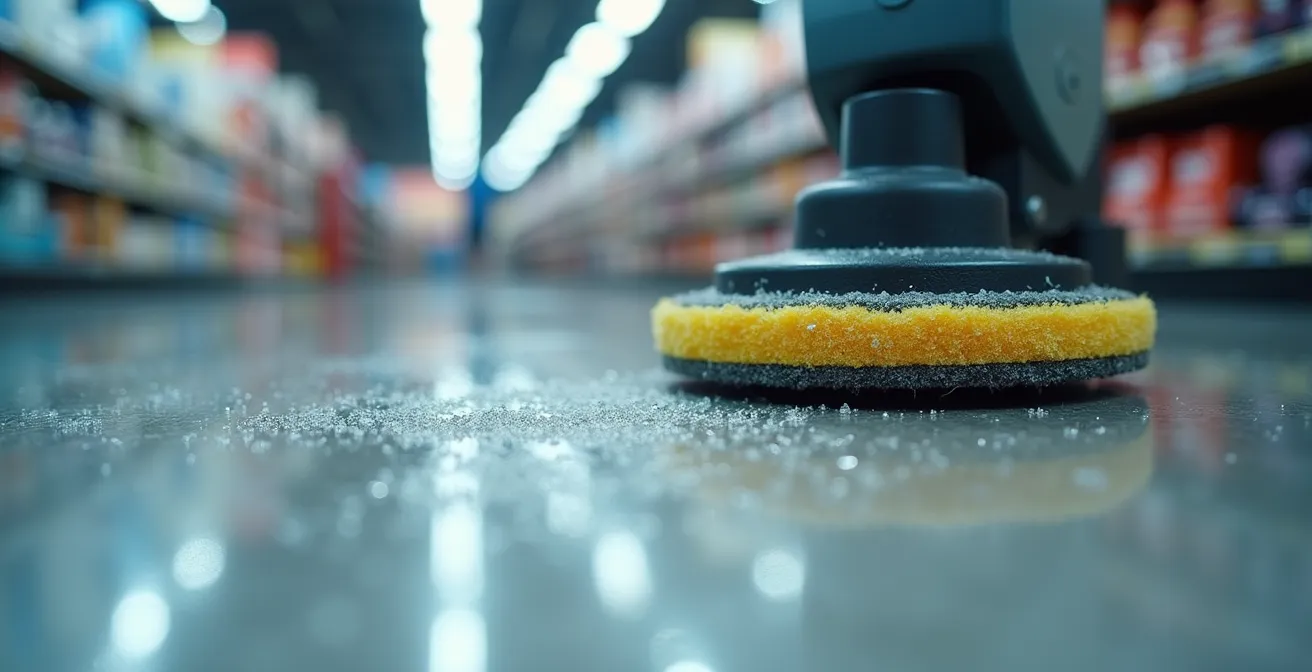
The financial and operational benefits are significant. A proactive buffing program, performed on a weekly or bi-weekly basis during overnight cleaning, can dramatically extend the life of a floor finish. This turns an expensive annual or semi-annual stripping job into a predictable, lower-cost operational expense. The impact is well-documented; floors that are not actively maintained often need to be stripped every 6-9 months, while a consistent burnishing schedule can easily push that requirement to 12, 18, or even 24 months, depending on traffic. This represents a direct extension of 6 months or more, saving not only money but also the major disruption of a full strip-out.
How to Perform a Mid-Winter “Scrub and Recoat” to Save Your Floor’s Life?
The Quebec winter is brutal on retail floors. The constant cycle of snow, slush, and, most damagingly, abrasive rock salt and calcium chloride acts like sandpaper on floor finish. By mid-January, even a robust 5-coat finish applied in the fall can look dull, scratched, and worn out, particularly in high-traffic entranceways. Many assume the only option is to endure it until spring for a full strip. However, a strategic intervention known as a “scrub and recoat” can save the floor’s life and maintain store appearance through the toughest months.
A scrub and recoat is a less invasive procedure than a full strip. Instead of chemically dissolving all layers of wax, the process uses a low-speed floor scrubber with a moderately abrasive pad and a strong floor cleaner to remove only the top one or two layers of damaged finish. This removes the salt-etched, scratched, and dirty surface wax. After the scrubbing, the floor is rinsed thoroughly, allowed to dry, and then one or two fresh coats of finish are applied. This sacrificial top layer restores the gloss and protective barrier without the time, cost, and intense chemical use of a full strip-out.
From a planning perspective, this is a highly profitable and value-added service. It demonstrates a proactive asset protection strategy to the client. By presenting a cost-benefit analysis, you can show how this mid-winter service prevents more significant damage to the underlying VCT and postpones the need for an emergency strip, which is far more costly. As one analysis on extra-bill work notes, this type of proactive maintenance is not only highly profitable but also makes routine cleaning easier and drastically improves the facility’s appearance, reinforcing the value of the maintenance partnership. For a retail manager, it means not having to live with a decrepit-looking floor for three months of the year.
Why Do Certain Detergents Leave a Slippery Residue on Ceramic Tiles?
While much of the focus in floor care is on VCT, ceramic tile floors in areas like vestibules, washrooms, or food service sections present their own unique challenges, particularly concerning safety. A common and dangerous issue is a slippery residue left after cleaning. This is often caused by an incorrect choice or misuse of cleaning detergents. Many “quat-based” disinfectants (containing Quaternary Ammonium Compounds) are known to leave behind a sticky or slippery film if not diluted and rinsed properly. This residue can build up over time, creating a significant slip-and-fall hazard, especially when the floor gets wet.
The problem is exacerbated in winter. The residue from these cleaners can react with the calcium chloride in de-icing salts tracked into the building, creating a greasy film that is very difficult to remove with standard mopping. Furthermore, some all-purpose cleaners contain soaps or oils that are not meant for non-porous ceramic and leave a slippery coating. The solution lies in using pH-neutral cleaners specifically formulated for hard surfaces and ensuring that cleaning equipment, like auto-scrubber tanks and mops, are rinsed daily to prevent chemical buildup. Calibrating the dilution settings on auto-scrubbers is also critical, as using too much chemical is a primary cause of residue.
For a retail manager in Quebec, preventing a slippery floor is not just a cleaning issue—it’s a legal and financial liability. This is where the CNESST’s role becomes highly relevant. As their guidelines clearly state, employers have a legal obligation to ensure a safe work environment.
Employers must ensure that their organization complies with rules relating to employee rights, salaries, working hours, and workplace safety.
– CNESST Quebec Guidelines, What is the CNESST? Guide to Workplace Health and Safety in Quebec
This means that documenting slip hazards and taking proactive steps to prevent them, such as using the correct detergents and implementing proper rinsing procedures, is a fundamental part of a store’s risk management strategy.
Key Takeaways
- Strategic scheduling is about more than just working overnight; it’s about planning for environmental factors like winter humidity and temperature.
- The choice between 3 and 5 coats of wax is a crucial financial decision balancing short-term cost against long-term durability and disruption.
- Proactive maintenance, like regular buffing and mid-winter scrub-and-recoats, provides a significantly better ROI than reactive, full-scale stripping jobs.
Why Do Some “Universal” Waxes Fail on Modern Luxury Vinyl Tiles (LVT)?
A common and costly mistake in floor maintenance is treating all vinyl flooring the same. While Luxury Vinyl Tile (LVT) and VCT may look similar, they are fundamentally different materials, and using a “universal” VCT wax on LVT can lead to widespread finish failure. The critical difference lies in their composition and surface properties. VCT is a porous material, composed of limestone, fillers, and vinyl. Its absorbency is precisely why it requires a protective layer of wax; without it, the tile is vulnerable to staining and moisture penetration.
In stark contrast, LVT is a solid vinyl product with a non-porous factory-applied wear layer, usually made of urethane. This built-in protective layer is designed to be the primary defense against wear and tear. Applying traditional VCT wax on top of this non-porous surface is problematic. The wax has nothing to “bite” into and cannot form a strong mechanical bond. As a result, the finish is prone to peeling, scuffing easily, and turning yellow quickly. In the cold of a Quebec winter, another issue called “plasticizer migration” can occur, where plasticizers from the LVT move into the wax, making it soft and sticky.
The failure of universal waxes on LVT is therefore not a product defect, but a fundamental incompatibility. The proper procedure for maintaining LVT is to use cleaners and, if necessary, specialized coatings or polishes that are specifically formulated to be compatible with its factory wear layer. Always checking the flooring manufacturer’s specifications is the most crucial step before undertaking any maintenance. Attempting to strip and wax LVT like VCT can not only result in a poor finish but may also damage the original wear layer and void the flooring’s warranty, turning a simple maintenance task into a major capital expense.
Ultimately, shifting your floor care from a reactive expense to a strategic asset management program is the key to minimizing disruption and maximizing value. By understanding the science behind the shine—from pH neutralization to coating compatibility—you transform a recurring headache into a predictable and well-managed aspect of your retail operation. For your Quebec store, this means floors that not only look great year-round but also contribute to a safe and welcoming environment for customers and staff, without ever compromising on operational uptime. To apply these strategies effectively, the next logical step is to have a professional assessment of your specific floor conditions and traffic patterns.