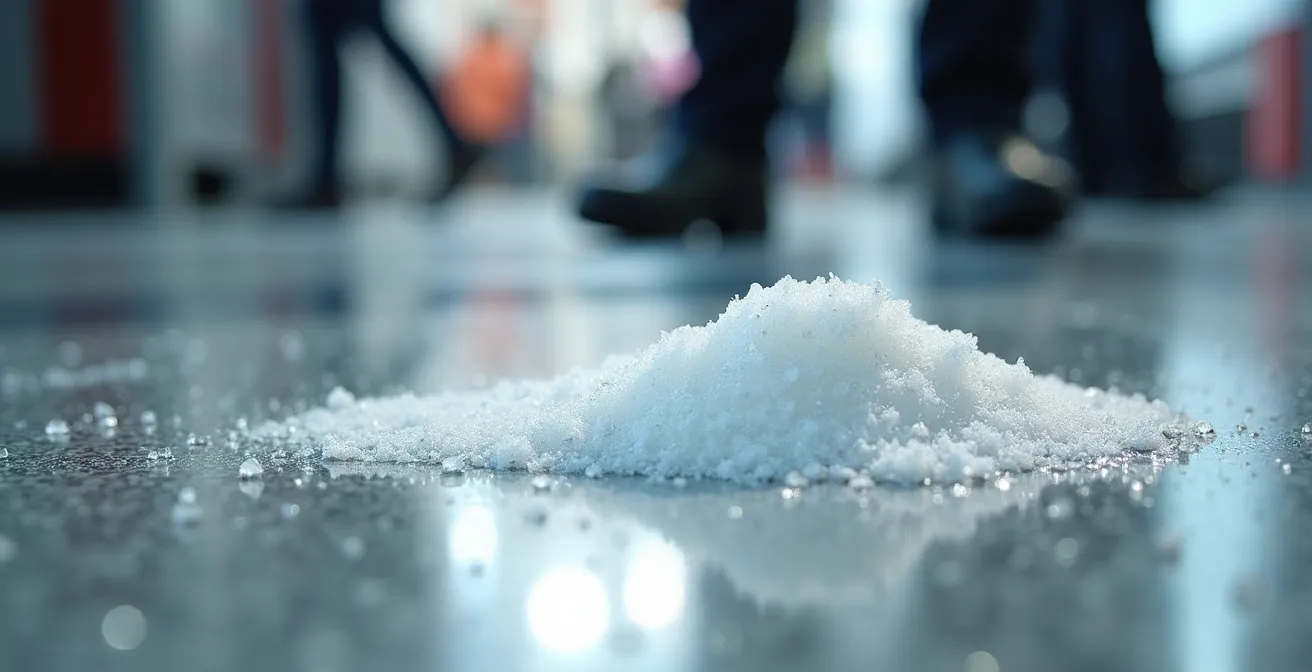
The dull, lifeless look of your commercial floors in winter isn’t just from salt stains; it’s the result of the “Sandpaper Effect.” Each footstep grinds tiny, sharp salt and sand crystals into your floor’s finish, acting like microscopic cutting tools. This guide explains the physics of this destructive process and provides an expert-led strategy, focused on the Quebec winter, to stop the abrasion before it leads to irreversible damage and costly repairs.
As a Quebec business owner, you know the January ritual all too well. The fresh, glossy shine you paid for in the fall has vanished, replaced by a hazy, dull, and scratched surface. You blame the relentless white film of road salt, mop more frequently, and try various cleaners, but the damage only seems to worsen. You’re fighting a constant battle against an enemy you can see, but perhaps don’t fully understand. The problem is not just the chemical residue; it’s a mechanical one.
Most advice focuses on the obvious: use mats and clean up salt. While correct, this advice misses the core of the issue. The real culprit is a process we call the “Sandpaper Effect.” The thousands of sharp-edged salt and sand crystals tracked into your building don’t just sit there; under the pressure of foot traffic, they are transformed into a distributed abrasive surface that systematically grinds away your floor’s protective wax layers with every person who walks through the door.
But what if you could stop treating the symptom and start fighting the cause? The key isn’t just to clean more, but to clean smarter by understanding the physics of this abrasion. It’s about removing the “sandpaper” before it can do its work and protecting the vulnerable layers underneath. This article will deconstruct the Sandpaper Effect piece by piece. We will explore why dry cleaning is superior to wet mopping for prevention, how a strategic matting system is your best defense, and when to perform critical maintenance to save your floor’s life before a full, costly strip-and-wax is your only option.
This comprehensive guide breaks down the science behind winter floor damage and outlines a clear, actionable plan to protect your investment. Explore the sections below to master each aspect of winter floor defense.
Summary: The Sandpaper Effect and How to Defeat It
- How Does Foot Traffic Turn Salt Grains into Cutting Tools for Wax?
- Why Vacuuming Salt (Dry) Is Better Than Mopping It (Wet) for Scratch Prevention?
- Scraper Mats vs Wiper Mats: Why You Need Both to Stop Abrasion?
- The Acid Rinse Mistake: When Does Neutralizing Salt Become Etching the Floor?
- How to Perform a Mid-Winter “Scrub and Recoat” to Save Your Floor’s Life?
- How Placing 15 Feet of Matting Can Capture 80% of Debris Before It Enters?
- Why Micro-Scratches on Stone Floors Lead to Permanent Staining Risks?
- When Is the Best Time to Schedule Floor Stripping to Minimize Business Disruption in Retail?
How Does Foot Traffic Turn Salt Grains into Cutting Tools for Wax?
The destruction of your floor’s finish begins the moment a customer steps inside. The de-icing products used on Quebec’s roads and sidewalks are not just salt; they are a mixture of sodium chloride, calcium chloride, and abrasive sand. When tracked indoors, these tiny, sharp crystals become the teeth of the sandpaper. The real damage occurs under pressure. A person’s body weight, concentrated onto a heel or the ball of a foot, generates immense pressure on the few salt crystals trapped beneath. This is pressure point grinding.
Instead of being swept aside, the crystal is pressed directly into the floor’s protective wax or finish. As the person pivots or walks, that crystal cuts a microscopic groove into the surface. One scratch is invisible, but multiply that by thousands of footsteps each day, and the result is a network of millions of micro-scratches. This is what refracts light unevenly and gives your once-glossy floor its dull, hazy appearance. The heaviest, most damaging crystals typically fall off shoes within the first few feet of entering a building.
The composition of the de-icer is critical. Both calcium chloride and sand particles act as potent micro-abrasives. Their sharp, crystalline structure is remarkably similar to the grit on actual sandpaper. Each step smashes these particles into the floor, grinding away the finish layer by layer. Without a proactive strategy, you are essentially allowing your customers to sand your floors down to the vulnerable tile or stone beneath, leading to damage that a simple mopping can never fix.
Why Vacuuming Salt (Dry) Is Better Than Mopping It (Wet) for Scratch Prevention?
When you see salt on the floor, the first instinct is to grab a mop and bucket. This is one of the most common and damaging mistakes in winter floor care. Mopping salt residue doesn’t truly remove it; it just dissolves it. This creates a salty, abrasive slurry that we can call “wet contamination.” As the mop moves across the floor, it drags these dissolved but still-sharp crystals everywhere, spreading the “sandpaper” over a much wider area and ensuring even more scratches.
The superior method is dry removal first. Using a high-quality commercial vacuum with a HEPA filter is the most effective way to lift salt and sand crystals off the floor before they can be ground in or dissolved. This physically removes the abrasive agents rather than just spreading them around. According to floor care experts, you should always begin daily floor care with thorough sweeping or vacuuming to remove these loose, sharp soils. Only after the dry debris is gone should you consider mopping with a proper neutralizer.
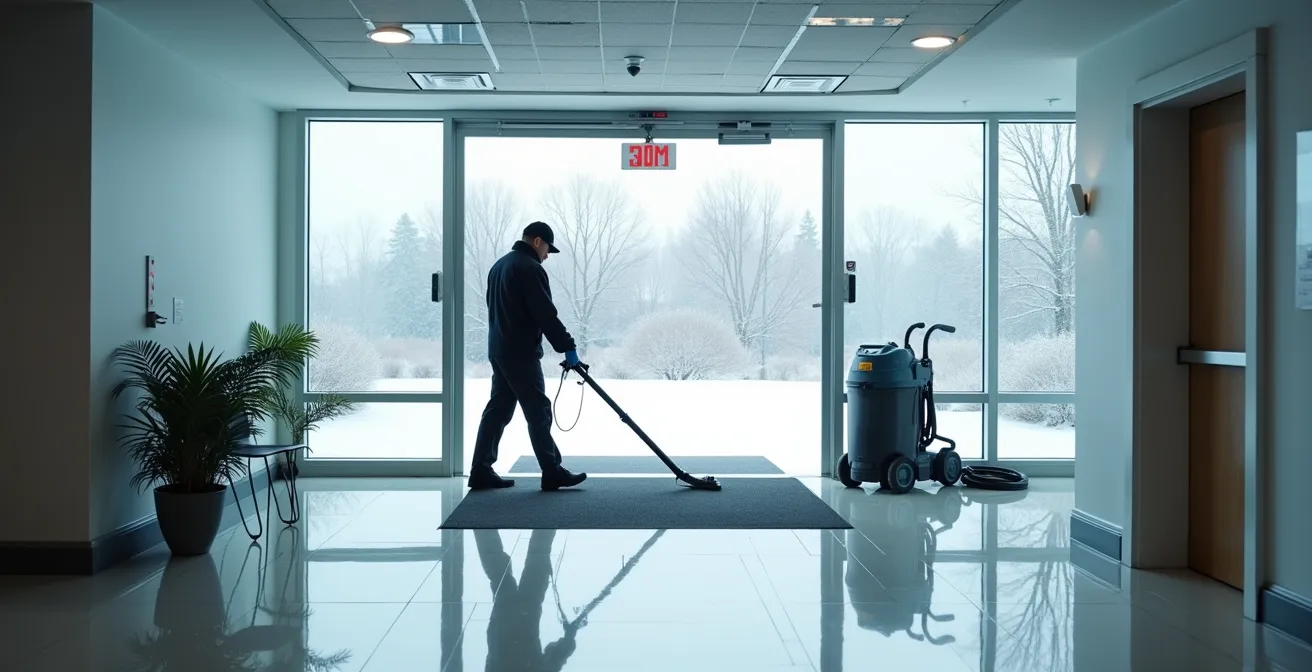
This wet contamination is not only bad for your floors. The corrosive salt water can reduce the effective life of your cleaning equipment, damaging metal parts like squeegees and tanks on auto-scrubbers. If there is significant moisture from melted snow, a regular vacuum should be avoided. In these cases, a wet-dry vacuum is the appropriate tool for large areas, allowing you to remove both the water and the abrasive salt in one step, minimizing the grinding action that occurs during cleaning.
Scraper Mats vs Wiper Mats: Why You Need Both to Stop Abrasion?
If vacuuming is the first step in active cleaning, matting is the single most important passive defense against the Sandpaper Effect. However, not all mats are created equal, and using only one type is a recipe for failure. An effective matting system for a harsh Quebec winter requires a strategic, multi-stage approach, typically involving at least two, and ideally three, distinct types of mats working in sequence.
First is the scraper mat, placed outside the entrance. This is your first line of defense. Its job is to be aggressive, with a textured, bristly, or ridged surface designed to scrape the largest and most damaging particles—rock salt, sand, and clumps of ice—from the deep treads of winter boots. Without this initial scraping action, those heavy abrasives are guaranteed to come inside and fall off in your entranceway, where they do the most damage.
Next, inside the door, is the wiper/scraper mat (or transition mat). This mat has a dual function, continuing to scrape off smaller particles while also beginning to absorb moisture. Finally, the third stage is the wiper mat (or finishing mat). This is typically a carpet-style mat whose primary function is to absorb the remaining salt-laden water and fine, dust-like particles. This sequence ensures that by the time a visitor’s foot hits your actual floor, it is as clean and dry as possible.
Investing in a comprehensive system provides a clear return by drastically reducing cleaning labour and extending the life of your floor finish. A multi-mat system is not a cost; it’s an investment in preservation.
| Mat System Type | Initial Investment | Salt Capture Rate | Annual Floor Restoration Savings |
|---|---|---|---|
| Basic 2-Mat System | $500-800 | 70% | $2,000 |
| Quebec 3-Mat System (15ft total) | $1,200-1,800 | 90% of soil particles | $5,000+ |
| Extended Matting (30ft) | $2,500-3,500 | Up to 90% with proper maintenance | $8,000+ |
The Acid Rinse Mistake: When Does Neutralizing Salt Become Etching the Floor?
Once you’ve vacuumed the dry salt, the next logical step is to mop the remaining white residue. Many turn to a floor neutralizer, assuming it’s the correct product for the job. While it is designed to counteract the high alkalinity of salt residue, its misuse is a common and costly mistake. The critical fact that many overlook is that floor neutralizers are, by design, slightly acidic.
This acidity is what allows them to effectively dissolve and lift alkaline salt stains. However, this same property makes them dangerous for regular use. As experts from Imperial Dade caution, this is a significant distinction:
Unlike neutral floor cleaners, a floor neutralizer is slightly acidic. This means that floor neutralizers should not be used during everyday floor cleaning because they can damage or mess with the appearance of your commercial floors.
– Imperial Dade Technical Experts, Neutral Floor Cleaner vs Floor Neutralizer Guide
Using an acidic product repeatedly on a waxed floor can begin to break down and dull the finish, essentially etching the very surface you’re trying to protect. A common question is whether a simple vinegar solution can be used. The answer is a definitive no. Like a neutralizer, vinegar is an acid and can strip the finish off floors, particularly wood and some types of stone. For routine cleaning, a true pH-neutral cleaner is always the safest choice. Floor neutralizer should be reserved for targeted, periodic use specifically to remove heavy salt buildup, not for daily mopping.
How to Perform a Mid-Winter “Scrub and Recoat” to Save Your Floor’s Life?
Even with perfect daily maintenance, the sheer volume of winter traffic will inevitably wear down your floor’s protective finish. By late January or February, you may notice significant dulling and scratching that daily cleaning can’t fix. This doesn’t mean you need a full, disruptive, and expensive strip-and-recoat. The solution is a strategic “scrub and recoat,” also known as a top scrub.
A scrub and recoat is a restorative procedure that removes only the top one or two heavily damaged layers of wax—the sacrificial layers—along with ingrained dirt and salt residue. A floor machine with a gentle scrubbing pad is used to deep clean the surface without cutting down to the bare tile. After the slurry is removed and the floor is rinsed, one or two fresh coats of finish are applied. This process restores the gloss and protective barrier, effectively resetting the clock on winter damage for a fraction of the cost and time of a full strip.
The ideal time to build these protective layers is in the fall, before the first snowfall. Applying 3-5 coats of finish creates a thick buffer to absorb winter abuse. However, a mid-winter scrub and recoat is a vital triage step to ensure that buffer doesn’t wear through completely, which would expose the flooring itself to permanent damage.
Action Plan: Top Scrub vs. Full Strip Decision Checklist
- Assess the damage: Are there deep scratches and stains penetrating multiple layers of wax, or is the damage mostly superficial dulling and light scratching on the top layer?
- Evaluate the finish integrity: Use the top scrub method if the base coats of wax are still intact and well-adhered. Regular scrubbing removes dirt and salt from the top layer and restores shine.
- Consider a full strip: If the floor has excessive wear, deep gouges, or areas where the wax is peeling or yellowed, a full strip is necessary to remove all old layers and start fresh.
- Check the calendar: The best time for preventative maintenance is a solid scrub and recoat in the fall. A mid-winter scrub is a reactive measure to save the floor.
- Plan for resources: A top scrub is faster and less disruptive. A full strip requires more time, labour, and ideal (non-winter) drying conditions.
How Placing 15 Feet of Matting Can Capture 80% of Debris Before It Enters?
The effectiveness of an entrance matting system is not just about the type of mat; it’s about its length. The core principle is simple: the more steps a person takes on a mat, the more dirt, moisture, and salt will be removed from their shoes. A small, 3×5 foot mat at the door is little more than a welcome gesture; it does almost nothing to stop the ingress of damaging abrasives.
Industry research provides a clear benchmark for effectiveness. To be truly effective, a person needs to take approximately 8 to 10 steps on matting material before reaching your finished floor. This translates to a required matting length of at least 15 feet (around 4.5 meters). This length gives the combination of scraper and wiper mats enough contact time with shoes to do their job properly. The results are dramatic.
Facility maintenance studies confirm that a well-designed matting system of this length is incredibly efficient. Research shows a matting system at least 15 ft long traps about 90% of soil particles before they can enter the main facility. This single, passive measure prevents the vast majority of the “sandpaper” from ever touching your floors. For maximum effect in a place like Quebec, this often means having 15 feet of matting *outside* the entryway and an additional 15 feet *inside*, creating a 30-foot cleaning zone.
Why Micro-Scratches on Stone Floors Lead to Permanent Staining Risks?
While vinyl composite tile (VCT) is resilient, natural stone floors like marble, limestone, and even granite are uniquely vulnerable to winter salt. The damage here goes beyond simple surface scratching and enters the realm of permanent chemical and physical alteration. The “Sandpaper Effect” on stone creates micro-scratches that do more than just dull the surface; they compromise the stone’s protective sealant and open up its natural pores.
Once these pores are exposed, the real danger begins. When salt dissolves in melted snow, it forms a corrosive brine that seeps into these tiny new openings in the stone. As the water evaporates, the salt recrystallizes *inside* the stone’s pores. This process, known as subflorescence, creates immense internal pressure that can lead to spalling, flaking, and permanent pitting. The salt residue also leaves behind stubborn white stains (efflorescence) that are extremely difficult to remove without damaging the stone itself.
Different stones have different levels of vulnerability, primarily based on their hardness and porosity. A softer, more porous stone like Saint-Marc limestone is far more susceptible to salt damage than a dense, hard stone like Stanstead granite. For property owners in Quebec, understanding the specific type of local or imported stone used in their facility is critical for tailoring a maintenance plan.
The following table provides a general guide to the vulnerability of common commercial stones found in Quebec, highlighting the need for vigilant sealing and maintenance.
| Stone Type | Hardness (Mohs) | Porosity Risk | Salt Vulnerability | Recommended Sealant Interval |
|---|---|---|---|---|
| Stanstead Granite | 6-7 | Low | Moderate | 2-3 years |
| Saint-Marc Limestone | 3-4 | High | Very High | 6-12 months |
| Italian Marble | 3-4 | Medium-High | High | Annual |
| Local Slate | 3-5.5 | Low-Medium | Moderate | 18-24 months |
Key Takeaways
- The “Sandpaper Effect” is the primary cause of winter floor damage, where foot pressure grinds salt crystals into the finish.
- Dry vacuuming with a HEPA filter is superior to mopping for removing abrasive salt, as mopping creates a damaging slurry.
- An effective defense requires a 15-foot, multi-stage matting system (scraper and wiper) to capture up to 90% of debris at the door.
- A mid-winter “scrub and recoat” is a vital procedure to restore the protective wax layers and prevent the need for a full, costly stripping.
When Is the Best Time to Schedule Floor Stripping to Minimize Business Disruption in Retail?
When the damage is too deep for a scrub and recoat, a full floor strip becomes necessary. This is the most intensive restoration process, involving chemicals to remove every last layer of old finish, dirt, and salt residue down to the bare floor, before meticulously reapplying a new base of multiple coats. Given its disruptive nature, timing is everything, especially in a retail environment. The absolute worst time to schedule this procedure is during the winter.
Stripping floors in winter is fraught with problems. Cold temperatures and fluctuating humidity dramatically increase the drying and curing time for new floor finish. This extended downtime is often untenable for a retail business. Furthermore, the risk of moisture and new contaminants being tracked onto the still-soft, curing finish is extremely high, which can lead to imperfections like cracking, peeling, or hazing, potentially ruining the entire job and wasting the investment.
The intense maintenance schedule required during winter further highlights why major restoration should be avoided. In high-traffic Quebec retail entranceways, facility maintenance data reveals that mopping should occur as frequently as every two hours to manage salt and slush. Introducing a full stripping project into this already demanding environment is operationally impractical. The ideal window for a full strip and recoat is during more stable, warmer, and drier weather—typically in the spring, after the thaw has ended all risk of salt contamination, or in the late fall, well before the first snowfall.
By understanding the Sandpaper Effect and implementing these strategic defenses, you can move from a reactive cleaning cycle to a proactive preservation strategy. Protecting your floors is not just about aesthetics; it’s about protecting a significant business asset and ensuring a safe, welcoming environment for your customers, even in the harshest Quebec winter. To assess your facility’s specific needs and build a customized floor care program, the next logical step is to consult with a specialist.