
After a contamination event, simply cleaning your Quebec facility isn’t enough; you must scientifically *prove* it’s safe to protect yourself from liability and win back customers.
- Visual cleanliness is deceptive due to hidden biofilms and contaminants absorbed by soft surfaces.
- Scientific validation using methods like ATP testing provides the objective, defensible data required.
Recommendation: Assemble a complete “dossier de preuve” (proof file), including third-party validation and meticulous documentation, to meet CNESST requirements and confidently announce your reopening.
The silence in a closed restaurant or an empty gym after a contamination incident is deafening. As a Quebec business owner, your first instinct is to call a cleaning crew for a “deep clean,” hoping to erase the problem and reopen as quickly as possible. This reaction is understandable, but it’s a critical misstep. The common approach focuses on the appearance of cleanliness, a standard that is dangerously insufficient in the face of legal liability and eroded public trust.
The reality is that wiping down surfaces until they shine offers no real proof of safety. What happens when, despite your efforts, a health inspector’s swab still tests positive? How do you defend your business against a liability claim? How do you convince a hesitant public that your space is genuinely safe for their return? The answer lies not in more vigorous scrubbing, but in a paradigm shift in your approach.
But what if the true key to a confident reopening wasn’t how clean your facility *looks*, but how rigorously you can *prove* it’s clean? This guide is not another cleaning checklist. It is a strategic framework for building an irrefutable dossier de preuve—a file of scientific and legal documentation that serves as your liability shield. We will explore how to go beyond visual inspection, employ scientific validation methods, document every action, and use this proof to not only satisfy CNESST but also to rebuild the most valuable asset you have: your customers’ confidence.
This article will provide a clear pathway, from understanding the hidden failures of standard cleaning to leveraging validated results for a powerful reopening announcement. Follow this structure to turn a crisis into a demonstration of your commitment to safety.
Summary: Validating Decontamination and Reopening Your Quebec Business
- Why Do “Cleaned” Areas Still Test Positive for Contaminants 24h Later?
- How to Document Every Step of the Decontamination Process for Liability Defense?
- Hydrogen Peroxide Vapor vs Chemical Wipe-Down: Which Reaches the Cracks?
- The Curtain and Upholstery Mistake That Harbors Contaminants After Deep Cleaning
- How to Display Decontamination Certificates to Restore Customer Confidence?
- How to Use ATP Testing Swabs to Validate Disinfection Scientifically?
- How Establishing a Biohazard Response Contract in Advance Saves Crucial Hours?
- Managing Biohazards: What Are Your Legal Cleaning Obligations After a Workplace Accident in Quebec?
Why Do “Cleaned” Areas Still Test Positive for Contaminants 24h Later?
The most frustrating experience for a diligent business owner is investing in a thorough cleaning only to find that the area is still contaminated. This common failure is rarely due to a lack of effort but rather a misunderstanding of the enemy. The primary culprit is often an invisible layer of microorganisms called biofilm. This sticky, matrix-like substance protects bacteria and viruses from disinfectants, allowing them to survive a simple wipe-down and multiply once the cleaning crew has left.

As this magnified view of a seemingly clean surface shows, what appears smooth to the naked eye is a landscape of microscopic peaks and valleys where biofilms thrive. A chemical wipe may sanitize the peaks, but it often misses the contaminants hiding in the crevices. Furthermore, the effectiveness of the validation process itself is sensitive. For instance, cleaning validation experts note that ATP test readings are most consistent at an optimal temperature of around 70°F (21°C); significant deviations can skew results and create a false sense of security or a misleading positive test.
High ATP values highlight areas where microorganisms are likely to thrive, allowing preventive controls and sanitation teams to act before pathogens multiply.
– Hygiena Technical Team, ATP Cleaning Verification Guidelines
This is why professional validation moves beyond a simple visual check. It uses tools designed to detect the organic material that indicates a risk, confirming that both visible dirt and invisible biofilms have been properly eliminated. True cleanliness is not a visual state, but a scientifically measurable one.
How to Document Every Step of the Decontamination Process for Liability Defense?
In the event of a public health inquiry or a liability claim in Quebec, your word is not enough. Your proof is in your paperwork. The single most powerful tool at your disposal is a meticulously compiled “dossier de preuve” (proof file). This is not merely a collection of invoices; it is a comprehensive, structured file that documents every facet of the decontamination process, creating a legal liability shield. Its purpose is to demonstrate that you acted responsibly, diligently, and in accordance with established standards.
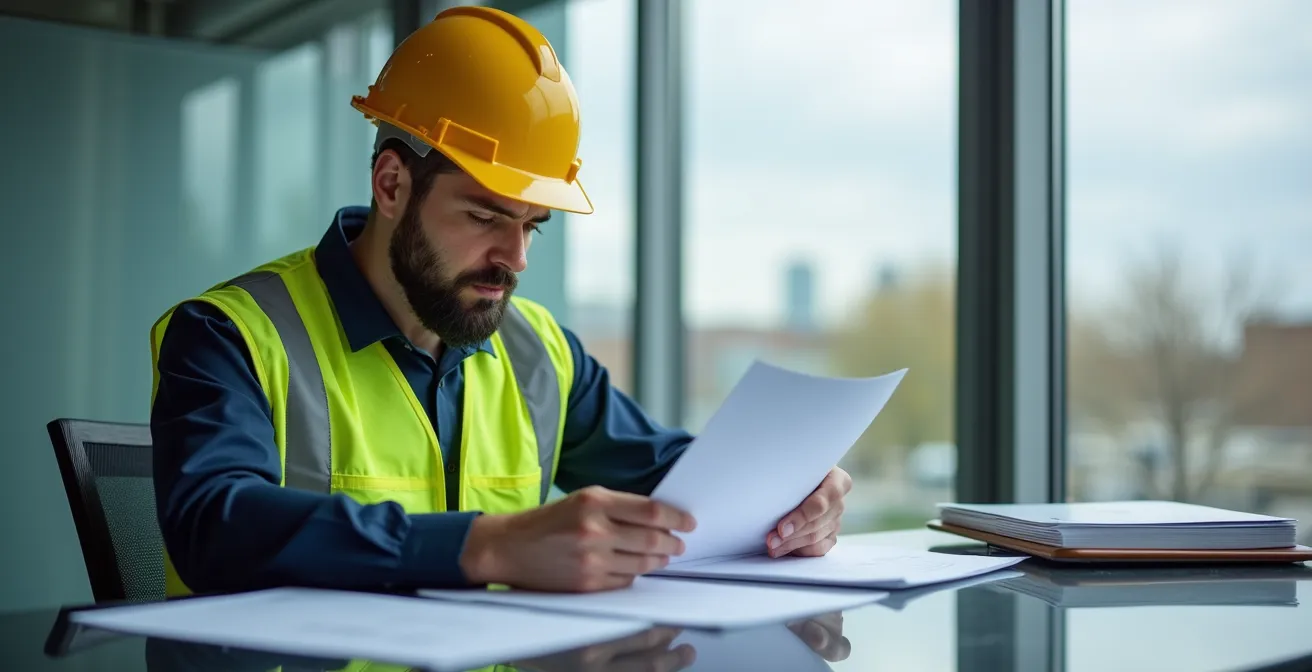
Each document in this file tells a part of the story, from the initial response to the final validation. It demonstrates a chain of custody for safety, proving that an incident was not just “handled,” but managed with professional rigor. This documentation process should be treated with the same seriousness as financial accounting. It is the definitive record that protects your business, your employees, and your customers. The key is to ensure this file is complete *before* you consider reopening your doors.
Action Plan: Assembling Your Quebec ‘Dossier de Preuve’
- Obtain an independent third-party validation certificate from a certified Quebec industrial hygienist to ensure objectivity.
- Include all ATP test results, clearly showing the comparison between pre-incident baseline levels and post-decontamination readings.
- Record your chosen contractor’s CNESST compliance number and verify their registration is active.
- File all chemical Safety Data Sheets (SDS), ensuring they are available in French as required.
- Maintain detailed, timestamped photographic and/or video documentation logs of the entire process.
- Include anonymized incident records, respecting Quebec’s Law 25 privacy requirements.
- Prepare a French-language summary of the entire file for easy submission to CNESST and Quebec courts if needed.
Think of this dossier as the ultimate insurance policy. In a crisis, its value is immeasurable, providing clear, indisputable evidence of your due diligence and commitment to public health.
Hydrogen Peroxide Vapor vs Chemical Wipe-Down: Which Reaches the Cracks?
Once you understand that invisible contaminants hide in hard-to-reach places, the limitations of a simple chemical wipe-down become obvious. While effective for flat, non-porous surfaces, manual wiping is inconsistent by nature. It is subject to human error, can miss crevices, and may not achieve the necessary contact time for disinfectants to work. For complex environments like a gym with intricate equipment or a restaurant with detailed woodwork, a more comprehensive solution is needed. This is where Hydrogen Peroxide Vapor (HPV) decontamination offers a significant advantage.
Unlike a liquid spray, HPV is a “dry” gas that actively fills the entire volume of a room. It penetrates cracks, crevices, and even the filters of electronic equipment that cannot be touched with liquid chemicals. The vapor reaches every exposed surface, ensuring a uniform and total application of the decontaminating agent. This “no-touch” method eliminates human error in application and provides a much higher level of assurance for complete coverage.
Case in Point: Decontamination Challenges in Quebec’s Complex Structures
The challenges of decontaminating older or intricate buildings in Quebec highlight the need for advanced methods. As noted by decontamination specialists at Sinisco, when contaminants like mould or asbestos are found in complex structures, specialized teams must apply strict protocols. These experts evaluate the premises and develop a specific plan, often employing methods that go far beyond surface wiping to ensure hidden areas are treated. This same principle applies to a modern gym or restaurant, where equipment and fixtures create countless “cracks” for pathogens to hide.
The choice is not always one or the other; a hybrid approach is often best. However, for a final, validated terminal clean, HPV provides a level of certainty that manual wiping cannot match. A certified hygienist can assess your specific facility and recommend the most effective protocol to ensure no surface is left untreated.
The Curtain and Upholstery Mistake That Harbors Contaminants After Deep Cleaning
One of the most common and costly mistakes in decontamination is focusing exclusively on hard surfaces while ignoring soft materials. Fabric items like curtains, upholstered chairs, fabric cubicle dividers, and even carpets act like sponges for airborne contaminants. They can trap viruses and bacteria, effectively becoming reservoirs that re-contaminate the air and surrounding surfaces long after a deep clean is complete.
Case Study: The Montreal Call Center’s Persistent Contamination
A Montreal call center faced recurring contamination issues despite multiple professional cleanings of all hard surfaces. An investigation by specialists from Elite Extermination revealed the source: the fabric on hundreds of office chairs and cubicle dividers was harboring pathogens. As their team notes, contaminants can be unintentionally transported via dust particles from these materials, infecting the air. The problem was only solved after a specialized textile decontamination process using HEPA-filtered equipment was performed and validated with fabric-specific ATP testing.
For a gym or restaurant owner in Quebec, this presents a critical decision: should you decontaminate these items or dispose of them? The choice involves balancing cost, time, and safety. Disposing of hundreds of chairs or extensive drapery is not only expensive but also environmentally problematic due to Quebec’s eco-fees. Specialized decontamination can often be more cost-effective, but only if done correctly by a team with the right equipment for soft surfaces.
The following framework, based on data from Quebec service providers, can help guide your decision-making process.
| Item Type | Decontamination Cost | Disposal + Replacement Cost | Recommendation |
|---|---|---|---|
| Office Chair (fabric) | $75-150 per chair | $200-400 + eco-fees | Decontaminate if <100 units |
| Cubicle Walls (fabric) | $50-100 per panel | $150-300 + disposal fees | Decontaminate if fire-retardant certified |
| Curtains/Drapes | $30-60 per panel | $100-200 + eco-fees | Dispose if heavily contaminated |
| Carpet (per sq ft) | $0.50-1.00 | $3-5 + removal costs | Decontaminate unless structural damage |
Ignoring your facility’s soft surfaces is not an option. A failure to address these hidden reservoirs will undermine your entire decontamination effort and put your business at risk of a failed validation test.
How to Display Decontamination Certificates to Restore Customer Confidence?
Completing a scientifically validated decontamination and compiling your *dossier de preuve* is only half the battle. The final step is to leverage this proof to manage public perception and actively restore customer confidence. Transparency is your most powerful tool. You must communicate your commitment to safety clearly, consistently, and through multiple channels. Simply stating “we are clean” is not enough; you must *show* them the proof.
A tiered communication strategy allows you to deliver the right level of information to the right audience, from employees to customers and regulatory bodies. This is not about boasting; it is about providing reassurance backed by third-party evidence. A key element is making the validation accessible. Displaying a certificate with a QR code, for example, allows curious customers to see a summary of the validation report for themselves, turning a piece of paper into an interactive tool for building trust.
Your Tiered Communication Strategy for Quebec Businesses
- Public Entrance: Display a bilingual ‘Certificate of Safety’ with a QR code linking to a non-technical validation summary.
- Employee Areas: Post a more detailed ‘Validation Report Summary’ in both French and English to inform and reassure your team.
- Health & Safety Committee: Present the full results to your ‘Comité de santé et de sécurité’ before any public announcement.
- Digital Presence: Create a dedicated page on your website featuring the independent validator’s name, certification date, and a summary of the findings.
- Regulatory Filing: Keep the complete ‘Dossier de Preuve’ on hand for immediate access by CNESST or insurers.
- Customer Communications: Send a bilingual email update to your client list, highlighting that the facility’s safety has been confirmed by an independent third party.
In all communications, language is critical. As a Quebec business, you are legally and culturally obligated to prioritize French. This is not just a formality; it is a sign of respect for your community and your employees.
The CNESST reminds you that according to the Charter of the French Language, companies established in Québec must use French in their activities and communicate in this language with their workers and clients.
– CNESST, Act to modernize the occupational health and safety system
By proactively and transparently communicating your validated safety status, you transform a potentially damaging incident into a powerful demonstration of your business’s integrity and commitment to your community’s well-being.
How to Use ATP Testing Swabs to Validate Disinfection Scientifically?
Now that we’ve established the need for proof, how is it actually generated? The industry standard for rapid hygiene validation is Adenosine Triphosphate (ATP) testing. ATP is an energy molecule found in all living cells, including bacteria, mould, and organic residues. An ATP test doesn’t identify the specific type of germ, but it provides a direct, numerical measure of the overall level of biological cleanliness on a surface. A high ATP reading means a surface is dirty and can support microbial growth; a low reading indicates it is clean. This method replaces subjective visual inspection with objective, scientific data.
The process involves using a swab to collect a sample from a surface, which is then inserted into a luminometer. The device measures the amount of light generated by the reaction with the ATP, providing a score in Relative Light Units (RLU). While general guidelines exist, such as the 22 femtomoles of ATP/cm² alert level suggested by ISO standards for medical devices, the most defensible approach for your facility is to compare post-decontamination results against your own pre-incident baseline. A professional protocol is essential for ensuring the results are accurate and legally defensible.
A certified industrial hygienist will follow a strict protocol to guarantee the integrity of the results. Here are the key steps involved:
- Engage a Third Party: Hire an independent, certified industrial hygienist in Quebec. This avoids any conflict of interest and ensures the results are viewed as credible by CNESST and your insurers.
- Establish a Baseline: Ideally, baseline RLU readings from various surfaces in your facility should be established *before* an incident occurs, providing a clear “clean” target.
- Proper Swabbing Technique: To get a representative sample, the hygienist will swab multiple spots (e.g., five) on the same large surface and average the results.
- Document Chain of Custody: Every step, from swabbing to testing, is documented with photographic evidence and sealed transport to maintain the integrity of the samples.
- Compare and Conclude: The post-cleaning results are compared against the established facility-specific baseline, not a generic standard, to prove the effectiveness of the decontamination.
- Advanced Testing (if needed): For high-risk situations, ATP testing can be paired with more specific pathogen tests (like PCR) to confirm the absence of a particular virus or bacteria.
By using ATP testing, you are no longer guessing if your facility is clean. You are measuring it, documenting it, and creating the scientific cornerstone of your *dossier de preuve*.
How Establishing a Biohazard Response Contract in Advance Saves Crucial Hours?
In the middle of a contamination crisis, every hour counts. The time spent frantically searching for a qualified and available decontamination specialist, vetting their credentials, and negotiating a contract is time your business remains closed and your liability exposure grows. A proactive approach—establishing a biohazard response contract in advance—can be one of the most prudent decisions a Quebec business owner can make.
Having a pre-vetted, certified contractor on retainer transforms your response from reactive panic to a controlled, immediate action plan. When an incident occurs, you make one phone call. The response team, already familiar with your facility and legal requirements, can be mobilized within hours, not days. This rapid deployment significantly shortens your downtime and demonstrates to regulatory bodies like the CNESST that you have a serious, pre-existing safety protocol in place.
The Advantage of 24/7 Readiness: GFL Environmental’s Model
Major environmental service providers in Quebec like GFL Environmental showcase the value of preparedness. They offer secure, round-the-clock decontamination services on an urgent basis precisely because they have “stockpiled, trained and prepared for evolving situations.” Their ability to be called upon 24/7 to mitigate contamination issues is built on a foundation of proactive planning. By establishing a contract in advance, a business owner effectively taps into this pre-existing infrastructure, saving crucial hours and ensuring a response that meets the highest safety standards from the very first moment.
This is not an unnecessary expense; it is a strategic investment in business continuity. A response contract should include pre-negotiated rates, guaranteed response times, and confirmation that the contractor holds all necessary Quebec certifications and CNESST compliance. In a crisis, this single piece of paper can be the difference between a swift, controlled recovery and a prolonged, costly shutdown.
Key Takeaways
- Visual cleanliness is not proof of safety; invisible biofilms and contaminated soft surfaces are common points of failure.
- Scientific validation, primarily through ATP testing performed by a third-party hygienist, provides the only objective, defensible proof of decontamination.
- A comprehensive “dossier de preuve” is your essential liability shield, documenting every step to satisfy CNESST requirements and rebuild trust.
Managing Biohazards: What Are Your Legal Cleaning Obligations After a Workplace Accident in Quebec?
Now that you understand the science of validation and the strategy of documentation, it is critical to anchor this knowledge in your non-negotiable legal obligations as a Quebec employer. The *Act respecting occupational health and safety* is clear: you have a fundamental duty to provide a safe workplace. After a biohazard incident—be it a workplace injury involving blood or an infectious disease outbreak—this duty translates into specific, time-sensitive actions overseen by the CNESST (Commission des normes, de l’équité, de la santé et de la sécurité du travail).
The scale of this issue is significant. A 2022 report highlighted that Quebec experienced over 80,000 workplace injuries in 2020, underscoring the importance of having robust post-incident protocols. Failure to properly manage and document the decontamination process can result in severe penalties, mandated shutdowns, and an inability to defend against future claims. Your legal obligations are not suggestions; they are the baseline for responsible business operation in the province.
Immediately following any incident involving a biohazard, you must initiate a formal reporting process with the CNESST. This is not the time to “wait and see.” Swift, transparent action is required. The following checklist outlines the immediate steps you must take to remain compliant.
Checklist: CNESST Immediate Reporting for Biohazard Incidents
- Report Immediately: Notify the CNESST of the incident within 24 hours of its occurrence.
- Document the Incident: Create a formal record including the date, time, location, and the specific nature of the biohazard exposure.
- Submit Records: Provide all necessary employment injury records and salary documentation for the affected workers.
- Coordinate Inspection: Work with the CNESST to schedule any required workplace inspections by their representatives.
- Implement and Prove Correction: Put corrective measures in place (i.e., professional decontamination) and provide formal documentation of the cleanup’s completion and validation.
These legal requirements are the “why” behind every other step in this guide. The *dossier de preuve* is precisely the tool you will use to fulfill Step 5, proving that you have not only cleaned the workplace but have restored it to a verifiably safe condition.
To ensure your facility’s reopening is built on a foundation of irrefutable proof, the next logical step is to consult a certified industrial hygienist. They can help you implement these protocols and begin building your own comprehensive and defensible *dossier de preuve* today.