
A surprise visit from a CNESST inspector can expose hidden operational gaps in your chemical management, leading to significant fines.
- Improperly labelled containers and inaccessible Safety Data Sheets (SDS) are the most common and easily penalized violations.
- Demonstrable compliance relies on digital SDS access, continuous staff training on GHS pictograms, and documented safety protocols.
Recommendation: Adopt an auditor’s mindset to systematically identify and close these compliance gaps before an inspector walks through your door.
The unexpected arrival of an inspector from the Commission des normes, de l’équité, de la santé et de la sécurité du travail (CNESST) is a scenario that causes considerable stress for any Quebec business owner. You might believe you’re compliant because you have a binder of Safety Data Sheets somewhere in an office and your staff generally knows not to mix chemicals. However, under the Workplace Hazardous Materials Information System (WHMIS) 2015 regulations, this superficial approach is a direct path to non-compliance and financial penalties. The standards for chemical management, particularly for a cleaning inventory, are precise, documented, and rigorously enforced.
Many businesses fall into the trap of treating compliance as a passive, box-ticking exercise. They have the “what” (the SDS, the labels) but fail on the “how” (instant accessibility, proper training, correct application). But what if you could shift from a state of constant anxiety about an audit to a position of confidence? The key is not just to follow the rules, but to learn to think like an inspector. This guide is not another generic checklist. It is a simulated pre-audit of your cleaning chemical program, designed to illuminate the common but costly operational gaps that inspectors are trained to find. We will dissect the nuances of WHMIS 2015 in the Quebec context, moving your safety program from a reactive necessity to a proactive, audit-proof system.
This article will guide you through the critical areas a CNESST inspector will scrutinize. We will cover everything from the costly mistakes of decanting products to the legal requirements for floor maintenance, providing you with the knowledge to make your entire operation demonstrably compliant and fundamentally safer.
Summary: A Guide to WHMIS 2015 and CNESST Audit-Readiness
- Why Do Decanted Cleaning Products in Spray Bottles Attract Fines?
- How to Organize Safety Data Sheets (SDS) Digitally for Instant Access?
- Old Symbols vs New GHS Pictograms: Are Your Staff Trained to Recognize the Difference?
- The Ammonia and Bleach Mistake: Understanding the Reactivity Risks in Your Closet
- How to empower Night Shift Cleaners to Report Safety Hazards Proactively?
- Why Do Missing SDS Sheets Result in Immediate Penalties During Inspections?
- The Storage Closet Mistake That Turns Your Cleaning Tools into Germ Incubators
- Preventing Slips and Falls: What Are Your Legal Obligations for Floor Maintenance in Quebec?
Why Do Decanted Cleaning Products in Spray Bottles Attract Fines?
One of the fastest ways to incur a fine during a CNESST inspection is through improperly labelled secondary containers. When your staff transfers a concentrated cleaning chemical from its original drum into a smaller, unlabelled spray bottle for daily use, you create a significant information gap. The worker using that bottle has no immediate way to know the product’s identity, its specific hazards, or the correct first-aid measures in case of accidental exposure. From an auditor’s perspective, an unlabelled bottle is a clear sign of a broken information chain of custody.
This isn’t a minor administrative oversight; it’s a direct contravention of a worker’s right to know about the hazards they face. The consequences are not just theoretical. Non-compliance with CNESST orders can quickly escalate from simple warnings to severe penalties. For serious breaches, the commission may prosecute, which can result in hefty fines in the thousands of dollars or, in cases of extreme negligence leading to injury, potential criminal charges.
To avoid these penalties, every decanted product must have a compliant workplace label. This label serves as a condensed version of the most critical safety information, ensuring the user is never in doubt about the product they are handling. The requirements are specific and must be meticulously followed for every single secondary container in your facility.
Action Plan: WHMIS 2015 Workplace Label Requirements
- Ensure all decanted products have a workplace label with the product identifier in both French and English.
- Include all required GHS pictograms that match the original product’s hazard classification.
- Add precautionary statements describing safe handling procedures and essential first aid measures.
- Verify that all labels are legible, easy to read, and permanently attached to their respective containers.
- Update labels immediately when new information is available or when a new Safety Data Sheet is received for the product.
How to Organize Safety Data Sheets (SDS) Digitally for Instant Access?
The era of the dusty SDS binder hidden in a manager’s office is over. WHMIS 2015 regulations mandate that Safety Data Sheets must be readily accessible to all employees who may be exposed to a hazardous product. In the context of a surprise inspection, “readily accessible” means an employee can produce the correct SDS for any given chemical in moments, not minutes. If a night-shift cleaner has to search for a key or call a supervisor to access a locked office, you are non-compliant.
This is why digital SDS management has become the industry standard for ensuring compliance. Centralizing your SDS library in a secure digital format guarantees that the information is available 24/7 to any authorized worker, on any site. This creates what auditors call demonstrable proof of access. Modern solutions leverage technology that your staff already uses, such as smartphones, to bridge the information gap instantly.
The image below illustrates a common and highly effective method: using QR codes on chemical containers. A simple scan with a smartphone can immediately bring up the full, bilingual SDS, providing all necessary safety information directly at the point of use. This system is efficient, easy for staff to use, and provides a clear, auditable trail of information access.

Choosing the right digital system depends on your operational needs, from simple QR code systems to comprehensive cloud-based platforms. The key is to select a solution that guarantees immediate access for all staff, including those working off-hours or at remote sites. As you can see from the comparison below, different systems offer varying levels of offline capability and administrative features.
Here is a breakdown of common digital solutions to help you determine the best fit for your Quebec-based operations, ensuring bilingual support is a primary consideration.
| Solution Type | Access Method | Offline Capability | Quebec Compliance |
|---|---|---|---|
| QR Code Labels | Smartphone scan | Yes with cached PDFs | Bilingual support available |
| Cloud Platform | Web browser/app | Requires internet | French interface options |
| Digital Binder | PDF download | Full offline access | Manual language management |
Old Symbols vs New GHS Pictograms: Are Your Staff Trained to Recognize the Difference?
WHMIS has undergone a significant update, aligning with the Globally Harmonized System of Classification and Labelling of Chemicals (GHS). This transition replaced the old, circular WHMIS 1988 symbols with a new set of pictograms in red-bordered diamonds. An inspector will absolutely test your staff’s knowledge of these new symbols. If an employee cannot identify the “Health Hazard” pictogram (the exploding chest) or confuses it with another symbol, it’s a major red flag indicating a failure in your training program.
This isn’t just about memorization; it’s about comprehension. The pictograms are a universal language designed to quickly communicate a chemical’s specific dangers, from flammability to carcinogenicity. A lack of understanding can lead to catastrophic errors, such as storing reactive chemicals together or using inadequate personal protective equipment (PPE). Your responsibility as an employer is to ensure every single worker who handles chemicals has been thoroughly trained on the meaning of each GHS pictogram.
The timeline for this transition is not infinite. Quebec businesses must be fully compliant with the new requirements, and the grace period is ending. As the CNESST makes clear, the deadline is firm, and enforcement will be strict. According to the official guidelines on Quebec’s implementation of the new standards:
The latest amendments to the Hazardous Products Regulations (HPR), which came into force on 15 December 2022, provide for a transition period ending on 14 December 2025. From 15 December 2025, all workplaces will have to comply with the Workplace Hazardous Materials Information System (WHMIS) new requirements
– CNESST, Quebec WHMIS Implementation Guidelines
This deadline means your training program must be active and documented. You need records—signed attendance sheets, completed quizzes, training dates—to prove to an inspector that you have fulfilled your duty to inform and train your workforce. Without this demonstrable proof of training, your program is merely a claim, not a compliant reality.
The Ammonia and Bleach Mistake: Understanding the Reactivity Risks in Your Closet
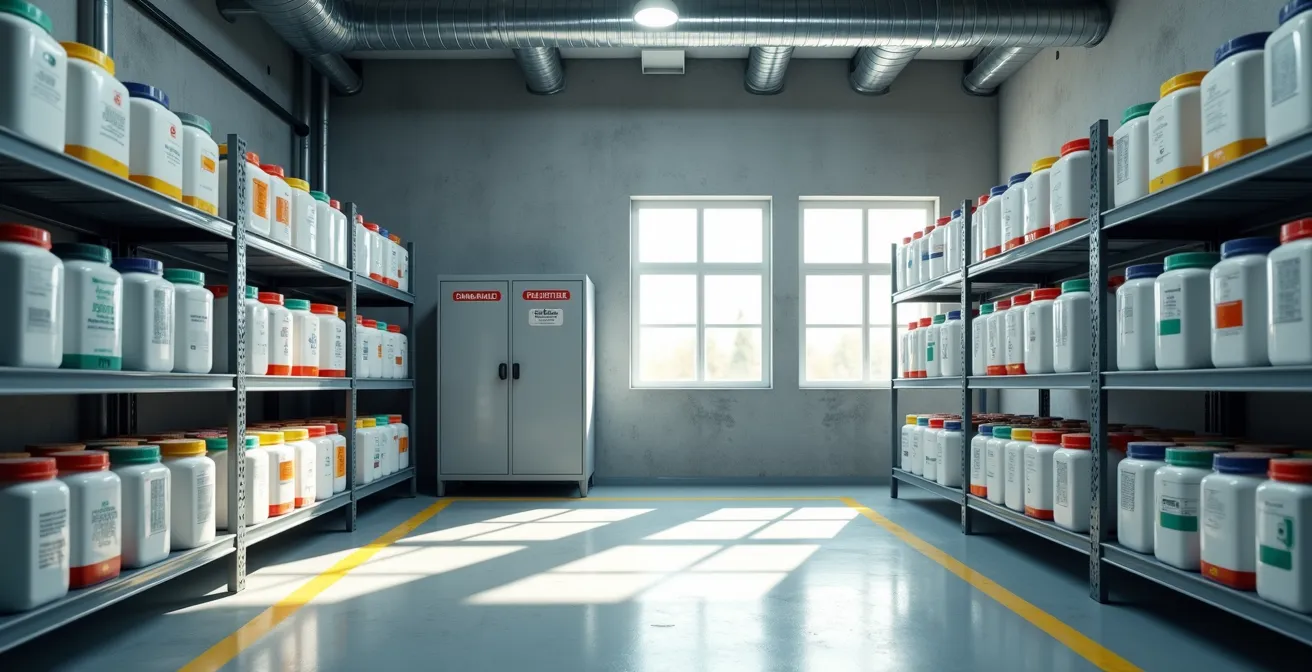
A disorganized cleaning closet is more than just untidy; it’s a chemical reaction waiting to happen. One of the most classic and dangerous errors is storing ammonia-based cleaners next to chlorine bleach. When these two substances mix, even through vapor cross-contamination in a poorly ventilated space, they create toxic chloramine gas. Inhaling this gas can cause severe respiratory damage, and an inspector who sees this storage mistake will recognize it as an immediate and serious hazard.
Effective chemical management goes beyond labels and data sheets; it requires a physical understanding of chemical incompatibility. Your storage area must be designed to enforce segregation between different hazard classes. This means acids are kept away from bases, and oxidizers (like hydrogen peroxide) are stored separately from flammable materials. A well-organized closet, with clear separation, proper ventilation, and designated storage zones, is a hallmark of a mature safety program.
Furthermore, your legal obligations in Quebec extend to formal documentation. Employers must maintain a detailed register of all hazardous substances present in the workplace. This isn’t a one-time task; a recent analysis of provincial health and safety regulations highlights that employers must submit updates on this register to the CNESST every three years. This requirement transforms your chemical inventory from a simple supply list into a legally mandated document that must be accurate and current.
The following table, based on information from legal experts at Fasken on the AMOHSR, illustrates common chemical incompatibilities that your storage plan must address. Using a matrix like this is a proactive step to prevent dangerous reactions.
| Chemical Type | Incompatible With | Reaction Risk | Storage Requirement |
|---|---|---|---|
| Chlorine Bleach | Acids, Ammonia | Toxic chlorine gas | Separate cabinet, bottom shelf |
| Ammonia Cleaners | Bleach, Acids | Toxic chloramine vapors | Ventilated area, away from oxidizers |
| Acidic Cleaners | Bleach, Bases | Heat, toxic gases | Acid-resistant containment |
| Hydrogen Peroxide | Metals, Organics | Fire, explosion | Cool, dark storage |
How to empower Night Shift Cleaners to Report Safety Hazards Proactively?
Your night-shift employees are often the frontline users of hazardous cleaning chemicals, yet they can be the most isolated group in your safety program. If a cleaner on an overnight shift discovers a leaking chemical drum or a cracked safety nozzle, do they have a clear, immediate, and frictionless way to report it? Or do they have to wait until morning, leaving a potential hazard unaddressed for hours? An effective safety program must empower every single employee, regardless of their shift, to act as an extension of your safety team.
A proactive reporting system is your best defense against accidents and a powerful piece of evidence during a CNESST audit. It shows an inspector that you have a living, breathing safety culture, not just a set of rules on paper. This is critical because, as a guide for small businesses points out, CNESST inspections can be random, and an inspector has broad powers to issue orders for immediate correction. As one resource notes, upon finding a violation, an inspector can demand you to ” cease using a dangerous chemical” on the spot, halting your operations.
Empowering your night staff means removing all barriers to reporting. This includes language barriers (providing forms in French and English), fear of reprisal (a documented no-blame policy), and procedural friction (using simple tools like QR codes for anonymous reporting). When cleaners feel safe and equipped to report minor issues—like a worn-out label or a faulty spray trigger—they help prevent major incidents. This creates a continuous feedback loop that strengthens your overall compliance and safety posture.
Action Plan: Implementing a Night Shift Safety Reporting System
- Install multilingual QR code posters in all cleaning areas, linking directly to simple, anonymous hazard reporting forms.
- Implement mandatory 5-minute safety huddles at the start of each shift to review any new chemicals or equipment issues.
- Create a formal, no-blame reporting policy and ensure it is documented in the employee handbook in both French and English.
- Track all hazard reports in a log, documenting the corrective action taken and the date of resolution (aim for within 48 hours).
- Post monthly summaries of reported hazards and their resolutions in break rooms to demonstrate that reporting leads to action.
Why Do Missing SDS Sheets Result in Immediate Penalties During Inspections?
For a CNESST inspector, a missing Safety Data Sheet is not an “oops” moment; it is a fundamental breakdown of the WHMIS system. The SDS is the cornerstone of chemical safety information. It contains everything a worker and emergency responder needs to know: health effects, fire-fighting measures, handling and storage instructions, and PPE requirements. Its absence for any hazardous product on your premises is considered a serious violation because it leaves your employees uninformed and unprotected.
The penalties for this are not trivial. While an inspector may issue a remedial order with a deadline for compliance, repeated or serious offenses are met with significant financial consequences. As compliance guides for Quebec businesses confirm, these are not small fines meant as a slap on the wrist. Non-compliance can result in hefty fines amounting to thousands of dollars, an expense no business can afford to ignore. This penalty is immediate because the risk is immediate; without an SDS, a simple spill or accidental splash can become a crisis.
Legal analysis of Quebec’s safety regulations further clarifies the enforcement process. Inspectors have the authority to issue remedial orders, and failure to comply within the given timeframe triggers amended, often harsher, penalties. The expectation is that your SDS management is flawless. This means you must have a current (dated within the last 3 years), bilingual (French and English) SDS for every single hazardous product in your inventory, and it must be accessible to workers in seconds. An audit is a test of this system, and passing requires meticulous preparation.
Checklist: SDS Compliance Audit Preparation
- Audit your entire chemical inventory and verify that every hazardous product has a current SDS (dated within the last 3 years).
- Ensure all SDSs are readily available in French, as required by Quebec law, in addition to English.
- Confirm that whether digital or physical, any SDS can be accessed by an employee within 30 seconds of request.
- Maintain a log to document that all workers who handle chemicals have received specific training on how to read and use SDSs.
- Establish a system to archive obsolete SDSs for the regulatory retention period, rather than simply discarding them.
The Storage Closet Mistake That Turns Your Cleaning Tools into Germ Incubators
While chemical safety is a primary focus of WHMIS, a CNESST inspector’s view of safety is holistic and includes biological hazards. A common but dangerous operational gap is the improper storage of cleaning tools. When wet mops, used cloths, and damp buckets are piled together on the floor of a poorly ventilated closet, you are not just creating clutter; you are cultivating a breeding ground for mold, bacteria, and other pathogens. These tools, intended to clean your facility, instead become vehicles for cross-contamination.
An inspector will immediately identify a damp, disorganized closet as a health risk. Standing water, lack of air circulation, and the mixing of wet and dry tools are all red flags. A compliant storage area is designed for hygiene. It features mechanical ventilation to control humidity, designated hooks to allow mops and cloths to air dry completely, and separate zones for clean and used items. Storing buckets inverted on drying racks prevents water from pooling and becoming a stagnant soup of microbes.
This commitment to hygiene must be codified in your operational procedures. A simple “end-of-shift” protocol for cleaning tools provides staff with a clear, repeatable process that ensures tools are not just put away, but put away safely. This documented process serves as another piece of demonstrable proof to an auditor that your safety program extends to preventing biological contamination.
The following table outlines the stark difference between a compliant, hygienic storage setup and the common violations an inspector will be looking for.
| Storage Element | CNESST Compliant Setup | Common Violations | Health Risk |
|---|---|---|---|
| Ventilation | Mechanical exhaust system | No air circulation | Mold growth, chemical vapors |
| Tool Storage | Separate wet/dry zones with hooks | Tools piled on floor | Bacterial contamination |
| Chemical Storage | Segregated by hazard class | Mixed storage | Cross-contamination, reactions |
| Drainage | Floor drain with trap | Standing water | Pathogen breeding ground |
Key Takeaways
- Workplace labels for decanted products are non-negotiable and must be complete and bilingual (French/English) to be compliant in Quebec.
- Digital, instantly accessible Safety Data Sheets are the new standard for demonstrating compliance to a CNESST inspector.
- Chemical segregation in storage and proper hygiene for cleaning tools are as critical as documentation for preventing accidents and contamination.
Preventing Slips and Falls: What Are Your Legal Obligations for Floor Maintenance in Quebec?
Your responsibility for workplace safety extends to the very floors your employees and customers walk on. Slips, trips, and falls are among the most common workplace accidents, and in Quebec, there are specific legal obligations related to their prevention. A CNESST inspector will not only look at your chemicals but also at your floor maintenance program, especially during the challenging winter months. Your prevention program must be documented, consistently applied, and regularly reviewed.
For any establishment in Quebec with 20 or more workers, the law mandates the creation of a health and safety committee. This committee has expanded responsibilities, including actively participating in the creation and monitoring of the workplace prevention program. This program must identify all risks, including those related to floor conditions, and lay out a clear action plan to mitigate them. Crucially, as legal experts in Quebec workplace law note, both the prevention programme and the action plan are not static documents; they must be reviewed and updated annually.
This annual review is another form of demonstrable proof. During an audit, you must be able to produce your documented prevention program, your action plan, and the minutes from your safety committee meetings showing that you are proactively managing these risks. This includes having specific protocols for high-risk situations, such as winter conditions with slush and salt being tracked indoors. A simple “wet floor” sign is not enough; you need a systematic approach to prove due diligence.
Checklist: Winter Floor Safety Protocol for Quebec Facilities
- Install high-capacity entrance mats (minimum 12 feet / 3.6 metres) at all building entries to capture snow, water, and salt.
- Apply certified anti-slip treatments to high-traffic floor surfaces like entrances and lobbies before the winter season begins.
- Schedule and log an increased frequency of floor cleaning during winter months, with a minimum of every 2 hours in high-traffic areas.
- Deploy bilingual (French/English) wet floor signage immediately after any mopping or to cordon off any spill or wet area.
- Maintain a detailed floor maintenance log, documenting all cleaning, inspections, and incident responses, ready for CNESST review.
Ultimately, achieving and maintaining WHMIS 2015 compliance is not about passing a single test on inspection day. It is about building a resilient safety culture where every employee is informed, empowered, and protected. By adopting the mindset of an auditor—constantly seeking out operational gaps and demanding demonstrable proof—you transform compliance from a source of anxiety into a cornerstone of your business’s excellence. To ensure your business is fully protected, the next logical step is to conduct a thorough internal audit using these principles as your guide.