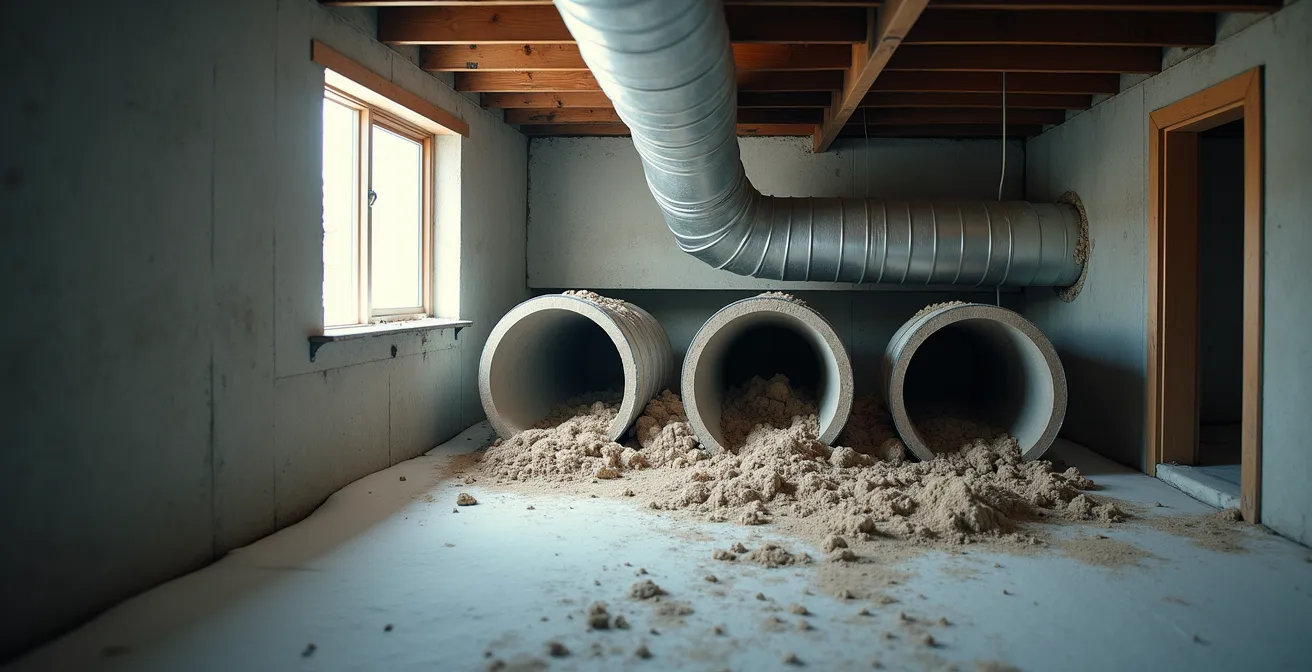
For a building manager, a dirty HVAC system is not a cleaning issue; it is a quantifiable financial liability that directly inflates your energy budget and degrades your asset.
- Dust accumulation on coils creates thermal resistance, forcing your system to fight against itself and increasing energy consumption significantly.
- Québec’s unique building stock (triplexes, older homes) and climate conditions (wood stove use, humidity) accelerate this efficiency loss.
Recommendation: Implement a verification-based cleaning protocol based on specific building usage and NADCA standards, not a generic 3-5 year schedule, to protect your investment and control costs.
As a building manager in Québec, you scrutinize every line item on your operating budget, especially during the harsh winter months. You’ve likely invested in better window seals, upgraded insulation, and optimized boiler settings. Yet, have you considered that your building’s own respiratory system—the HVAC network—could be the silent culprit draining your heating budget? The common perception is that duct cleaning is primarily for improving indoor air quality, a response to tenant complaints about allergies. This view is dangerously incomplete.
From an energy efficiency engineering perspective, neglecting HVAC hygiene is a critical operational oversight. It’s not about simple cleanliness; it’s about thermodynamics, fluid dynamics, and asset preservation. A layer of dust, seemingly harmless, acts as an insulator on heat exchange coils, fundamentally compromising their function. This forces the entire system to run longer and harder to achieve the target temperature, a phenomenon known as increased system drag. This directly translates into higher energy consumption, with studies showing that heating and cooling account for a staggering 60% of energy consumption in commercial buildings across Canada.
This guide reframes the conversation. We will move beyond the superficial topic of dust and delve into the measurable financial impact of a compromised HVAC system. We will treat duct hygiene not as a janitorial task, but as a crucial component of strategic asset management. You will learn how to diagnose the problem, how to vet a truly qualified technician in the Québec market, understand the right technology for your specific building type, and ultimately, how to transform a maintenance expense into a verifiable return on investment through sustained energy savings.
This article provides a comprehensive engineering framework for managing your building’s HVAC efficiency. Explore the sections below to understand the core principles of energy loss, contractor verification, technology selection, and creating a proactive maintenance schedule tailored to your property’s unique needs.
Summary: A Building Manager’s Guide to HVAC Efficiency and Cost Reduction
- How Does Dust Accumulation on Coils Force Your HVAC System to Work Harder?
- How to Verify if a Duct Cleaner Follows NADCA Standards?
- Robotic Cleaning vs Manual Brushing: Which Reaches Deep Into Complex Ducts?
- The Renovation Mistake That Clogs Ducts Before the Building Opens
- How to Determine the Optimal Cleaning Interval Based on Building Usage?
- Sub-Floor Cleaning: Should You Do It Annually or Quarterly to Prevent Airflow Blockage?
- Why Do Dust Mites Thrive in Bedrooms Despite Regular Vacuuming?
- Why Does Drywall Dust Reappear 24 Hours After a Standard Vacuuming?
How Does Dust Accumulation on Coils Force Your HVAC System to Work Harder?
To understand the energy penalty of dirty ducts, we must first analyze the core of your HVAC system: the heat exchange coils. These fins are engineered with a massive surface area to facilitate the rapid transfer of thermal energy. In winter, hot fluid or gas runs through them to heat the air blown across. The efficiency of this process depends entirely on unimpeded contact between the metal and the air. When a layer of dust, dander, and other airborne particles settles on these coils, it creates a layer of thermal resistance.
This buildup acts like a blanket, insulating the very surfaces that need to be exposed. The system’s thermostat, unaware of this insulation, only registers that the target air temperature isn’t being reached. Consequently, it commands the furnace or boiler to continue running, consuming more gas or electricity in a futile attempt to push heat through the insulating dust layer. This extends run times and drastically increases energy consumption. Furthermore, the caked-on debris obstructs airflow, increasing the static pressure within the system. Your fan motor must then work harder, drawing more power and undergoing accelerated wear to move the same volume of air.
This visual below shows an extreme close-up of this insulating effect. What you’re seeing is not just dust, but a mixture of common household debris that creates a tangible barrier to heat exchange, directly leading to higher utility bills.
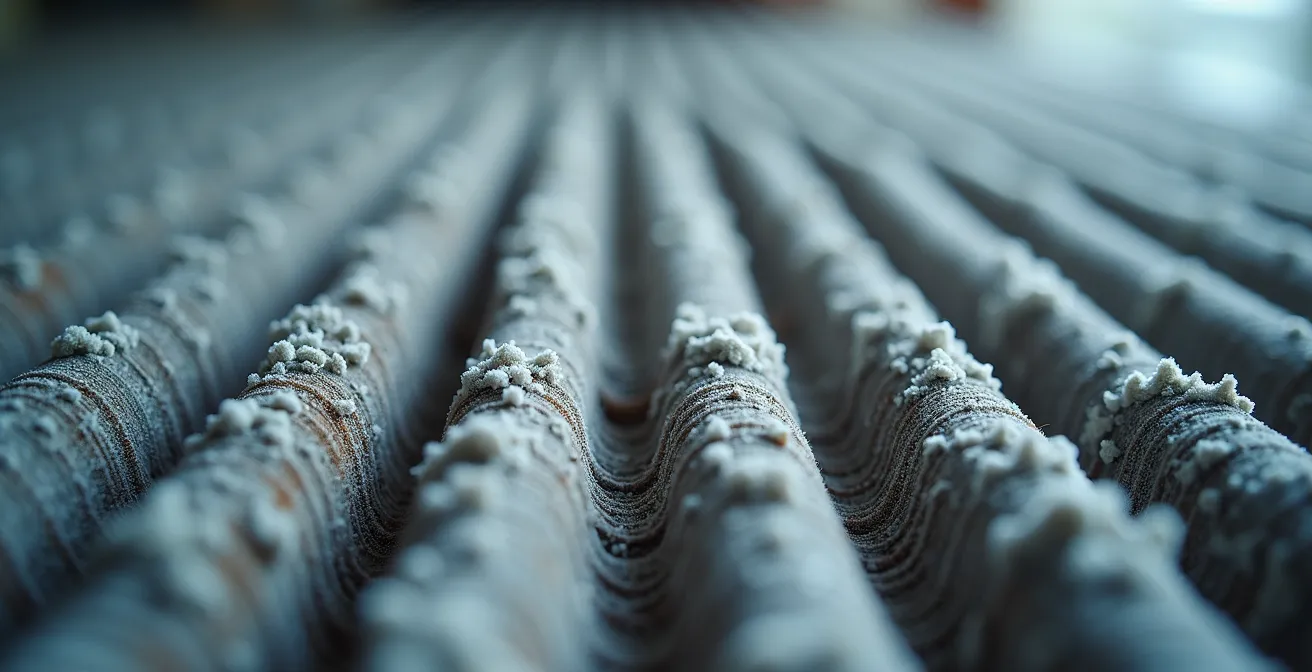
The impact is not trivial. A mere 1/8th of an inch of dust on a heating coil can reduce its efficiency by over 20%. For a building manager, this translates directly to the bottom line, turning a manageable maintenance task into a significant and unnecessary operational expense month after month. The system is forced into a state of constant overwork, leading to accelerated asset degradation and a higher likelihood of premature failure.
How to Verify if a Duct Cleaner Follows NADCA Standards?
In the duct cleaning industry, the most significant distinction between a legitimate professional and a potential scam is adherence to the standards set by the National Air Duct Cleaners Association (NADCA). For a building manager, hiring a NADCA-certified company is non-negotiable; it’s your primary shield against subpar work that can damage your system or, worse, leave it in a dirtier state than before. NADCA certification isn’t just a logo; it’s a rigorous process confirming a technician’s expertise in HVAC system hygiene, safety protocols, and the proper use of equipment.
A NADCA-compliant cleaning is a “whole system” cleaning. This means all components of the HVAC system are addressed, including the coils, drain pans, fan motor and housing, and the entire ductwork network. A “blow-and-go” operator might only clean the easily accessible ducts, leaving the core of the problem untouched. This is why performance verification is a cornerstone of the NADCA standard; a certified professional should be able to provide before-and-after photos or even video footage from inside the ducts to prove the efficacy of their work.
Vetting a contractor in Québec involves a few extra steps beyond just asking for a certification number. Due to the province’s specific regulations and building stock, a truly qualified provider must demonstrate local expertise. Use the following checklist to ensure you are hiring a competent and legally compliant professional.
Actionable Checklist: The Québec Trust Checklist for NADCA Verification
- Verify their NADCA certification directly on the official NADCA website—do not rely on a logo on their truck.
- Cross-reference the business name with the Registraire des entreprises du Québec (REQ) to confirm their legal status.
- Check for a valid Régie du bâtiment du Québec (RBQ) license, especially if any ventilation modification work is proposed.
- Ask for specific experience with your building type, such as Montréal plex/triplex systems, which have unique ductwork configurations.
- Inquire about their protocol for handling potential asbestos in homes built before 1980, a common concern in Québec.
By following this verification process, you move from hiring a simple “cleaner” to partnering with an HVAC hygiene specialist who understands both the technical standards and the specific challenges of Québec’s built environment. This diligence mitigates your liability and ensures the job contributes positively to your building’s operational efficiency.
Robotic Cleaning vs Manual Brushing: Which Reaches Deep Into Complex Ducts?
The architecture of Québec, particularly in older cities like Montreal, presents unique challenges for HVAC maintenance. Buildings such as triplexes, duplexes, and century-old stone houses often feature complex, retrofitted ductwork with sharp turns, narrow passages, and varying diameters. In these environments, the choice of cleaning technology is not a matter of preference but of effectiveness. The two primary methods are manual brushing and robotic systems, and their suitability varies dramatically with building type.
Manual brushing, which often involves brushes on long, flexible rods coupled with a high-powered negative air machine, can be effective for simple, straight-run ductwork found in many mid-century bungalows. However, its reach is limited. In a triplex with ducts that bend sharply around structural beams, manual brushes can get stuck or fail to navigate the turns, leaving significant portions of the system untouched. Robotic cleaning systems, conversely, are specifically designed for these complex geometries. These units, often equipped with cameras, lights, and articulated rotating brushes, can be driven deep into the ductwork, providing real-time visual feedback to the operator and ensuring that every corner and crevice is reached.

As detailed in an Imperial Cleaning case study on a Montreal triplex, advanced methods like an electrical pivot brush connected directly to the suction hose are essential for these buildings. Their friction-suction-pulsion technique was shown to be superior for navigating the sharp turns where manual methods would fail. For a building manager, selecting the right method is critical for ensuring a complete cleaning and maximizing the return on investment. The following table, based on an analysis of Québec housing types, provides a clear guide.
| Housing Type | Manual Brushing | Robotic Systems | Recommended Method |
|---|---|---|---|
| 1960s Bungalow | Adequate | Overkill | Manual with negative pressure |
| Montreal Triplex | Limited reach | Essential | Robotic with camera |
| Quebec City Stone House | Cannot navigate | Required | Robotic + 16,000 CFM suction |
| Modern Condo | Good | Better | Either with proper vacuum |
Ultimately, the choice of technology should be dictated by the building’s anatomy. Insisting on a robotic inspection for an older, complex property is a mark of due diligence, ensuring you are paying for a comprehensive cleaning, not a partial one.
The Renovation Mistake That Clogs Ducts Before the Building Opens
One of the most common and costly mistakes in building management occurs during and immediately after a renovation. Whether it’s a minor tenant fit-up or a major building overhaul, construction activities generate vast quantities of fine particulate matter, with drywall dust (gypsum) being the most pervasive. Many contractors and managers mistakenly believe that covering vents and running a shop vac is sufficient protection. This is a fundamental misunderstanding of the physics of airborne particles.
Drywall dust particles are incredibly small, often in the PM2.5 range (2.5 micrometers or less). Standard furnace filters and vacuum bags are simply not designed to capture particles this fine. As a result, when the HVAC system is turned on post-renovation, this microscopic dust is drawn into the return vents and distributed throughout the entire building. It doesn’t just pass through; it settles on every surface inside the ductwork, creating a massive, hidden reservoir of contaminants. This pre-loads the system for failure, coating the freshly cleaned or new coils with that insulating layer we discussed earlier, before a single tenant moves in.
The mistake is one of sequence. The common practice is to perform a final “deep clean” of the space and then turn on the HVAC. Within 24-48 hours, a fine layer of white dust reappears on every surface. This isn’t poor cleaning; it’s the HVAC system redistributing the dust it has stored. The correct protocol is to treat the HVAC system itself as the primary source of contamination post-renovation. A professional “system flush” using powerful negative air machines (typically 5,000+ CFM) must be performed *before* the final cosmetic cleaning of the space. This removes the reservoir of dust from the ducts, ensuring it won’t be re-introduced into the environment.
Failing to account for this step essentially guarantees that your brand-new or newly renovated space will suffer from poor air quality and reduced HVAC efficiency from day one. It’s a classic case of winning the battle (the renovation) but losing the war (long-term operational performance and air quality). For a building manager, specifying a post-construction HVAC system flush in the renovation contract is a crucial act of liability mitigation and asset protection.
How to Determine the Optimal Cleaning Interval Based on Building Usage?
The generic advice to clean air ducts every 3 to 5 years is overly simplistic and often financially inefficient for a building manager. The optimal cleaning frequency is not a fixed date on a calendar but a dynamic variable dependent on the specific use and conditions of your property. Adopting a usage-based approach allows you to align maintenance spending with actual need, maximizing both air quality and energy efficiency.
Several key factors specific to Québec lifestyles and environments dramatically accelerate the accumulation of debris in an HVAC system. For instance, the prevalence of pets introduces dander and hair, which readily stick to coils. The tradition of using wood stoves, especially in rural areas or older homes, generates fine soot that can infiltrate the ductwork. Proximity to major traffic arteries like Montreal’s Autoroute 15 or 40 means a higher load of outdoor pollutants and fine particulate matter entering the building. Finally, any recent renovation is the single largest contributor of duct-clogging debris. By quantifying these factors, you can move from a generic schedule to a tailored, justifiable maintenance plan.
This proactive approach yields measurable financial returns. A proper cleaning restores the system to its designed efficiency, directly impacting your bottom line. In fact, an analysis by Blueguard demonstrates that professional duct cleaning can result in up to a 36% reduction in electricity bills under the right conditions. This isn’t just about saving money; it’s about optimizing the performance of a multi-thousand-dollar asset. A simple scoring system can help you determine if your building requires more frequent attention than the baseline suggests.
Consider the following: assign +1 point if pets are present, +2 for a smoker in the home, +2 for wood stove usage, +1 for proximity to heavy traffic, and +3 for any recent renovations. A total score of 7 or more strongly indicates that an annual cleaning is a sound financial decision to maintain optimal efficiency and prevent the kind of buildup that leads to inflated energy bills. This data-driven approach is far more defensible and effective than a one-size-fits-all schedule.
Sub-Floor Cleaning: Should You Do It Annually or Quarterly to Prevent Airflow Blockage?
While much of the focus in HVAC hygiene is on the visible ductwork, the unseen spaces beneath your floors—crawlspaces (`vides sanitaires`) and sub-floor plenums—can be a major source of both airflow blockage and significant health hazards. For building managers in Québec, understanding the condition of your building’s foundation and sub-floor area is critical, as it directly impacts indoor air quality, energy efficiency, and tenant safety. The required cleaning frequency is determined entirely by the type of sub-floor system in place.
In many older Québec homes, particularly those with unfinished basements or dirt-floor crawlspaces, this area is a prime environment for moisture accumulation, mold growth, and pest intrusion. More alarmingly, these spaces can be a collection point for radon, a radioactive gas that is a known health risk in many parts of the province. As highlighted by Health Canada, radon mitigation is a serious concern. A case study documented a home in Montreal with a dirt-floor crawlspace where implementing a quarterly sub-floor cleaning regimen, combined with improved ventilation, led to a 40% reduction in radon accumulation. This demonstrates that sub-floor hygiene is not just about cleaning, but is a critical component of liability mitigation.
For standard finished basements (`sous-sols`) or buildings with sealed crawlspaces, the concerns are different. Here, the sub-floor area might be used as a return air plenum. Over time, these spaces can accumulate dust and debris that gets drawn into the HVAC system, blocking airflow and re-distributing contaminants. In these cases, cleaning every 3-5 years as part of a whole-system duct cleaning is generally sufficient. The key is to match the intervention to the risk profile. A dirt-floor crawlspace demands an aggressive quarterly schedule to manage moisture and radon, while a sealed, finished space requires less frequent, but still essential, maintenance.
Ignoring the sub-floor is to ignore a fundamental part of the building’s respiratory system. An annual inspection of all crawlspaces and sub-floor areas should be a standard part of your building maintenance protocol to identify the specific risks your property faces and schedule cleaning accordingly. This prevents minor issues from escalating into major health or structural problems.
Why Do Dust Mites Thrive in Bedrooms Despite Regular Vacuuming?
Tenant complaints about persistent allergies, especially in bedrooms, are a common issue for building managers. Many assume that regular vacuuming and surface cleaning should resolve the problem. However, if the root cause is a dust mite infestation within the HVAC system, standard cleaning efforts are largely ineffective. Dust mites don’t just live in carpets and bedding; they thrive in the dark, protected environment of your ductwork, which acts as a perfect breeding ground and distribution network.
A standard vacuum cleaner, even one with a HEPA filter, can only address the mites and their allergens that have already settled in the room. It does nothing to stop the source. The HVAC system continuously circulates air, and with it, a fresh supply of dust mites, their feces, and shed skins—the primary triggers for allergies and asthma. This creates a frustrating cycle where a room appears clean but remains an allergenic environment. The problem is often compounded in modern Québec buildings constructed with a mandatory Heat Recovery Ventilator (HRV).
While HRVs are excellent for energy efficiency, their core can become a nexus for contamination if not professionally cleaned. A case study from a Laval family suffering from severe allergies illustrates this perfectly. Despite meticulous weekly cleaning, their symptoms persisted. An investigation revealed that their HRV unit had become a dense breeding ground for dust mites. After a professional cleaning of both the duct system and the HRV core, the family reported a 70% decrease in allergy symptoms within two weeks. This demonstrates that for effective allergen control, you must treat the entire air circulation path.
For a building manager, this means that addressing persistent allergen complaints requires looking beyond the visible surfaces. When a tenant reports ongoing issues despite regular cleaning, an inspection of the HVAC ducts and any associated HRV or ERV unit should be the immediate next step. Professional cleaning provides a “system reset” that surface cleaning can never achieve, with reports showing that it can provide up to 67% relief in allergen symptoms for occupants.
Key Takeaways
- A dirty HVAC system is an engineering failure, not a janitorial issue, directly impacting your budget through increased thermal resistance and system drag.
- Vetting a contractor in Québec requires verifying NADCA certification, REQ status, and RBQ licensing to ensure compliance and competence.
- The optimal cleaning frequency is determined by a building’s specific usage profile (pets, renovations, wood stoves), not a generic calendar date.
Why Does Drywall Dust Reappear 24 Hours After a Standard Vacuuming?
The fine, white dust that plagues a building after renovation is one of the most misunderstood challenges in property management. This drywall dust, or gypsum, is notorious for its ability to bypass standard cleaning efforts and reappear on surfaces just a day after a thorough cleaning. As one expert on a GreenBuildingAdvisor forum noted, “Drywall dust is notorious for going right through regular furnace and vacuum air filters and putting a fine dust coating on pretty much everything in a house.” This is not an exaggeration; it’s a statement of fact based on the particle’s physical properties.
The problem lies in its microscopic size. These PM2.5 particles are so light they can remain suspended in the air for hours or even days. When you perform a “final clean” with standard equipment, you are only capturing the particles that have already settled. The vast majority are still airborne or, more critically, are stored within the HVAC ductwork. When the system activates, it blasts this reservoir of dust back into the clean space, where it slowly settles again, creating the illusion of reappearance. A standard furnace filter offers almost no resistance to these fine particles.
Effectively removing post-renovation dust requires a complete paradigm shift in the cleaning sequence. The HVAC system must be addressed *first*, not last. The correct protocol involves hiring professionals equipped with high-CFM negative air machines to place the entire duct system under suction. Specialized agitation tools are then used to dislodge the caked-on dust, which is immediately captured and exhausted from the building. Only after this “system flush” is complete should the furnace filter be replaced (ideally with a MERV 13-rated filter or higher) and the final cosmetic cleaning of the space begin. This ensures the primary source of contamination is eliminated, not just temporarily managed.
For a building manager, understanding this principle is crucial for writing effective renovation contracts and setting correct expectations. Specifying a professional, post-construction HVAC duct cleaning is not an optional add-on; it is the only way to ensure the project delivers a truly clean and healthy environment with an efficiently operating system from day one.
To translate these engineering principles into a concrete financial benefit for your property, the next logical step is to commission a professional audit of your building’s HVAC system. This will establish a performance baseline and create a data-driven maintenance plan that protects your asset and your budget.
Frequently Asked Questions on Duct Cleaning for Energy and Health
How often should Quebec homes with wood stoves clean ducts?
While general industry guidelines suggest cleaning every 3-5 years, homes with wood stoves should have their systems inspected annually. The fine soot produced by wood combustion accumulates rapidly on HVAC components, reducing efficiency and posing a potential air quality risk, necessitating more frequent professional cleaning.
Do heat pumps require more frequent cleaning?
Yes, heat pumps, which are increasingly common in Québec for their dual-function capability, generally require more frequent cleaning. Because they operate year-round for both heating and cooling, they accumulate dust, pollen, and other debris at a much faster rate than single-season systems like a furnace alone.
Should cabanes à sucre clean more frequently?
Absolutely. A commercial operation like a sugar shack, with its heavy seasonal use and significant production of cooking vapors and steam, requires a more aggressive cleaning schedule. The sticky residue from sugar evaporation can combine with dust to create a stubborn buildup, necessitating quarterly cleaning during the operating season to maintain air quality and system efficiency.