
The greatest threat to your Montreal data center isn’t visible dust, but a range of microscopic, environment-specific contaminants that standard cleaning protocols miss.
- Zinc whiskers and salt residues cause silent, catastrophic short circuits, not just overheating.
- Improper procedures, even with “safe” cleaners, can generate enough electrostatic discharge (ESD) to destroy sensitive components.
Recommendation: Shift from a janitorial mindset to one of environmental forensics; audit your cleaning protocols against Quebec-specific climate and legal risks (Law 25) to ensure true operational resilience.
As a data center manager in Montreal, your core mission is uptime. You’ve engineered resilient power systems, optimized cooling with ruthless efficiency, and implemented robust cybersecurity. Yet, the most insidious threats to your infrastructure might not be digital attacks or power grid failures, but something far more mundane: dust. However, focusing on visible dust is a critical miscalculation. The real danger lies in the microscopic particles that infiltrate your facility, carried by Montreal’s distinct seasonal shifts and urban environment.
Standard commercial cleaning approaches are dangerously inadequate. They often overlook the unique material science of a data center, from the conductive potential of metallic “whiskers” growing from floor tiles to the electrostatic fields generated by incorrect wiping techniques. These are not janitorial issues; they are engineering problems. In an environment where a single spark can cost millions and where regulations like Quebec’s Law 25 impose strict liabilities on third-party access, treating critical environment cleaning as a low-skill task is a recipe for disaster.
But what if the key to maximizing uptime and PUE wasn’t just more cooling, but a radically different approach to cleanliness? This guide abandons generic advice. We will delve into the specific, often invisible, contaminants that plague Quebec data centers. We will dissect the physics of electrostatic discharge, explore the legal ramifications of vetting your cleaning staff, and connect the dots between sub-floor particle buildup and the strain on your HVAC system. It’s time to move beyond dusting and embrace a strategic, risk-based approach to contamination control.
This article provides a comprehensive framework for Montreal data center managers to re-evaluate their contamination control strategies. The following sections break down the most critical, and often misunderstood, aspects of maintaining a truly clean and resilient critical environment.
Summary : The Manager’s Guide to Mitigating Micro-Contamination Risks in Montreal Data Centers
- Why Zinc Whiskers from Floor Tiles Are a Silent Killer for Server Motherboards?
- How to Clean Server Racks Using ESD-Safe Vacuums and Grounding Techniques?
- Sub-Floor Cleaning: Should You Do It Annually or Quarterly to Prevent Airflow Blockage?
- The Aerosol Cleaner Mistake That Corrodes Sensitive Circuitry
- How to Vet Cleaning Staff for High-Security Clearance Zones?
- How to Sanitize Shared Keyboards and Touchscreens Without Damaging Electronics?
- How Does Dust Accumulation on Coils Force Your HVAC System to Work Harder?
- Degreasing Heavy Machinery: How to Maintain Equipment Efficiency in Quebec Manufacturing Plants?
Why Zinc Whiskers from Floor Tiles Are a Silent Killer for Server Motherboards?
The term “dust” is dangerously generic in a data center context. The most catastrophic failures are not caused by inert cellulose fibres but by conductive micro-contaminants. Among the most notorious are zinc whiskers: microscopic, crystalline filaments of zinc that can grow from the galvanized steel surfaces common in raised floor tiles and structural supports. These whiskers, often too small to see, can break off, become airborne through vibration or maintenance activities, and circulate through your CRAC units directly into server intakes.
Once inside a server, a single zinc whisker can bridge the microscopic gaps between traces on a motherboard or other PCB, causing a low-voltage short circuit. This leads to intermittent, inexplicable errors, data corruption, or complete component failure. The problem is far from theoretical. A dramatic incident in 2002 at a Toronto company serves as a stark warning: weeks after a data center cleaning, the facility experienced a wave of mysterious server failures. An investigation revealed that lifting floor tiles had released a cloud of zinc whiskers, which were then ingested by the servers, leading to the failure of approximately 50 servers, along with numerous motherboards and hard drives.
This single type of micro-contamination highlights a fundamental flaw in conventional cleaning mindsets. The issue isn’t just removing dirt; it’s understanding the material science of your environment and preventing the mobilization of harmful particles. While it’s difficult to isolate the exact cause of every failure, some studies indicate that up to 70% of equipment breakdowns in IT environments are linked to dust and contamination, with conductive particles like zinc whiskers being a primary suspect in “no-fault-found” hardware failures.
How to Clean Server Racks Using ESD-Safe Vacuums and Grounding Techniques?
While conductive particles present one danger, the very act of cleaning can introduce another invisible killer: electrostatic discharge (ESD). Plastic components on vacuum cleaners, improper wiping cloths, and even the clothes of untrained staff can generate thousands of volts of static electricity. This charge can then discharge into a sensitive electronic component in a nanosecond, causing latent or catastrophic damage. According to industry experts, up to 33% of printed circuit board failures can be attributed to ESD damage, a risk that is massively amplified by improper cleaning techniques.
Maintaining ESD integrity is a systemic process, not a product choice. It requires a combination of specialized, grounded equipment and strict, repeatable procedures. The goal is to create an “equipotential balance,” where the technician, their tools, and the equipment being cleaned are all at the same electrical potential, preventing any damaging discharge. This involves more than just using an “anti-static” wipe; it requires a comprehensive protocol.
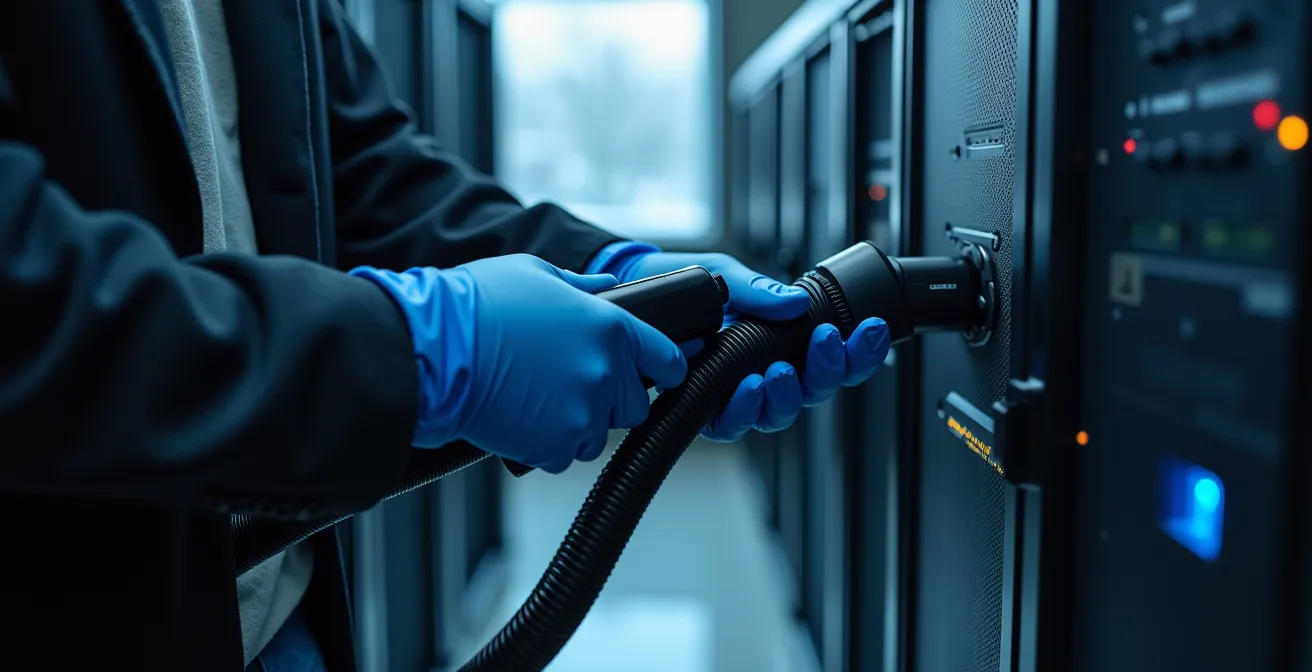
The image above illustrates the precision required. Every tool, from the vacuum to the brush attachment, must be specifically designed for static dissipation and properly grounded to the building’s infrastructure. This meticulous approach is the only way to safely remove particulate contaminants without introducing the greater risk of ESD damage.
Action Plan: 5 Essential Steps for ESD-Safe Server Cleaning
- Filtration is Key: Use only HEPA-filtered vacuums with a certified efficiency of 99.97% for particles down to 0.3 microns. Ensure the vacuum and all attachments are rated as ESD-safe.
- Systematic Wiping: When wiping surfaces, use pre-saturated, lint-free ESD-dissipating wipes. Move in straight, deliberate, overlapping strokes (10-25% overlap) to prevent re-depositing contaminants and minimize static generation.
- Correct Chemical Use: Avoid common alcohol-based cleaners. They can dry out and damage the conductive properties of anti-static mats and surfaces, creating micro-fissures that compromise their effectiveness.
- Universal Grounding: Confirm that all cleaning equipment, including the technician’s personal wrist strap, is properly bonded and grounded to a verified common point in the building’s infrastructure before beginning work.
- Control the Environment: Actively monitor and maintain the data center’s relative humidity (RH) between 45% and 55%. This optimal range naturally helps to dissipate static charges and is a critical, often overlooked, component of ESD control.
Sub-Floor Cleaning: Should You Do It Annually or Quarterly to Prevent Airflow Blockage?
The question of sub-floor cleaning frequency cannot be answered with a simple “annually” or “quarterly.” For a Montreal data center, the optimal schedule is dictated by a process of environmental forensics, analyzing the specific external contaminants introduced by our city’s harsh and varied seasons. The underfloor plenum is the primary lung of your data center, and its contamination directly impacts cooling efficiency and hardware reliability. A blocked plenum forces your CRAC units to work harder, consuming more energy and reducing their effectiveness.
Properly maintained airflow is not just about temperature; it’s about energy cost. When airflow is unrestricted, cooling systems can operate more efficiently, often leveraging “free cooling” from outside air economizers. In fact, research shows a potential 30% reduction in mechanical cooling power when economizers are used effectively—an advantage that is completely negated by a contaminated air supply. Debris in the plenum can also be ingested by servers, leading to the kind of micro-contamination failures discussed earlier.
The type of debris is highly seasonal in Quebec. Winter brings corrosive road salt and de-icing residues, which can be tracked in and become airborne. Spring unleashes high pollen counts and a surge in construction dust as the ground thaws. A generic, one-size-fits-all cleaning schedule fails to account for these predictable spikes in contamination. A more strategic approach links cleaning frequency to these external environmental triggers.
The following table outlines a cleaning schedule tailored specifically to the risks present in the Montreal environment, providing a strategic framework rather than a simple calendar-based one.
| Season | Montreal-Specific Contaminants | Recommended Frequency | Critical Risk Areas |
|---|---|---|---|
| Winter (Dec-Mar) | Road salt, de-icing residues, crystallized minerals | Monthly | Near REM construction, downtown high-traffic zones |
| Spring (Apr-May) | High pollen counts, construction dust surge | Bi-monthly | Industrial East End facilities |
| Summer (Jun-Aug) | Construction peak dust, humidity-driven particles | Quarterly | All locations |
| Fall (Sep-Nov) | Leaf debris, pre-winter preparation | Quarterly | Suburban locations near green spaces |
The Aerosol Cleaner Mistake That Corrodes Sensitive Circuitry
In the high-stakes environment of a data center, even well-intentioned cleaning efforts can backfire catastrophically. One of the most common and damaging mistakes is the use of standard commercial aerosol cleaners or “canned air” for spot-cleaning electronics. These products introduce two distinct but equally destructive risks: extreme electrostatic discharge and chemical corrosion.
The propellants used in many aerosol cans, combined with the friction of the spray itself, can act as a powerful Van de Graaff generator. Technical analyses have shown that certain cleaning fluids can generate a static charge of up to 12,000 volts—more than enough to instantly destroy the sensitive gate oxides in modern microprocessors and memory chips. Furthermore, the rapid expansion of the propellant causes a dramatic cooling effect, leading to condensation. When combined with Montreal’s high summer humidity, these micro-droplets of moisture can mix with chemical residues in the cleaner, forming a corrosive film on circuit boards.
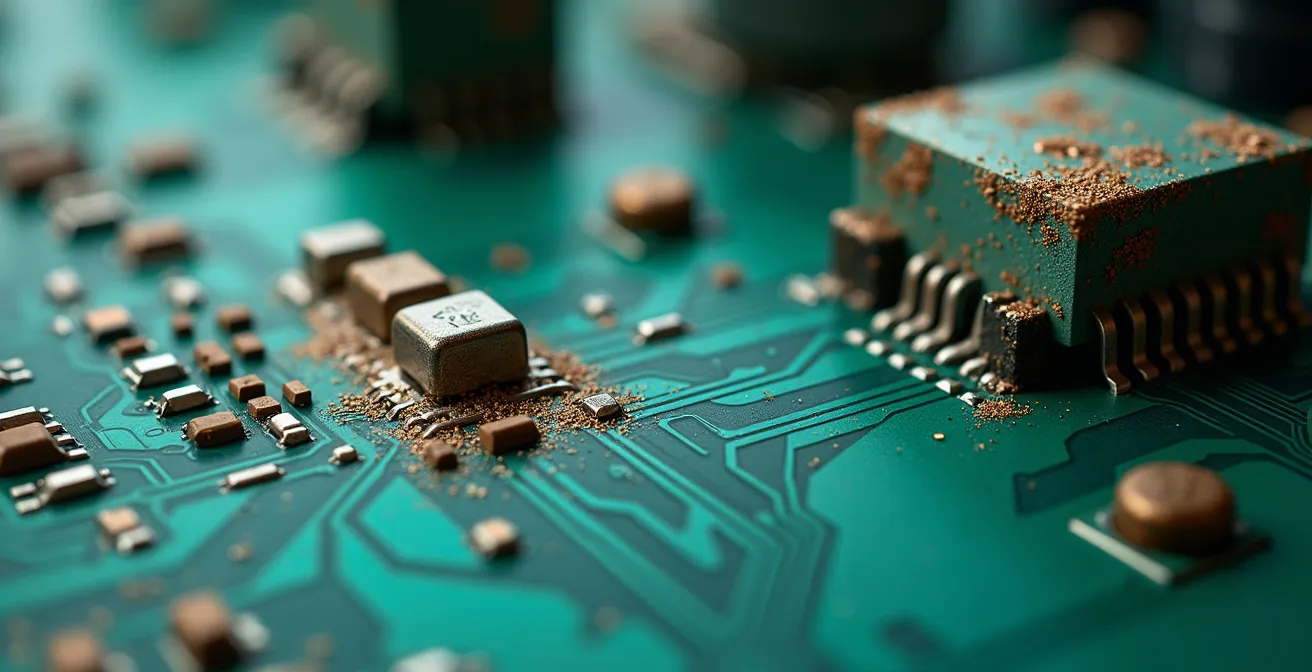
This is not a theoretical risk. The resulting chemical corrosion attacks copper traces and solder joints, leading to intermittent faults that are notoriously difficult to diagnose before they cause a complete hardware failure. The use of consumer-grade products is simply not an option. True contamination control relies on a toolkit of approved, non-reactive solutions applied with precise techniques.
Instead of reaching for a can of compressed air, technicians should adhere to a strict protocol of safe alternatives. The following practices are essential for removing dust and residues without introducing electrical or chemical hazards:
- Use anti-static cleaning solutions specifically formulated and tested for use in sensitive electronic environments.
- When liquid cleaners are necessary, use a 70-90% isopropyl alcohol solution applied to a lint-free cloth, never sprayed directly onto equipment.
- Prioritize the use of high-quality, lint-free microfiber cloths for surface dust removal over any form of compressed air.
- For particle removal from crevices and interiors, the only acceptable tool is a properly grounded, HEPA-filtered ESD-compliant vacuum.
- Never, under any circumstances, allow consumer-grade canned air products purchased from retail stores inside the data hall.
How to Vet Cleaning Staff for High-Security Clearance Zones?
The human element is the most critical and often weakest link in a data center’s contamination control and security chain. The individuals cleaning your server racks have physical access to your most critical assets. Therefore, vetting cleaning staff cannot be approached like hiring a standard janitorial service. It requires a security-first mindset that evaluates technical expertise, trustworthiness, and an understanding of the immense legal and operational risks involved.
As one industry service provider notes, specialized knowledge is paramount: “Data center cleaning requires specialized knowledge and security clearance. Our technicians undergo extensive background checks and possess the necessary clearances for high-security environments.” This goes beyond a simple criminal record check. For a Montreal facility, vetting must include verifying federal security clearances (e.g., Reliability Status, Secret) required for colocation clients in government or finance. It also means ensuring staff are fluent in the operational language of your facility. In Quebec’s bilingual environment, having bilingual (French/English) technicians is not a luxury but a core safety requirement to ensure clear communication during routine work and, most critically, during an emergency.
Perhaps the most pressing local concern is legal liability under Quebec’s Law 25 (formerly Bill 64). This legislation imposes strict rules on the handling of personal information. Cleaning staff are considered third-party personnel with physical access to the systems processing this data. In the event of a breach, if your cleaning vendor cannot demonstrate robust security protocols, documented training, and proper background checks, the liability could fall squarely on your organization. Your vetting process must include a thorough review of a vendor’s Law 25 compliance program, including their data handling policies and employee confidentiality agreements.
The vetting process is your first line of defense. It must be a rigorous evaluation of a vendor’s ability to operate within the unique technical, security, and legal framework of your Montreal data center. The right partner provides not just a service, but a verifiable layer of risk mitigation.
How to Sanitize Shared Keyboards and Touchscreens Without Damaging Electronics?
While server racks and sub-floors are primary concerns, high-touch shared interfaces like KVM crash carts, HVAC control panels, and security access terminals are critical vectors for both contaminants and ESD. These devices are often overlooked in cleaning protocols, yet their failure can be just as disruptive as a server outage. Sanitizing these interfaces requires a delicate balance: eliminating biological and particulate contaminants without damaging sensitive screens or introducing electrostatic risk.
The principles of ESD-safe cleaning are paramount here. As industry experts warn, the damage from a single spark can be immense. While they often cite semiconductor manufacturing, where a tiny spark can cost thousands of dollars, the principle is identical for the microelectronics in a modern touchscreen or keyboard. Applying the wrong cleaner or using a dry, abrasive cloth can easily generate a damaging static charge. Therefore, a strict, documented protocol is essential for all staff and technicians operating in the data hall.
The procedure must be precise and consistent, using only approved materials. It’s a matter of operational discipline. A simple, repeatable process ensures that sanitization is effective without introducing new risks. This protocol should be clearly posted at all cleaning stations to ensure universal compliance.
The following protocol provides a safe and effective framework for cleaning all shared electronic interfaces within the data center:
- Use Approved Solutions: Only use solutions containing 70% isopropyl alcohol that are specifically rated for electronic equipment. Never use ammonia-based window cleaners or harsh disinfectants.
- Apply Indirectly: Never spray any cleaning solution directly onto a keyboard, mouse, or touchscreen. Lightly dampen a lint-free, microfiber cloth with the solution first, then wipe the surface.
- Establish a Cadence: High-traffic interfaces like KVM crash carts and primary HVAC control panels should be cleaned at least weekly, or more frequently depending on usage.
- Prevent Cross-Contamination: Use a fresh, clean cloth for each distinct equipment zone (e.g., one cloth for the security desk, a new one for the KVMs in Row A). This prevents the transfer of contaminants from one area to another.
- Implement Bilingual Labeling: In compliance with Quebec’s language laws and for maximum clarity, all cleaning stations and solution bottles must have clear, bilingual (French/English) labeling detailing their contents and purpose.
How Does Dust Accumulation on Coils Force Your HVAC System to Work Harder?
The direct link between cleanliness and your Power Usage Effectiveness (PUE) is most evident at the HVAC system’s cooling coils. These coils function as the primary heat exchangers for your data center. As air passes over them, a layer of dust, fibres, and other airborne particles acts as an insulator, dramatically reducing the coil’s ability to transfer heat. This forces the entire cooling system—including compressors and fans—to run longer and at higher speeds to achieve the same setpoint temperature.
This isn’t a minor inefficiency; it’s a significant and continuous drain on your operating budget. A blanket of dust just 1mm thick on a cooling coil can increase energy consumption by over 20%. For a large-scale Montreal data center, this translates to tens or even hundreds of thousands of dollars in wasted electricity costs annually. It also puts additional wear and tear on critical HVAC components, increasing the likelihood of a premature failure that could lead to a thermal event in the data hall.

Preventing this requires moving beyond simple filter changes and implementing a proactive coil cleaning schedule. The goal is to maintain pristine heat exchange surfaces at all times. This is why leading-edge facilities are adopting innovative cooling technologies that minimize contamination risk. For example, the ROOT Data Center in Montreal utilizes Kyoto Cooling heat wheel technology. This system cools the supply air using a thermal wheel that is itself cooled by ambient air, but the two air streams never mix. This design ingeniously prevents external contaminants and humidity from ever entering the data hall, demonstrating a design-level commitment to contamination control.
For facilities with traditional CRAC/CRAH units, regular, professional coil cleaning is non-negotiable. It’s a direct investment in your operational efficiency and a critical preventative maintenance task that lowers both energy costs and the risk of a cooling-related outage.
Key takeaways
- The most dangerous data center contaminants are often microscopic and conductive, like zinc whiskers, not just visible dust.
- Effective cleaning is a technical process focused on maintaining ESD integrity, requiring specialized, grounded equipment and strict protocols to prevent damage.
- In Quebec, cleaning schedules must be adapted to local climate risks (salt, pollen) and legal frameworks (Law 25) for true operational resilience.
Ensuring Operational Resilience: Maintaining Critical Support Machinery in Quebec
The discussion of data center maintenance extends beyond the server racks to the heavy machinery that guarantees operational continuity. In Quebec, no piece of equipment is more critical to this mission than your backup power generator. The collective memory of the 1998 Ice Storm—which caused the largest deployment of Canadian military personnel since the Korean War and left millions without power for weeks—serves as a permanent reminder of our grid’s vulnerability to extreme weather. For a data center manager, a generator isn’t just a backup; it’s the ultimate guarantor of uptime in a predictable-risk environment.
Degreasing and maintaining this machinery is not a trivial task. Engine grease, fuel residue, and environmental grime can mask underlying issues like fluid leaks or corrosion. More importantly, buildup can interfere with cooling, leading to an engine overheat and failure precisely when the generator is needed most. Just as with the sub-floor, maintenance schedules must be tailored to Quebec’s climate, which presents unique challenges from extreme cold to high summer humidity.
A proactive maintenance plan, particularly for generators, is a core component of your facility’s risk management strategy. It ensures the machine will start and carry the full load during an extended outage, whether caused by another ice storm, a summer blackout, or a localized grid failure. The following schedule outlines key maintenance priorities adapted for our specific climate conditions.
| Season | Maintenance Priority | Quebec-Specific Risks | Recommended Actions |
|---|---|---|---|
| Pre-Winter (Oct-Nov) | Critical | Ice storm preparation (up to 100mm ice accumulation risk) | Full system test, fuel stabilizer, battery check |
| Winter (Dec-Mar) | High | Extended outages, extreme cold (-30°C) | Weekly run tests, block heater verification |
| Spring (Apr-May) | Moderate | Flooding risk, humidity surge | Degreasing, corrosion inspection |
| Summer (Jun-Sep) | Standard | High humidity, cooling system stress | Coolant system flush, air filter replacement |
To ensure your facility is truly protected, the next logical step is to conduct a comprehensive audit of your current contamination control protocols against the specific risks and best practices outlined here. Contact a certified critical environment cleaning specialist to evaluate your procedures and identify hidden vulnerabilities.
Questions fréquentes sur Data Center Cleaning in Montreal
Why is bilingual staff important for Montreal data centers?
Bilingual (French/English) staff ensure clear communication during emergencies and full comprehension of site-specific safety protocols, which is essential for facilities operating in Quebec’s bilingual environment.
What liability concerns exist under Quebec’s privacy laws?
Under Law 25 (formerly Bill 64), cleaning staff are considered third-party personnel with physical access to systems processing personal information, creating specific legal liabilities for data center operators.